Pillar guide
AI governance framework
Define ownership, approved data, human control, exception recovery, monitoring and controlled change around one workflow.
 Free 20-minute consultation ↗
Use these practical guides to choose the right process, map the real work, estimate its cost and design the controls that keep automation dependable.
Define ownership, approved data, human control, exception recovery, monitoring and controlled change around one workflow.
Follow a business document from intake through classification, extraction, validation, review, recovery and system update.
Move from process selection and current-state modeling through controls, a measured pilot and a reliable launch.
Connect customer request, pricing, approval, delivery, revisions and controlled follow-up in one traceable workflow.
Build accurate, traceable customer records that can safely support routing, follow-up, reporting and automation.
Correct CRM data in protected, reviewable batches and prevent the same defects from returning.
Separate confirmed matches from possible matches and preserve context through controlled resolution.
Connect reliable intake facts to accountable ownership, acceptance timing and exception handling.
Turn emails, forms and attachments into complete, validated inputs for pricing.
Route pricing, margin, terms and other commercial exceptions to the right authority.
Use accurate status, tested stop conditions and human escalation after a quote is delivered.
Understand the difference between capturing text and operating a dependable document workflow.
Map invoice capture, validation, matching, approval, exception handling and accounting entry.
Test invoice rules in the interactive lab, inspect failed checks and export a validation matrix and labelled sample results.
Use repetition, volume, data quality, exceptions, risk and business value to find a defensible starting point.
Test whether the workflow is stable and understood well enough to move into design.
Compare cash ROI, staff capacity and payback with costs, human review and adoption ramp.
Document triggers, inputs, decisions, handoffs, approvals and exceptions without overcomplicating the map.
Recognize when weak economics, unstable work, poor data, judgment or risk should lead to a pause.
Build and export a recovery runbook with ownership, safe retry rules and escalation. Includes invoice, CRM and quote examples.
Place human review where judgment, accountability or unusual commitments require it.
Define what to watch, who owns recovery and how a live workflow should change safely.
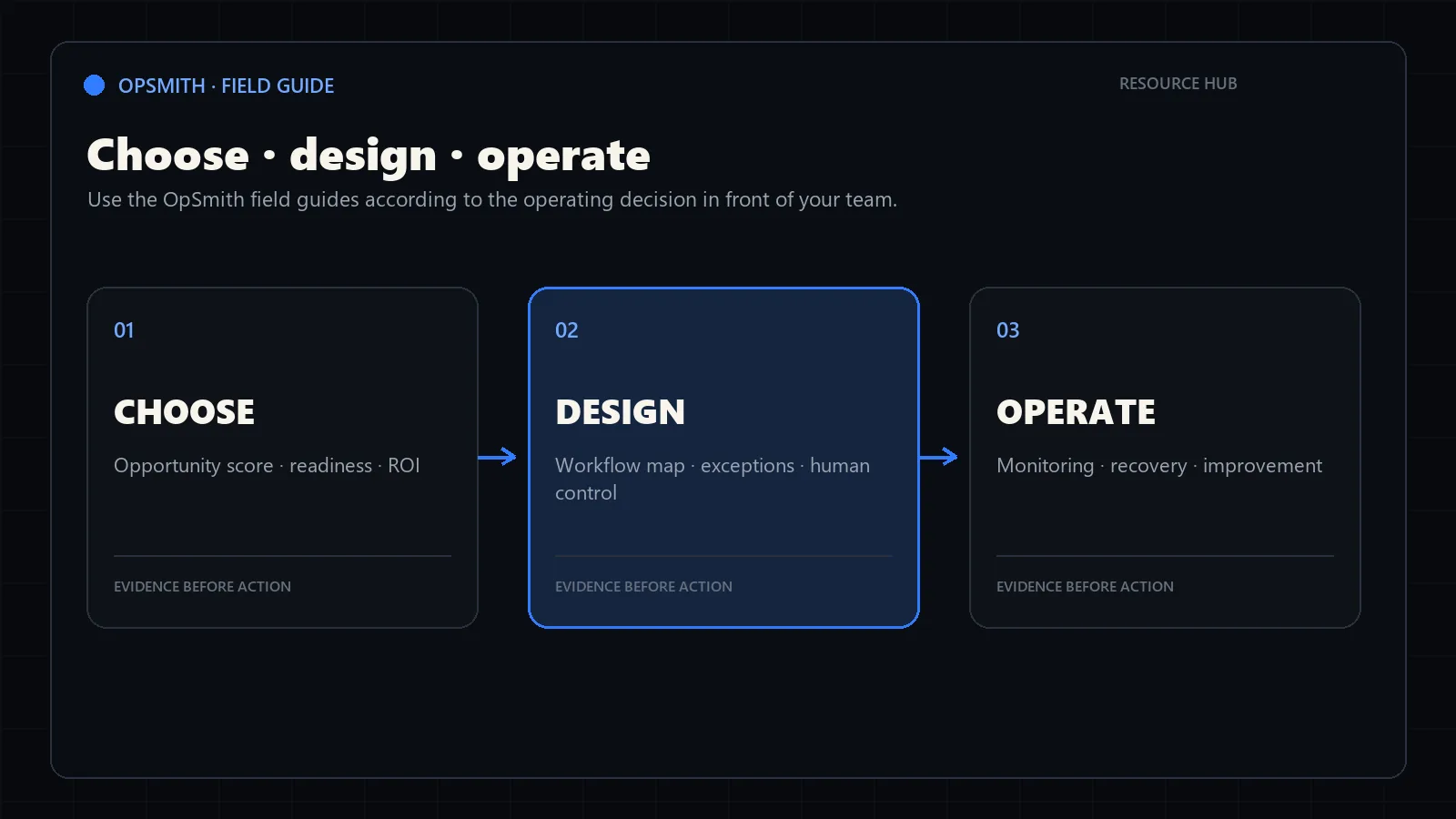
Start with the question in front of your team. Each guide links to the next decision and the relevant OpSmith service only where it is useful.
Identify one costly, recurring workflow with a measurable outcome.
Map inputs, decisions, approvals and the exceptions that define real work.
Monitor the live workflow, recover safely and improve it from evidence.
These guides support OpSmith’s AI workflow automation methodology from opportunity selection through live operations.
The Operational AI Blueprint turns one recurring workflow into a current-state map, opportunity score and decision-ready implementation brief.