
- Look for a bounded workflow with a clear trigger, output, owner and measurable operating problem.
- Score the opportunity using evidence from recent cases—not assumptions about how the process should work.
- A responsible assessment may recommend automation, a narrower scope, process improvement first or no automation.
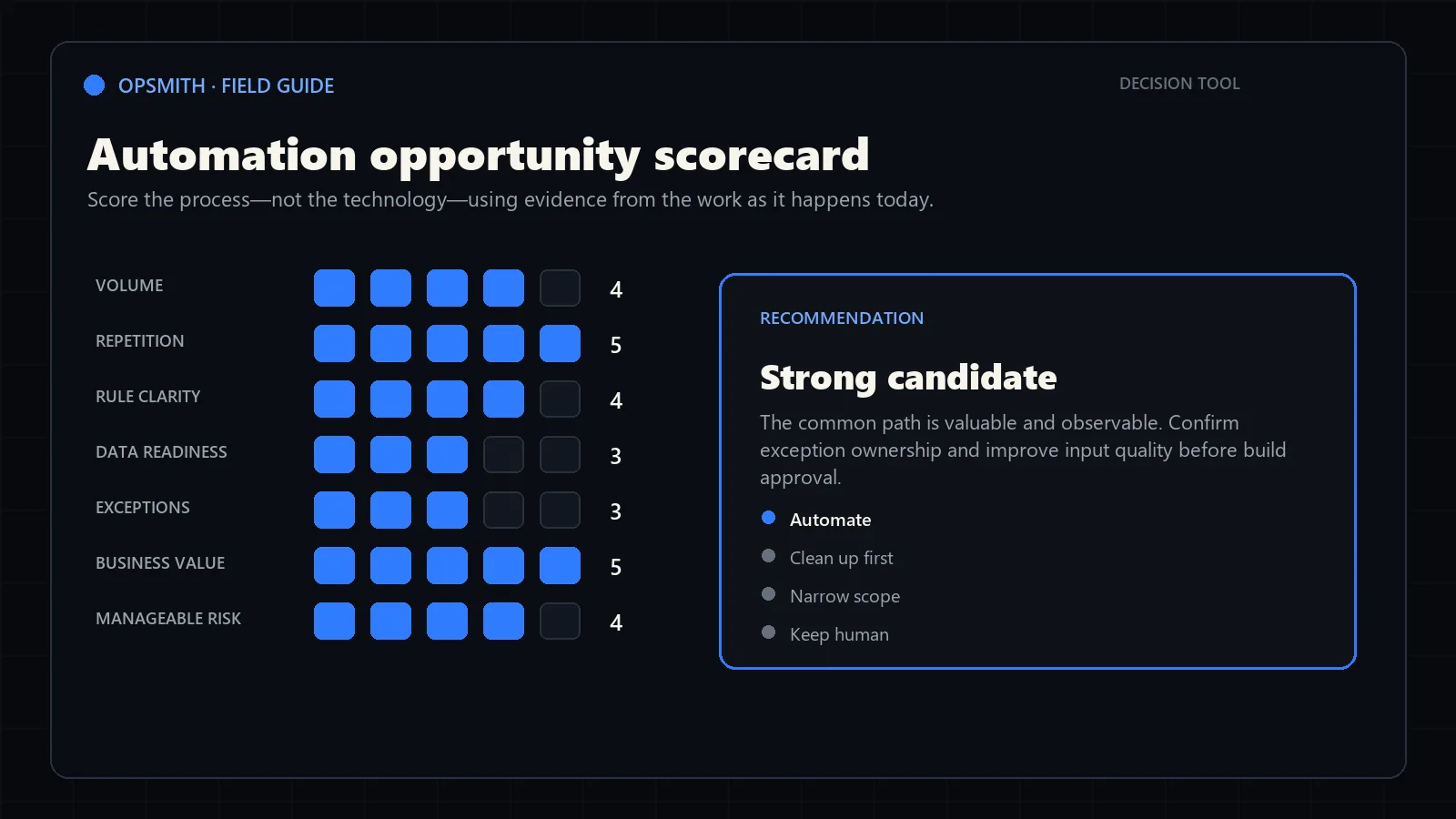
Start with operational friction—not AI
A useful automation opportunity usually appears as a recurring business complaint: information is copied between systems, documents wait in an inbox, managers chase the same updates or customers wait while someone prepares a predictable response. Write down the work that is actually happening before discussing tools.
The strongest first project is rarely the largest process in the company. It is a bounded workflow with a recognizable trigger, a repeatable output, an accountable owner and enough volume for improvement to matter.
Look for repetition
The same type of request, document or update arrives often enough that the handling pattern can be observed.
Look for waiting
Work pauses because someone must copy, check, route, clarify or approve information.
Look for rework
Missing fields, inconsistent formats or unclear ownership cause the same item to be handled more than once.
Look for a measurable outcome
Cycle time, labour, error rate, backlog or response time can be compared before and after.
Score the opportunity across six dimensions
A process should not be selected because it contains many manual steps. Score it as an operating investment. A high-volume process may still be a poor candidate when the rules change weekly or every item requires nuanced professional judgment.
Use a simple one-to-five score for volume, repetition, data quality, rule clarity, business value and manageable risk. Record evidence beside each score. The evidence is more important than the total because it reveals what must change before a build.
Volume
How often does the workflow run, and does demand arrive predictably or in bursts?
Rule clarity
Can the common path be explained without relying on one person’s intuition?
Data readiness
Are inputs available, permitted and consistent enough for dependable handling?
Exception rate
How often does the common path break, and can exceptions be recognized safely?
Business value
Would a faster or more reliable result change cost, capacity, risk or customer experience?
Change risk
How frequently do policies, systems, prices or responsibilities change?
Know when not to automate yet
Do not automate a process simply to preserve an existing workaround. If teams disagree about the required output, the source data is unreliable or ownership changes from case to case, automation can make confusion move faster.
Use the detailed guide to when not to automate a business process when the score is being distorted by unstable work, weak economics, poor data, judgment-heavy decisions or uncontained risk.
Unstable process
The intended steps or business rules are still changing materially.
Unclear accountability
Nobody owns the output, approval or response when something goes wrong.
Mostly exceptional
The supposed standard path represents too few real cases to justify automation.
Unbounded consequences
An incorrect action could create a commitment or risk that cannot be contained.
Choose the smallest useful first scope
Define the workflow from one trigger to one valuable output. For example: from an emailed purchase order to a validated draft record, not from customer request to every downstream accounting and fulfilment activity.
Keep human approval at consequential decision points. The first version should prove that the process can be observed, measured and recovered—not attempt to remove every human touch.
Place the selected scope inside the full guide to how to automate business processes, which carries the decision through mapping, baseline measurement, control design, piloting and monitored operation.
Name the trigger
Identify the event that starts the workflow and the information available at that moment.
Name the output
Describe the record, draft, routing decision or notification that makes the run useful.
Name the owner
Assign the person responsible for correctness and exceptions.
Name the baseline
Record current time, volume, rework and delays before implementation.
Score one real process
Use operating evidence—not optimism. A score is a starting point for investigation, not an automatic build decision.
Clean up first
Improve rules, inputs or exception ownership before committing to automation.
Before acting, record the evidence for every score and assess change risk, privacy, security and the consequence of an incorrect action.
Frequently asked questions
What makes a business process a good automation candidate?
A strong candidate has meaningful volume, repeatable inputs and steps, stable rules, manageable exceptions, a clear owner and a measurable result.
Should the most time-consuming process be automated first?
Not automatically. A smaller, bounded process with cleaner data and clearer ownership often produces a safer and more measurable first result.
What if only part of a process is repeatable?
Score that segment separately. Automating a narrow, stable path while routing other cases to people can be more dependable than forcing the entire process into one design.
Sources and further guidance
These official references provide relevant technical, privacy, risk-management or accountability guidance. OpSmith applies the useful principles to the operation of one business workflow.
- AI Risk Management Framework CoreNational Institute of Standards and Technology
- Business process management stepsMicrosoft