
- Give every human step a specific purpose: judgment, authority, uncertainty resolution or accountability.
- Increase review as consequence and irreversibility rise; do not add approval to every automated action by default.
- Measure the review queue so a control does not quietly become a new operating bottleneck.
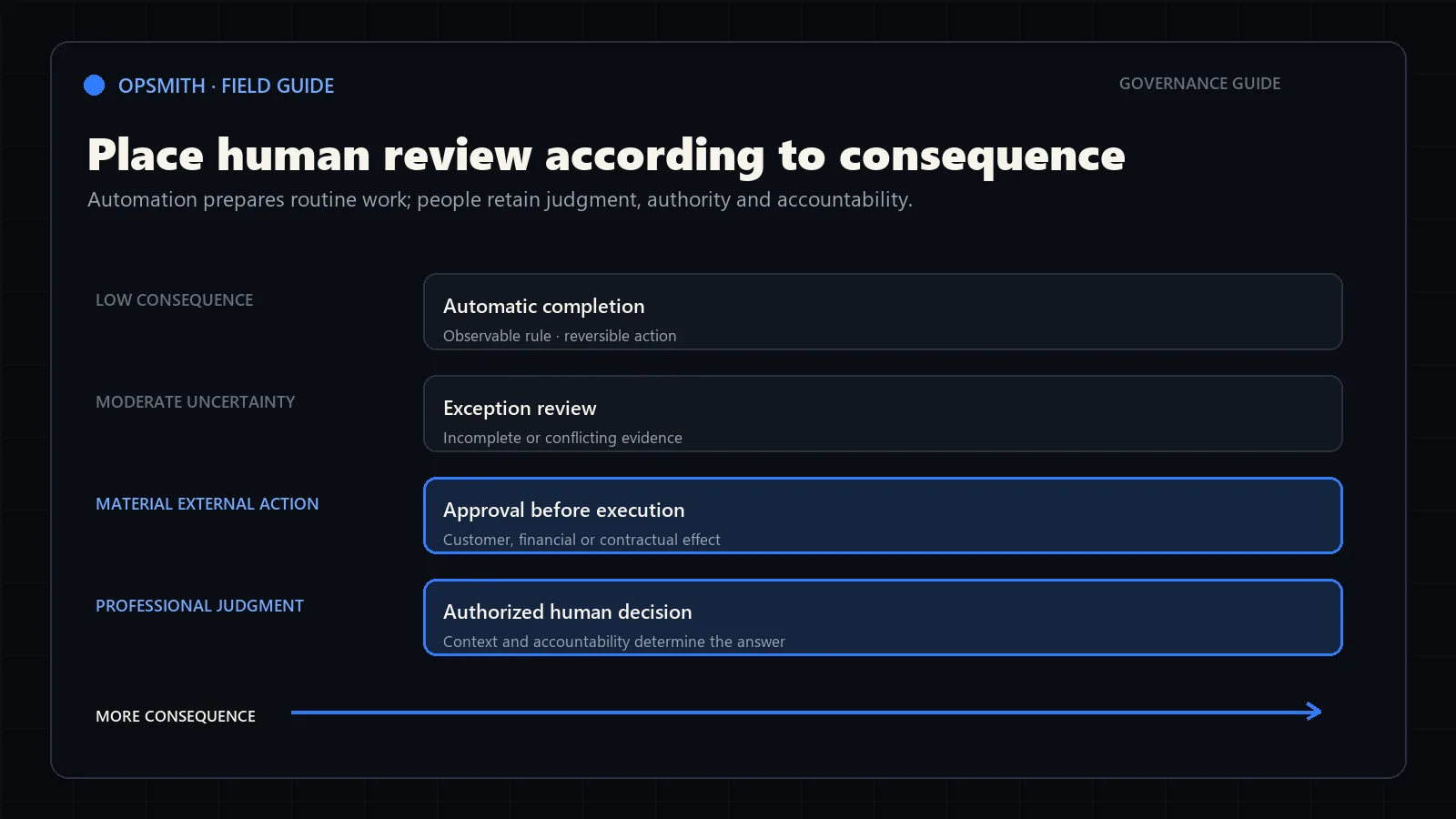
Give the human step a specific purpose
Human-in-the-loop does not mean adding a generic approval to every automated action. Each review point should exist because a person contributes judgment, accepts a commitment, resolves uncertainty or owns a material consequence.
That decision belongs inside the wider AI governance framework. The framework defines ownership and acceptable risk; this guide designs the actual review experience.
If reviewers approve nearly every item without inspecting it, the control is probably misplaced. If every item requires deep investigation, the automated preparation may not be giving the reviewer enough useful context.
Judgment
Context or professional experience affects the appropriate outcome.
Authority
Only an authorized person can accept the financial, contractual or customer commitment.
Uncertainty
The available evidence is incomplete, conflicting or below an approved confidence threshold.
Accountability
A named owner must be able to explain and stand behind the decision.
Place controls according to consequence
Use the consequence of a wrong action—not the novelty of the technology—to decide where approval belongs. Low-risk drafts can move quickly; irreversible or external actions may require explicit acceptance.
Controls can differ by threshold. A known customer request within standard terms may proceed automatically while unusual pricing, sensitive data or a new commitment routes to an authorized reviewer.
Before action
Require approval before sending, posting, paying or committing when consequences are material.
After preparation
Let the system assemble and validate information, then ask a person to accept the prepared result.
By exception
Allow approved common cases to continue and route only defined unusual conditions.
By sample
Review a controlled sample to monitor quality when individual actions are low risk.
Use a review decision matrix
Assess uncertainty and consequence separately. A well-supported output can still require approval because only a person may make the commitment. A low-consequence draft can still need review when the source is incomplete or conflicting.
For each workflow action, record whether it is reversible, who is affected, what authority is required, how uncertainty is detected and which evidence the reviewer will see.
Use the document data validation lab to see how a confidence threshold changes review workload on labelled examples, while failed business rules and missing evidence still prevent automatic progression.
Low uncertainty + low consequence
Automatic completion may be appropriate with source traceability and periodic sampling.
High uncertainty + low consequence
Route by exception so a person corrects or clarifies the evidence.
Low uncertainty + high consequence
Require authorized approval even when the prepared result appears dependable.
High uncertainty + high consequence
Stop the automated path and escalate with the complete source and decision context.
Design a decision—not an inbox notification
The reviewer needs the original source, the prepared output, the reason for review and the available actions in one place. A notification that says ‘please check’ simply transfers the old process into another queue.
Use the exception recovery runbook builder to connect the reviewer’s decision authority to a holding state, escalation owner and safe resume point. The quote example shows a pricing exception that requires approval before delivery.
Context
Show the customer, source, workflow stage and material values together.
Reason
Explain the rule, threshold or uncertainty that triggered review.
Actions
Offer approved choices such as accept, correct, reject or escalate.
Trace
Preserve the automated proposal and the final human decision.
Measure whether review is becoming a bottleneck
Track queue age, approval rate, correction rate and time spent per decision. A near-100-percent approval rate may support a future control change; frequent corrections indicate the system or its inputs need attention.
Human control should evolve from evidence. Monitor those signals through automation monitoring and maintenance, and change thresholds only after representative operating data shows the revised path remains safe.
Queue age
How long items wait before the authorized person reviews them.
Correction rate
How often the prepared result needs a material change.
Escalation rate
How often the initial reviewer lacks information or authority.
Decision consistency
Whether comparable cases receive comparable approved outcomes.
Frequently asked questions
What is human-in-the-loop automation?
Human-in-the-loop automation is a workflow design in which a person reviews, corrects, approves or overrides selected automated work. The human step should have a defined purpose tied to uncertainty, consequence, judgment or decision authority.
Does every AI output need human approval?
No. Low-risk, reversible work may use automatic completion or periodic sampling. Explicit approval is more appropriate when an action creates a material customer, financial, contractual or operational consequence.
How do you prevent human review from becoming a bottleneck?
Route only the cases that need a decision, show the source and proposed action together, give reviewers approved choices and measure queue age, correction rate and escalation rate.
Can approval thresholds change after launch?
Yes, but only through controlled change. Use representative operating data, test the revised threshold against normal and exceptional cases, record the approver and retain a rollback path.
Sources and further guidance
These official references provide relevant technical, privacy, risk-management or accountability guidance. OpSmith applies the useful principles to the operation of one business workflow.
- Artificial Intelligence Risk Management FrameworkNational Institute of Standards and Technology
- OECD AI Principle: Transparency and explainabilityOECD.AI