Winnipeg · Manitoba

AI workflow automation in Winnipeg for established businesses.

OpSmith is based in Winnipeg and works directly with established local businesses that want to reduce recurring administrative work without losing the operating knowledge of the people who currently keep it moving.

Experience behind the service

A connected customer journey, not just an AI experiment.

Work directly with Terry Williams, founder of OpSmith, from understanding the process through design, testing and launch. Based in Winnipeg, Terry can observe local handoffs on site when that makes the workflow clearer.

From manual mockups and quotes to a qualified lead.

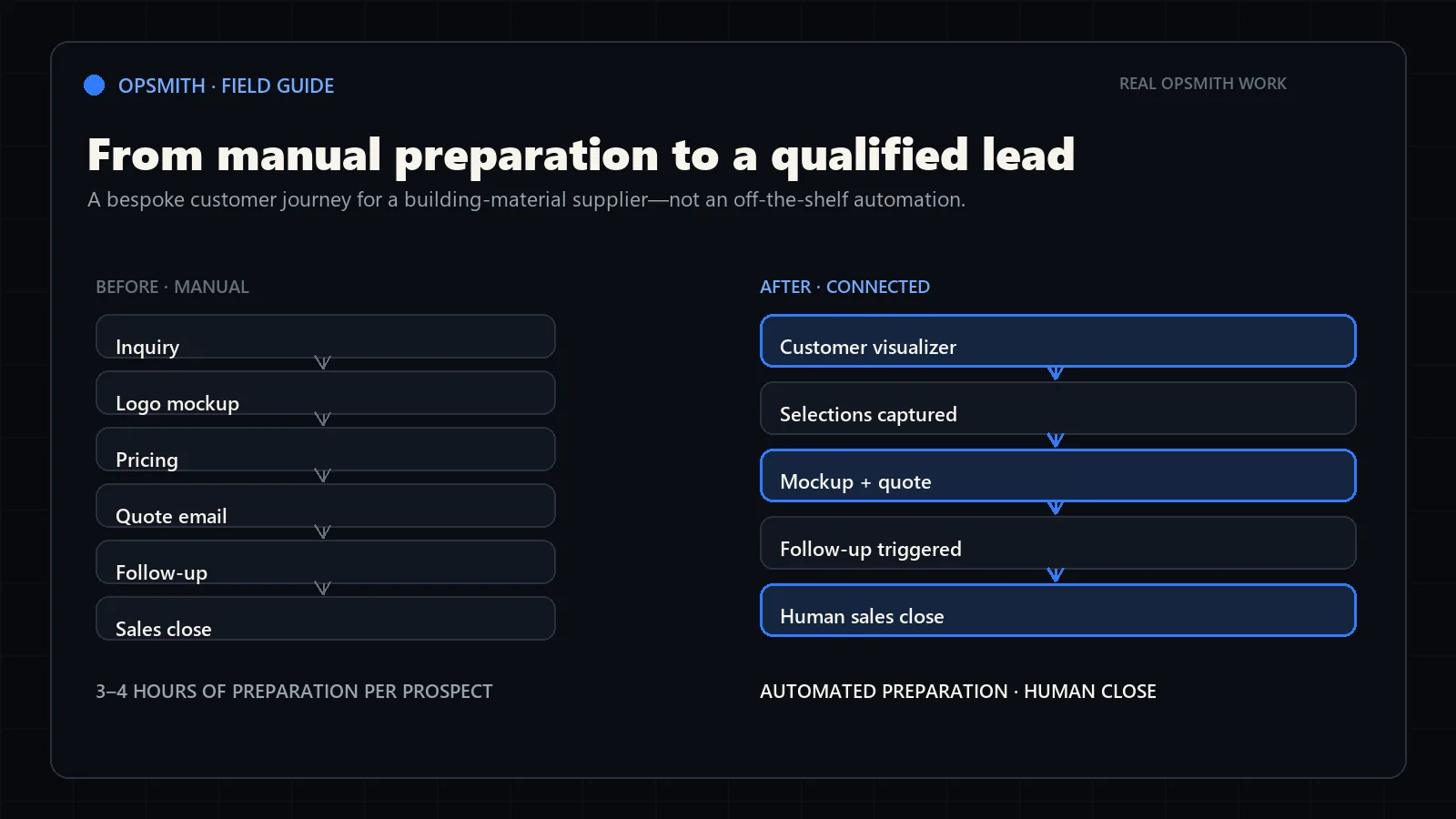
For a building-material supplier, Terry built an AI-assisted house-wrap visualizer connected to instant quoting and automated follow-up. Customer selections became the input for the next step instead of being recreated by a salesperson.

The case study describes 3–4 hours of repeated preparation removed per prospect sequence—not time removed from the final sales conversation. The system took several months of design, implementation, testing and refinement.

Custom visualizer and quote automation case study
BeforePrepare a branded mockup, assemble pricing and manage follow-up manually.
AfterCarry approved selections into the mockup, quote and follow-up sequence.
Still humanHandle unusual needs, the customer relationship and the final sales close.
Before and after the house-wrap workflow: manual mockup, quote and follow-up become connected preparation with a human sales close.
Workflow diagram of the project described in the case study, not a screenshot of the client’s system. The result is specific to that workflow, not a savings forecast for another business.
Where the work gets stuck

Combine local observation with practical system building.

For Winnipeg teams, Terry can examine the process where it happens—inside the real combination of people, software, documents and workarounds that a generic remote demo may miss.

On-site workflow observationFollow a recurring process across the office, field or operating environment and document the exceptions people handle without thinking about them.
Founder-led assessment and buildWork directly with Terry Williams from the first operating conversation through workflow design, testing and launch.
Built around existing systemsBegin with the CRM, inboxes, documents, spreadsheets and business software the team already relies on.
Local start, Canada-wide supportUse in-person discovery where it adds value, then continue documented implementation and managed support remotely when appropriate.
How the improved process works

Start locally with one measurable operating bottleneck.

OpSmith serves Winnipeg businesses that have real process volume, disconnected information and a team that has outgrown informal workarounds.

01

Observe the real work

Meet the people involved, follow the request or document through its actual path and record the waiting, re-entry and exceptions.

02

Design the responsible improvement

Choose the smallest system that reduces friction while preserving the approvals, customer judgment and recovery paths the business needs.

03

Launch with accountable support

Test the workflow with representative inputs, document ownership and remain available as the local process or operating rules change.

What we can improve

Four practical starting points for Winnipeg teams.

These are illustrative workflow designs, not claims about local client results. Each starts with your existing tools and a baseline your team can check.

Document processing automation

Input
An invoice, purchase order or application arrives by email or as a PDF.
Output
Validated fields and a review queue, ready for the next approved system update.
Human control
A person resolves missing or conflicting information and authorizes consequential changes.
Measure
Handling minutes per document, correction rate and age of the review queue.

Quote automation

Input
A customer sends a request, specifications and supporting attachments.
Output
An organized estimate brief or quote draft using the business’s approved pricing rules.
Human control
The estimator or salesperson confirms scope, exceptions and the final price before sending.
Measure
Time to a reviewed quote, clarification rounds and avoidable re-entry.

Lead follow-up automation

Input
A website inquiry or existing customer request enters the sales workflow.
Output
A matched record, assigned owner, next task and appropriate follow-up sequence.
Human control
People handle unusual requests; replies, opt-outs and agreed stop conditions interrupt automation.
Measure
Time to first useful response, unassigned leads and completed handoffs.

Reporting automation

Input
Recurring updates arrive from spreadsheets, business systems and team reports.
Output
A consolidated draft that identifies missing inputs and links back to its sources.
Human control
An accountable reviewer checks exceptions and approves the report before distribution.
Measure
Preparation time, missing-source rate and corrections after review.

Not sure which process is worth changing? Use the automation ROI calculator to compare cash savings, staff capacity and payback after implementation costs and human review. Test conservative and expected scenarios; the results are planning estimates, not a project quote or promised saving.

From first conversation to ongoing support

Know what each stage is for.

Start with one operating problem. An initial conversation does not commit you to a build, and an assessment may recommend process cleanup or leaving a step human.

1. Free 20-minute consultationDescribe one recurring process, the people involved and the friction. We establish whether there is a useful opportunity to examine—not a finished design or implementation during the call.
2. Paid Operational AI BlueprintA focused business process automation audit maps the current workflow, scores the opportunity and risk, establishes a baseline and produces an implementation brief. It is a separate assessment, not an automatic build commitment.
3. Scoped implementationThe build follows the agreed workflow boundaries: connections, business rules, human approvals, exception handling, testing and handover. Your team supplies a process owner, representative examples and feedback on whether the result works.
4. Ongoing operationManaged automation services cover an agreed scope of monitoring, recovery and improvement after launch. Software usage, support responsibilities and future changes need to be considered alongside the initial build.

For teams in construction or property management, the assessment follows the actual field-to-office handoffs. Remote work can support later design and delivery; an on-site visit is useful when observing the process will change the recommendation.

A good fit looks like this

You have a recurring process that is expensive, frustrating or dependent on one person—and you want a Winnipeg-based operator to examine it with you before recommending technology.

Strong starting points include quoting and customer intake, construction-office administration, property-management requests, logistics documents, reporting and processes unique to the way a local business competes.

Inputthe real request, record, document or update
Decisionrules, AI assistance and human review
Handoffthe right person, system or customer
Questions worth resolving

Know what should be automated—and what should not.

How much does workflow automation cost?

The first 20-minute consultation is free. A paid Blueprint and any implementation are scoped separately. Cost depends on the number of systems and handoffs, data cleanup, business rules, human review, testing and ongoing support. Discuss software and usage charges as well as the build; a process-cost estimate is not a project quote.

How long does an implementation take?

Timing depends on scope, access to existing systems, source-data quality, exception handling and how quickly the team can test and approve changes. A bounded handoff and a bespoke customer journey are different projects. We establish the scope and dependencies before proposing a delivery schedule, rather than promise the same turnaround for every business.

What will our team need to provide?

Start with a process owner, a description of the current steps and non-sensitive representative examples. During an agreed engagement, access to systems, business rules and feedback from the people doing the work are needed to design and test the workflow. Do not send credentials or confidential records through the public contact form or chat.

Does OpSmith work on site in Winnipeg?

Yes, when seeing the physical handoffs, documents or team interactions will materially improve the workflow assessment. Later design and support can continue remotely when that is more efficient.

Does OpSmith only work with Winnipeg companies?

No. OpSmith is based in Winnipeg and serves Canadian businesses remotely, with the option for in-person workflow observation for local teams.

What types of Winnipeg businesses are a fit?

The strongest fit is an established organization with recurring operational volume, disconnected systems or a process that has become too dependent on manual coordination.

Do we need to know which AI tool we want?

No. Begin with the operating problem. The recommended system may use rules, integrations, conventional automation, AI assistance or a combination based on the work and its risks.
Related workflows

Connect this process to the rest of the operation.

Construction automation

Explore office and field handoffs common to Winnipeg contractors and trade businesses.

Practical field guides

Plan the workflow before you automate it.

Use OpSmith’s workflow automation resources and guides to document the work, control exceptions and measure the operating change.

See whether this workflow is worth improving.

Tell us how the process works today, where it slows down and what a better handoff would change. We will use that context in the first conversation.

Discuss a Winnipeg workflow ↗