
- Accept requests through practical channels, but normalize the facts into one traceable record.
- Define quote-ready information by quote type instead of asking every customer the same exhaustive questionnaire.
- Route missing, conflicting or uncertain details for clarification; never let automation invent them.
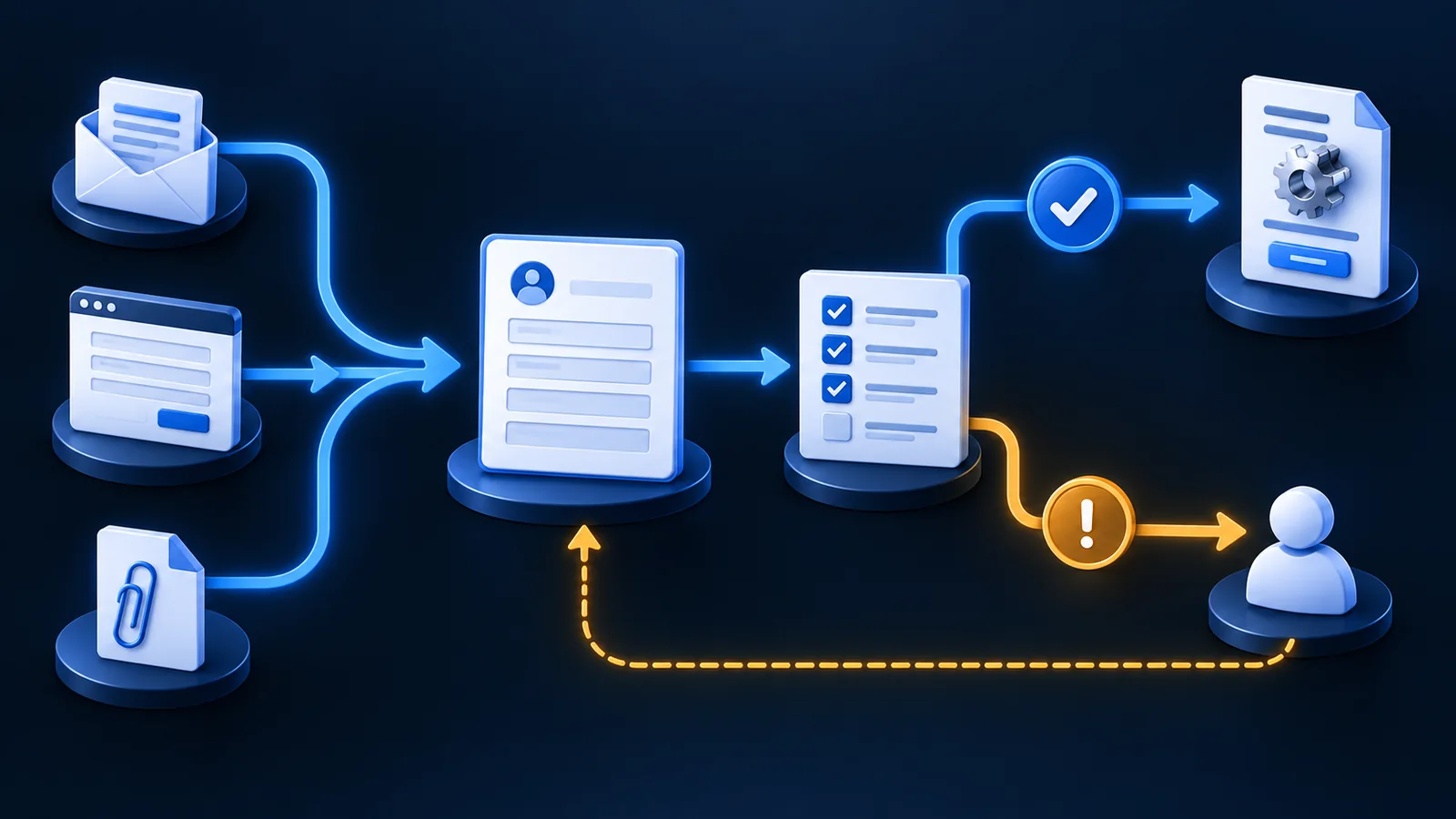
Define the output: a quote-ready request
The useful output of intake is not a submitted form or a forwarded email. It is a request that an estimator or pricing workflow can act on without reconstructing the customer's need from several channels. Give it an owner, a request identifier, a received time and a visible readiness state.
Quote-ready does not mean every possible field is filled. It means the facts required for this quote type are present, supported by their sources and internally consistent enough to begin pricing. Optional context can improve a proposal, but it should not block a standard quote unless the business has decided it changes the commercial decision.
This is the intake stage of the broader sales quotation process. Keeping the boundary explicit prevents intake from quietly becoming pricing, approval and customer communication at once.
Identity
Customer, contact, account or opportunity, including a safe path for an unknown or possible duplicate.
Requested outcome
What the customer wants priced, for what use, quantity, location or timeframe where relevant.
Evidence
Original messages, forms, drawings, photos, spreadsheets or selections connected to the structured facts.
Readiness
Ready to price, waiting for customer, internal clarification, duplicate, unsupported or closed.
Capture multiple channels without creating multiple truths
Customers will use the channel that is convenient to them: email, a website form, an uploaded file, a phone conversation or an existing sales relationship. A redesign can guide them toward better inputs, but forcing every request into a perfect form often shifts work back to the salesperson or customer.
Keep each source intact and connect it to one request. Extract structured values where the evidence supports them, and record who confirmed a correction. If an email and attachment disagree, mark a conflict rather than silently choosing the value that makes the workflow continue.
When attachments contain the required facts, a controlled document processing automation workflow can extract and validate them before the quote record is updated.
Preserve the sender, recipients, subject, body, attachments and thread reference.
Form
Store the submitted field values, consent context, source page and submission time.
Conversation
Record salesperson notes as an attributed interpretation, not as if the customer submitted a structured field.
Connected system
Retain the source record identifier and the event that authorized the intake action.
Build a requirements matrix by quote type
Review recent quotes and list the information that actually changed price, scope, feasibility, delivery or approval. Group requests that share the same decision model. A standard product replenishment may need account, item, quantity and destination; a custom installation may need measurements, site conditions, schedule and technical review.
For each field, define its purpose, permitted source, format, validation rule, whether it is required at intake and who may resolve ambiguity. This matrix becomes the shared contract between the form, extraction logic, CRM, pricing rules and human reviewer.
Required now
Without this fact, pricing cannot responsibly start.
Required before release
A draft may be prepared, but the quote cannot be approved or sent until this is known.
Optional context
Helpful for positioning or service, but not a hidden blocker.
Derived value
Calculated or classified from source facts and therefore accompanied by its method and confidence.
Design the clarification loop
A useful clarification request names the missing or conflicting fact, explains why it matters and gives the customer or owner a simple way to respond. It does not resend a twenty-field questionnaire because one measurement is absent.
Track the request state while waiting. Set an accountable owner and a reasonable response target, but do not convert silence into a guessed answer. When information arrives, reconcile it with the existing record and preserve the change history.
Some questions should remain human. Ambiguous scope, unusual site conditions, product substitutions and relationship-sensitive conversations may need an estimator or salesperson who can understand consequences beyond the available fields.
Validate before information reaches pricing
Apply deterministic checks for required fields, formats, permitted values, calculations, duplicate requests and references to approved customer or product records. The document data validation lab demonstrates how pass, review, hold and unknown outcomes should remain distinct.
A plausible value is not necessarily verified. If a model extracts a quantity with low confidence, the workflow should attach the source and route review. If the product identifier is absent from the approved catalogue, preserve it as unknown rather than changing it to the nearest match.
Proceed
Required evidence is present and the checks support moving into the approved pricing path.
Review
A named person can resolve uncertainty using the attached evidence.
Hold
The request cannot safely advance because a required fact or authoritative reference is missing.
Close
The request is duplicate, unsupported, withdrawn or otherwise outside the quoting process.
Implement the smallest useful intake path
Choose one common quote type and fifty or more representative historical requests if available. Map their sources, missing fields, clarification rounds, duplicates and time to quote-ready status. Include difficult examples instead of training the workflow only on clean submissions.
Pilot extraction and validation as a prepared record for human review. Measure corrections by field and source. Only automate downstream updates after the business can explain the failure modes and prove that uncertain requests remain contained.
OpSmith designs this intake-to-draft path through its quote automation service. For a decision-ready map before implementation, start with the Operational AI Blueprint.
Completeness
Percentage quote-ready at first review and the fields most often missing.
Effort
Human touch time spent collecting, interpreting and re-entering request information.
Delay
Elapsed time from receipt to quote-ready, separated into customer and internal waiting.
Quality
Correction, duplicate and hold rates by source and quote type.
Frequently asked questions
Should every quote request use the same form?
No. Use shared identity and tracking fields, then show requirements appropriate to the quote type. An exhaustive universal form can create unnecessary friction and still miss specialized facts.
Can AI read quote requests from email and attachments?
It can help extract and classify information, but important fields need validation against the source and approved records. Low-confidence, conflicting or unsupported values should go to review.
What happens when information is missing?
Place the request in a visible waiting state, ask for the specific fact that changes pricing and keep an owner accountable. Do not let the workflow invent a value or quietly use an old default.
How should duplicate quote requests be handled?
Match on agreed identifiers and present probable duplicates for review when the evidence is ambiguous. Preserve both sources and merge only under an approved rule or human decision.
Sources and further guidance
These official references provide relevant technical, privacy, risk-management or accountability guidance. OpSmith applies the useful principles to the operation of one business workflow.
- PIPEDA fair information principlesOffice of the Privacy Commissioner of Canada