
- A signed delivery record, accepted goods quantity and supported freight charge answer different questions.
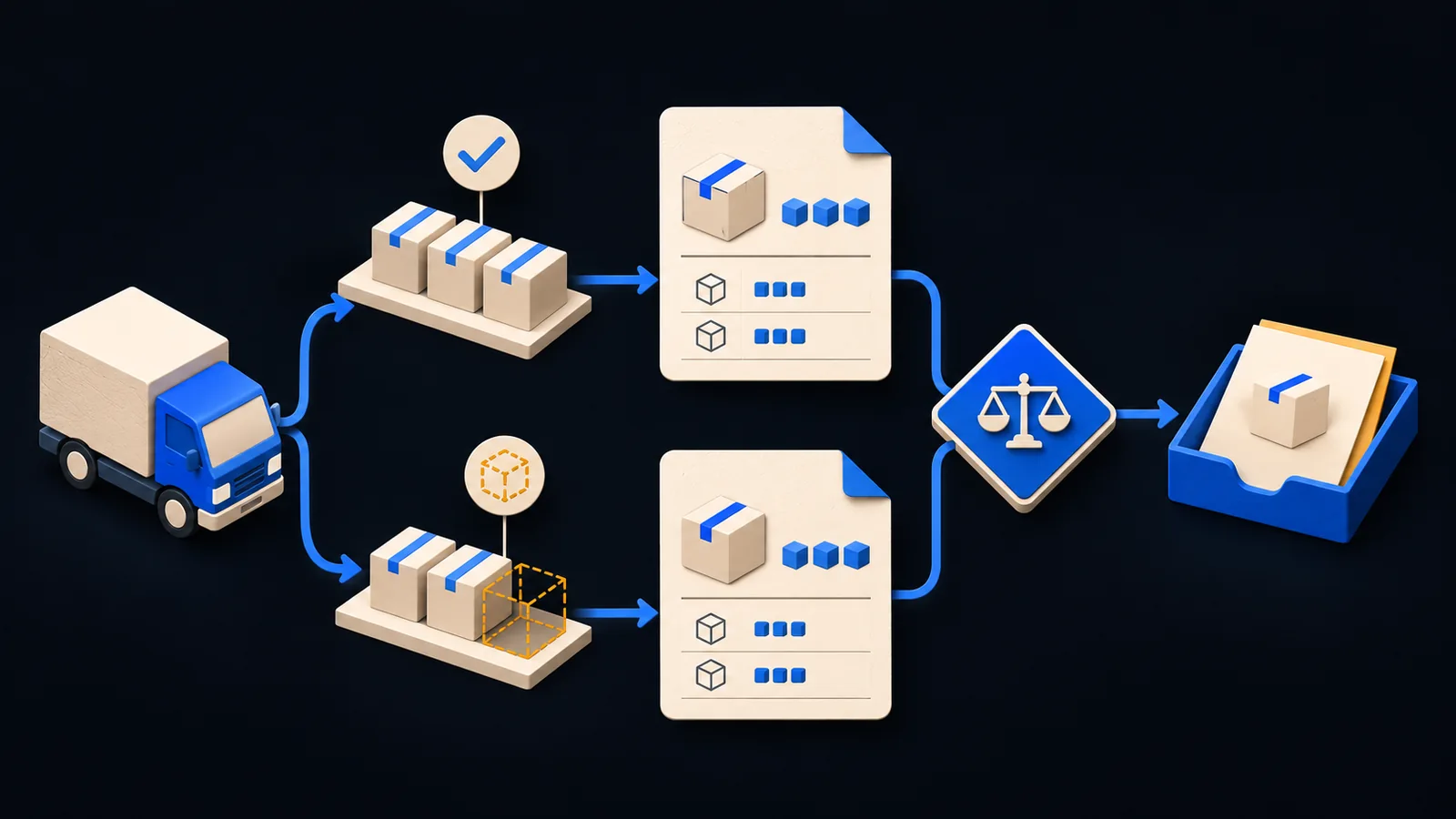
- In the worked example, 100 units are physically received, 96 are accepted and four remain in condition review; CAD 200 of additional freight charges also needs support.
- Use the shipment packet, reconciliation worksheet and seven exception cases to test identity, repeated receipts and incomplete evidence.
Decide what the delivery evidence must establish
Proof of delivery is useful only when it can be connected to the relevant shipment and business decision. Capture the shipment or load identifier, consignee, delivery location, event date, receipt reference and the original evidence. Identify who may resolve a mismatch. A familiar carrier name and a plausible invoice amount are not enough to establish the relationship.
Keep goods receipt and freight pricing separate. Goods may be counted in pieces, cases, pallets or another unit, while transport may be priced per load, distance, weight or an agreed combination. A shortage or condition hold can require investigation without implying a simple per-unit deduction from the carrier's invoice. The applicable agreement determines which charges and evidence matter.
The broader invoice processing workflow owns capture, approval and destination updates. This guide focuses on the narrower reconciliation between delivery evidence and a freight invoice; it does not determine liability, authorize payment or replace the agreement.
Worked example: 100 received, 96 accepted and two unsupported charges
Shipment S-801 covers 100 units in EA, with two planned delivery events to SITE-NORTH-04. POD-801-A records 60 received and accepted. POD-801-B records 40 received, of which 36 are accepted and four are held for condition review. The correct physical receipt total is 100, while accepted quantity is 96. The example makes no finding about who is responsible for the condition issue.
RATE-801-v1 supports CAD 1,500 linehaul and CAD 180 fuel. Freight invoice F-801 adds CAD 120 detention and CAD 80 redelivery, producing CAD 1,880 before applicable tax. The packet has no detention timestamps or approved redelivery reference. The CAD 200 difference therefore needs evidence and authority review. It is not automatically a credit, and CAD 1,680 is not declared payable by this example.
| Check | Worked evidence | Result / next action |
|---|---|---|
| Physical receipts | 60 EA + 40 EA | 100 EA received across two distinct events |
| Accepted condition | 60 EA + 36 EA | 96 EA accepted; four held for review |
| Agreed freight basis | 1,500 linehaul + 180 fuel | 1,680 CAD supported by the example rate reference |
| Additional charges | 120 detention + 80 redelivery | 200 CAD requires supporting evidence and authority |
| Invoice arithmetic | 1,680 + 200 | 1,880 CAD; arithmetic agrees |
| Business outcome | Condition and charge issues unresolved | Delivery-and-charge review; no automatic release |
Download the worked example
- Shipment, receipts, rate reference and freight invoice
- Completed quantity and charge worksheet
- Seven reconciliation and recovery tests
- Complete three-example reference pack with local check script (ZIP)
- Reference-pack instructions and limits
Adapt these working structures to your process. They are examples, with no claimed client results or production accuracy measurements.
Count delivery events rather than copies of attachments
If POD-801-A arrives in an email and then through a carrier portal, that does not establish another 60 units received. Link both source deliveries to the same stable unload event. Keep the original receipt reference and a traceable rule for identifying a replay. A filename or upload timestamp alone is a weak event identity.
Likewise, do not infer the final 40 units from the planned shipment when POD-801-B is inaccessible. Report that receipt evidence as unavailable and route the collection task. The shipment plan states what should move, not what the receiver has evidenced. A later receipt should complete the existing reconciliation rather than create a second shipment record.
Record unit of measure with every quantity. Ten pallets cannot be compared directly with 100 pieces unless an approved conversion and the actual contents are established. Preserve the source units and the conversion evidence. Do not let an extraction model choose the relationship because it makes the totals agree.
- Identify the movementJoin the shipment, carrier, consignee and destination using verified references.
- Reconcile distinct eventsDeduplicate replayed source events; retain each real partial receipt and its source.
- Separate quantity statesKeep received, accepted, held and missing evidence visible instead of forcing one delivered flag.
- Compare the charge basisCheck the rate version and evidence for each additional charge independently.
- Resolve and verifyThe authorized owner records the disposition; confirm any approved destination update before closure.
A signature does not erase qualifications in the receipt
Read the complete receipt context, including condition notes, exceptions and amendments. In S-801, the second record acknowledges receipt while explicitly leaving four units in review. Reducing the entire document to a signature-present field loses the information the reviewer needs.
Define the operational meaning of accepted, held and disputed in your process. They should refer to a documented state and responsible decision, not a model's sentiment about the note. If wording is unclear, prepare a clarification with a source reference. Do not silently turn uncertain handwriting into an unconditional acceptance status.
A condition issue and a charge issue can progress on different tracks. Resolving the four held units does not supply detention timestamps or authorize redelivery. The invoice release gate needs the dispositions required by the actual agreement and policy, not merely a green shipment dashboard.
Explain additional charges line by line
For each accessorial charge—an additional freight service or fee—record the applicable rate or rule, the triggering event and the required approval. In the worked example, detention needs the relevant waiting-time evidence under the agreement. A typed invoice line establishes that the carrier is requesting the charge; it does not establish the time or authorization supporting it.
The planned split delivery also matters when reviewing the redelivery charge. The coordinator should determine what movement the line describes and which authority supports it. Do not conclude that every second delivery is an extra billable trip, or that every planned split makes all additional costs invalid. Put the specific unresolved question in the review packet.
The same separation between supported work and an overall amount appears in property work-order invoice matching. That example is useful when designing a reviewer explanation, while the freight agreement and delivery evidence remain specific to this workflow.
Use extraction to prepare evidence, not settle the reconciliation
Technology references checked November 2, 2026: OASIS UBL provides separate business-document models including despatch and receipt advice. Those distinctions are useful when designing records for what was sent and what was received; this worked packet is not a claim of UBL conformance. Microsoft Dynamics 365 also documents quantity and price checks as distinct parts of invoice matching.
Current models such as GPT-6.1 Sol or GPT-6 Astra can be evaluated for candidate references, quantities and exception notes in mixed documents. Require the source location and an unresolved state where evidence is unreadable. Test ordinary receipts alongside partial, qualified, repeated and wrong-consignee records. This guide reports no measured model accuracy.
Use explicit rules for event identity, unit conversions, quantity arithmetic and required dispositions. Keep authority outside generated text. Place extraction within a controlled document processing workflow; an accurate copy of an invoice can still contain a charge unsupported by the agreement or source events.
Give every discrepancy a next owner and a safe recovery point
A useful queue names the affected shipment, failed check, evidence available, evidence missing, responsible owner and next action. Separate carrier follow-up from receiver condition review and integration recovery. A single generic mismatch flag forces someone to reconstruct the case every time it changes hands.
If an approved invoice update loses its acknowledgement, follow an owned workflow exception handling route: contain the item, check the destination by stable references and reconcile the result before another create operation.
Measure incomplete receipt packets, replayed events, charge-review age, reviewer corrections and uncertain destination outcomes separately. Avoid claiming savings from the total flagged value. A questioned charge is neither a confirmed overpayment nor a recovered amount.
OpSmith's logistics automation work can connect source collection, matching and accountable review around an existing transport or finance system. Start with one movement type and a small set of representative exceptions.
Check transport source meaning before reconciling receipt evidence
The earlier bill of lading data extraction step supplies document references, units and packaging context. Its worked example shows why a clean-looking extracted quantity should not become receipt evidence or an automatic system update.
Resolve the transport-source question before using receipt evidence
The shipment tracking data reconciliation example retains a delivery report, conflicting transit claim and later proof attachment separately. Its shipment exception management workflow keeps the operational case open while the appropriate evidence and authority decisions remain unresolved.
Frequently asked questions
Can a signed POD automatically approve a freight invoice?
Not as a universal rule. The signature must be interpreted with the receipt details and applicable agreement. Quantity qualifications, identity conflicts or unsupported charges may remain. This example routes those issues to the responsible decision owner.
Should damaged units be subtracted from the freight charge?
Do not assume that calculation. Goods condition, liability and freight pricing are separate questions governed by the actual agreement and process. The example keeps four units in condition review without deriving a per-unit freight deduction.
What if one invoice covers several shipments?
Keep shipment-to-invoice-line relationships explicit and reconcile the relevant evidence for each movement. Shared headers or totals should not hide an unsupported shipment or cause one receipt to be counted against multiple lines.
Does the downloadable packet test OCR?
No. It contains structured worked-example records and expected review actions. Use permissioned document images and independently labelled fields for a separate OCR or model evaluation; successful arithmetic on these records does not establish extraction accuracy.
Sources and further guidance
These official references provide relevant technical, privacy, risk-management or accountability guidance. OpSmith applies the useful principles to the operation of one business workflow.
- Universal Business Language 2.4 document modelsOASIS Standard
- Quantity and price matching overviewMicrosoft Learn
- Current model catalogOpenAI