
- SHP-310 follows eight received messages through an ETA risk, a late historical event, a replay, conflicting status and later delivery evidence. The case remains open for review.
- Use one event register across the carrier-intake, reconciliation and customer-notification guides. Download the packet and a read-only local inspector that preserves uncertainty.
- Current project44, FedEx and DCSA references illustrate different integration contracts and transport scopes. Named AI models are preparation candidates, not dispatch authority or measured winners.
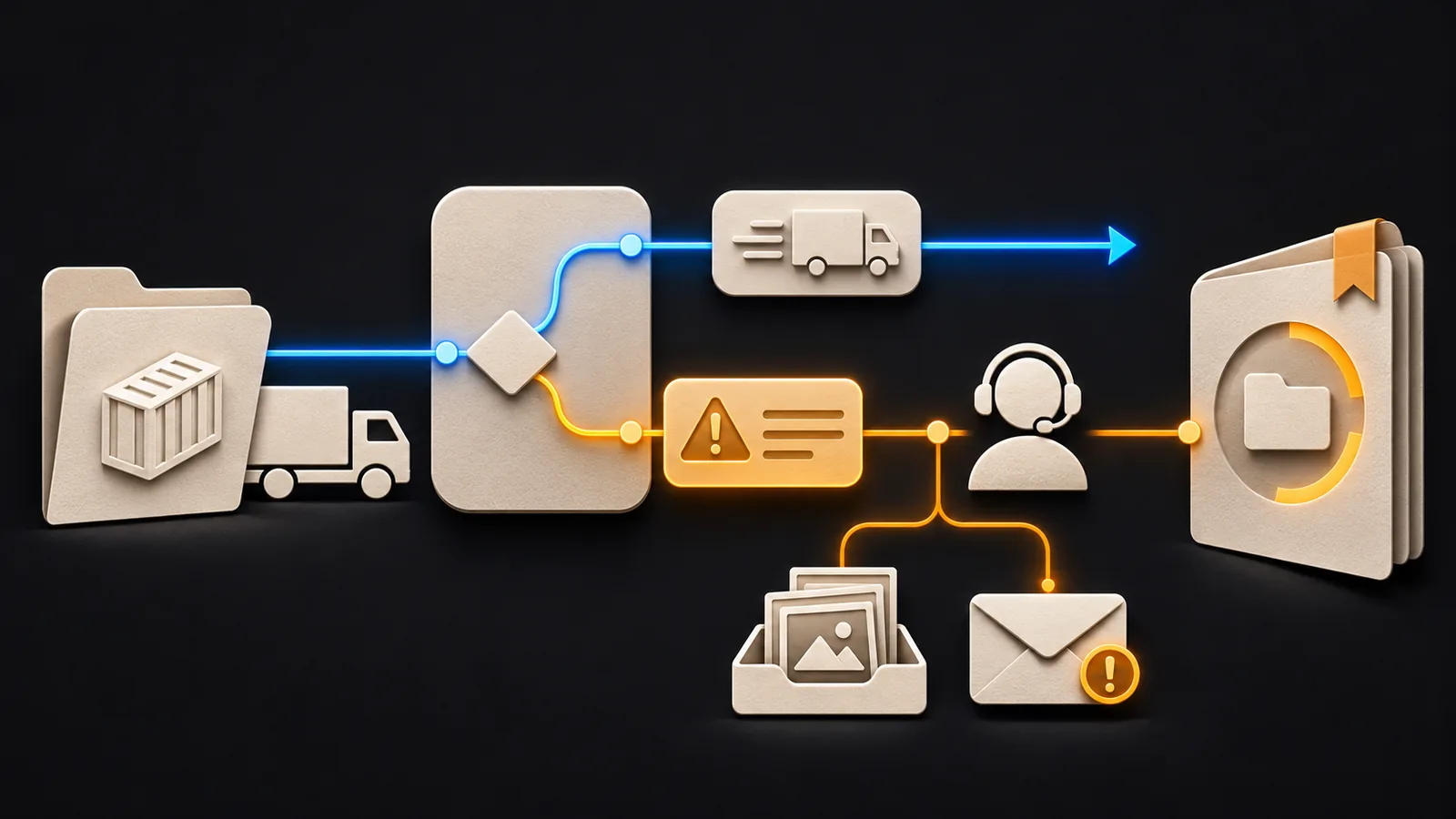
Define the deviation against the actual shipment commitment
A carrier status and an operational exception are different records. An in-transit event can be normal, late or irrelevant to a particular promised delivery window. A missing update can indicate an evidence gap rather than a physical delay. Start with the shipment, stop, service context and current customer commitment before deciding what requires action.
Define categories that lead to different owners: missing source information, estimate risk, missed milestone, conflicting status, unresolved delivery evidence and uncertain communication outcome. Record what is known and which question remains open. A universal exception flag is too weak when one item needs carrier clarification and another needs a customer decision.
The workflow described here supports coordination. It does not decide safe routing, hours-of-service compliance, customs requirements, liability or contractual remedies. Those decisions stay with the responsible dispatch, operational and professional authorities. Do not let a status summary silently create a new delivery commitment.
Worked example: SHP-310 has more evidence, but no justified automatic closure
SHP-310 is a worked road-freight coordination case on November 3, 2026, using explicit local UTC-06:00 timestamps. Its current customer window ends at 14:00. At 10:02 the team receives a carrier estimate of 16:30, reported at 10:00. That signals a risk against the existing window; it is not a customer-accepted replacement appointment.
At 10:10 an in-transit event arrives with an earlier event time of 09:20. At 10:11 the same estimate envelope is replayed. Later, delivery is reported at 14:10, a conflicting email claims transit at 14:20, and a separate payload adds POD-310 for review. One ambiguous email saying only 310 cannot be matched safely.
The eight receipts contain seven unique provider/message identities: six matched messages and one unmatched item. The new POD payload shares a delivery milestone with the earlier report but is not the same envelope. Retain it as new evidence. The reported delivery, unresolved conflict and pending document review do not establish accepted receipt or billing approval.
| Received local | Source meaning | Owned interpretation |
|---|---|---|
| 09:02 | Pickup occurred 09:00 | Retain event and source |
| 10:02 | Delivery estimate 16:30, reported 10:00 | Compare risk with current 14:00 window |
| 10:10 | In-transit event occurred 09:20 | Insert in history; keep ETA separate |
| 10:11 | Unchanged P-02 replay | No second logical envelope or notice |
| 14:12 | Delivery reported at 14:10 | Report retained; evidence pending |
| 14:21 | Conflicting transit claim at 14:20 | Coordinator reconciles sources |
| 14:25 | POD enrichment for same delivery milestone | Keep document; review pending |
| 14:27 | Ambiguous reference 310 | Clarify identity without guessing |
Download the worked shipment packet
- Complete worked messages and expected boundaries
- Event-time and received-time register
- Completed exceptions, owners and closure evidence
- Read-only local packet inspector
- Complete shipment reference pack (ZIP)
- Instructions and limits
Worked records, not carrier logs or client results. No live tracking, message sending or dispatch changes are performed by these files.
Connect detection, response and closure as separate gates
Capture the original payload or message, provider identity, stable envelope key, shipment and stop references, event type, event time, received time and any estimate or evidence fields. Validate identity and timing before changing a shared record. Unknown fields should create a reviewable state rather than plausible defaults.
Compare the evidence with the relevant window, expected milestone or unresolved prior action. Name one coordinator for the next useful decision and an approved fallback when that role cannot accept. A notification delivered to an inbox is not accepted ownership, and a technically healthy integration does not guarantee operational coverage.
Close the case only when its actual question is resolved and affected records or communications have an inspectable disposition. Receiving one more carrier update is not enough. A resolved status conflict can coexist with pending proof review, and a repaired feed can coexist with customer messages whose outcomes remain unknown.
- Capture and matchPreserve source, provider identity, shipment context and timing.
- Detect the deviationCompare facts and estimates with the applicable operational expectation.
- Assign and investigateObtain accepted ownership and retain the unresolved question.
- Communicate supported factsUse current evidence and approved commitments; keep uncertain sends owned.
- Verify and closeAccount for status, evidence, destination updates and required communications.
Use a different control for intake, reconciliation and customer updates
The carrier status update automation guide prepares identity, timing and source-linked fields from emails or APIs. It includes an ambiguous message that should not be forced onto a known shipment.
The shipment tracking data reconciliation guide preserves late events, repeated envelopes and new enrichment. It shows why sorting every message by arrival time cannot determine one trustworthy status.
The shipment delay notification workflow turns that evidence into a qualified customer draft, with current-state checks and a separate owner for uncertain sending outcomes.
Choose the integration contract for the actual transport mode
Technology references checked November 3, 2026. A parcel webhook, truckload visibility API and ocean-container standard are not interchangeable implementations. Confirm the account, mode, identifier scope, available fields and event contract before adapting examples. The SHP-310 packet is an independent worked structure, not a sample provider payload.
DCSA's public release page identifies Track & Trace v3.0.0, with the release available through member and partner access. The publicly accessible implementation guide we reviewed describes v2.2. For container shipping, verify the release you are actually adopting instead of treating an older public guide as the current schema. Neither document is a universal road-freight status dictionary.
| Reference | Useful implementation concept | Boundary |
|---|---|---|
| project44 Granular Webhooks | Configured change notifications and optional context | A delta payload may not contain complete shipment history |
| project44 Universal PUSH for FTL | Shipment identifier, event timestamp and optional stop context | 202 ingestion acceptance precedes asynchronous processing |
| FedEx webhook guidance | Additional payloads may enrich an existing milestone | Use the documented parcel/account contract; avoid milestone-only deduplication |
| DCSA Track & Trace | Shared container-shipping event vocabulary and releases | Confirm version, adoption access and ocean-container scope |
Use current AI for evidence preparation, with a fixed business boundary
GPT-6.1 Sol can be evaluated for structured field drafts from a carrier email. Claude Sonnet 5.5 is another candidate for source-grounded exception summaries; Gemini 4 Argon can be evaluated where an approved mixed text, image or PDF packet is useful. These task assignments are recommendations to test, not comparative performance claims.
Require the model to return source references and unknowns. It should not promote estimate to confirmed appointment, infer shipment identity from a bare partial reference, or turn reported delivery into consignee acceptance. Keep validation, allowed status transitions, tool permissions and dispatch authority outside the generated explanation.
Compare candidates on the same permissioned normal and conflicting inputs. Record unsupported claims, missed uncertainty, reviewer corrections, latency and cost separately. The downloadable evaluation sheet intentionally leaves actual-result fields blank: no provider benchmark or live carrier integration was run for these articles.
Use the automation regression testing checklist before changing prompts, mappings or provider versions. Keep workflow exception handling responsible for technical containment and recovery when a write or send outcome is unknown.
Download the worked shipment packet
- Six-case model-evaluation sheet with blank results
- Ten identity, ordering, enrichment and notification cases
- Complete shipment reference pack (ZIP)
- Instructions and limits
Worked records, not carrier logs or client results. No live tracking, message sending or dispatch changes are performed by these files.
Connect the shipment record with documents and operating measures
Use bill of lading data extraction for source identifiers, units and document interpretation. Those fields can support matching, but a printed transport document is not proof of a later physical event.
After delivery evidence arrives, proof of delivery invoice matching separates quantity, condition and charge support. The exception case must not shortcut those later review and authority decisions.
Track unresolved cause, age, accepted ownership and outcome verification using the workflow automation monitoring checklist. Avoid reporting every received payload as a distinct shipment progressed or every closed technical run as an exception resolved.
OpSmith's logistics automation work can connect intake, source reconciliation and accountable updates around your existing systems. Pilot one mode and one exception category with the people who own the operational decisions.
Frequently asked questions
Is every carrier exception a confirmed delivery delay?
No. Interpret the source event against the shipment's applicable milestone and commitment. An estimate risk, missing evidence and confirmed operational deviation require different review and communication. The carrier label alone does not settle the consequence.
Should the latest received message become the shipment status?
Not automatically. It may describe an older event, repeat a prior envelope or add evidence to an existing milestone. Preserve source timing and type, then apply the reviewed event and conflict rules.
Can AI rebook a shipment or change a customer appointment?
This worked workflow grants no such authority. AI prepares evidence and drafts. Actual changes to routing, capacity, safety decisions or customer commitments require the permitted process and responsible operational authority.
Does a delivered event close the exception?
Only when the actual case's closure conditions are satisfied. SHP-310 retains a conflicting source claim, pending delivery-evidence review and an unknown notice outcome, so its reported delivery does not justify automatic closure.
Sources and further guidance
These official references provide relevant technical, privacy, risk-management or accountability guidance. OpSmith applies the useful principles to the operation of one business workflow.
- Granular Webhook configuration and contextproject44 developer documentation
- Universal PUSH FTL events and ingestion acknowledgementproject44 developer documentation
- Webhook milestones, enrichment and timestampsFedEx developer documentation
- Track & Trace v3 release and accessDCSA
- Public implementation guide explicitly covering v2.2DCSA
- GPT-6.1 Sol model documentationOpenAI
- Claude Sonnet 5.5 model documentationAnthropic
- Gemini 4 Argon supported inputsGoogle