
- Formatting differences can conceal the same invoice, but equal amounts do not prove the same obligation.
- Keep source-event deduplication, invoice matching, revision handling and payment reconciliation as separate checks.
- Try eight worked examples in the comparison tool. Its routes explain what needs review; none authorizes deletion or payment.
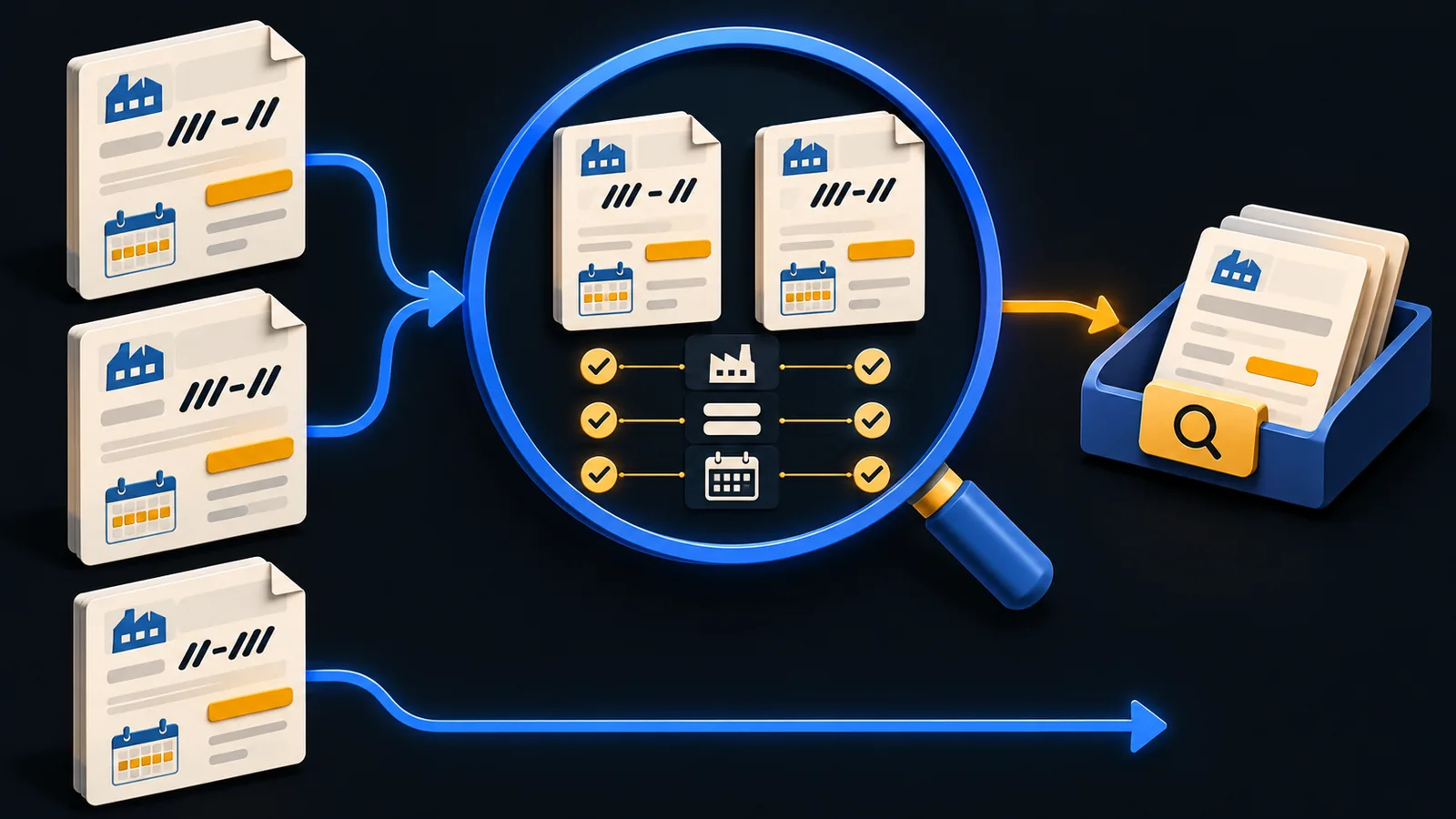
An invoice number is a clue, not the whole identity
INV-1042, inv 1042 and INV/1042 may be three captured forms of the same source identifier. A strict string comparison can miss that relationship. Conversely, two invoices for CAD 505 can represent separate months of an agreed recurring service. Matching on amount alone would produce an inappropriate duplicate flag.
Oracle's Payables documentation describes how supplier-name differences or identifier case can allow repeated entries despite an exact supplier-and-number check. That establishes a known limitation of exact matching, not a promise that any particular current product is vulnerable in the same way. Inspect the actual controls and source data in your own system.
Duplicate review belongs inside a broader invoice processing workflow. Its specific question is whether two records may represent the same billed obligation. A confirmed document relationship still does not tell you whether a payable was approved, posted, settled or reversed.
Worked example: different numbers for the same billed work
Record A uses SUP-071, CAD 505.00, INV-1042, work reference WO-701 and service period 2026-10. Record B has the same verified supplier, currency, amount, work reference and period, but uses INV-2099. The different number prevents an exact invoice-number match. The agreement across the billed-work evidence still makes the pair worth reviewing.
The expected outcome is candidate review. An AP reviewer needs the original sources and context: was B a reissued invoice, another bill for the same completed work, a legitimate installment, or an identifier copied incorrectly? The tool does not have the supplier's records or the ledger and cannot settle that question.
Choose D2 in the comparison tool, then change B's service period to 2026-11. The example routes records with different verified periods to separate-obligation checks. That route assumes the fields have already been verified. Typing a new period into a tool is not evidence that the underlying invoice belongs to that period.
| Field | Record A | Record B | Meaning |
|---|---|---|---|
| Supplier | SUP-071 | SUP-071 | Same verified identity |
| Currency / amount | CAD 505.00 | CAD 505.00 | Comparable scope and value |
| Invoice number | INV-1042 | INV-2099 | Different identifiers |
| Work reference | WO-701 | WO-701 | Same supplied obligation context |
| Service period | 2026-10 | 2026-10 | Same supplied period |
| Result | Inspect source | Inspect source | Duplicate candidate; not a confirmed duplicate |
Download the worked example
Adapt these working structures to your process. They are examples, with no claimed client results or production accuracy measurements.
Normalize formatting without erasing meaningful differences
The example tool uppercases identifiers and removes spaces, hyphens, slashes and full stops. It deliberately preserves letters and leading zeroes. The original identifier is always visible beside the normalized comparison value. This is an inspectable example policy, not a universal invoice-number standard.
Do not automatically remove every prefix or turn the letter O into zero across all suppliers. Some supplier numbering schemes use those distinctions. Build supplier-specific mappings only from verified evidence and retain a route for ambiguous cases. A normalization rule that finds more matches can also create more false positives.
Scope the comparison by verified supplier and currency. Supplier display names are not stable identity keys, and the same number can be reused by different vendors. If a supplier has duplicate master records, resolve the relationship through the authorized master-data process rather than letting the invoice comparison silently merge them.
Protect recurring charges, credits and legitimate revisions
Recurring charges need a service-period or milestone reference. A monthly amount may remain constant for years while representing separate obligations. Distinguish the billing period from the upload date: a late October invoice uploaded in November is not automatically a November service charge.
A credit note can reuse much of an invoice's context and amount. The tool routes any pair containing a credit or adjustment to related-document review. It uses a positive magnitude for comparison and keeps document type separate; it does not calculate the account balance or decide how a credit should be applied.
A revised invoice also needs its own route. Preserve the supersession reference and establish whether the earlier version was already posted or paid. Different amounts under a similar identifier should trigger investigation, not an automatic choice of the newest upload or lowest total. The correction process must account for the earlier business state.
| Case | Distinction | Expected route |
|---|---|---|
| D1 | Number formatting differs | Candidate review |
| D2 | Different number; same work, period and value | Candidate review |
| D3 | Different verified recurring period | Separate-obligation checks |
| D4 | Credit or adjustment | Related-document review |
| D5 | Currency differs | Scope review |
| D6 | Supplier identity missing | Insufficient evidence |
| D7 | Same stable source delivered twice | Repeated source event |
| D8 | Supersession reference supplied | Revision review |
Separate repeated source delivery from duplicate billing
The same email or webhook can be delivered twice without the supplier issuing a second invoice. A stable source-event identifier lets the intake system recognize that replay and look up the record already created. That is different from two separate emails carrying two invoices that may represent the same work.
D7 demonstrates a repeated source with matching supplied business fields. If the same source identifier contains conflicting fields, the checker holds the comparison instead. That conflict could indicate an extraction error, reused identifier or changed payload; it should not be silently accepted as the harmless replay of a known event.
For the relationship between authorization, completed work and billing, use property work-order invoice matching. It shows why matching an invoice identity cannot substitute for checking whether the underlying work and charges are supported.
Give the reviewer enough evidence to decide
A useful candidate queue includes both original documents, supplier identities, original and normalized identifiers, currency, amounts, work references, service periods, document types, revision links and source-event identities. Show which facts are verified and which are missing. State the rule that nominated the pair and the next decision required.
Record the review outcome with an owner and reason: confirmed same obligation, legitimate separate billing, related adjustment, replacement awaiting reconciliation or insufficient evidence. Keep any resulting cancellation or accounting correction within the authorized process. A candidate match should never become an unreviewable deletion instruction.
The wider document data validation guide covers arithmetic, required fields and authoritative source checks. Keep those controls independent: a nonduplicate invoice can still be incorrect, and a high extraction-confidence value cannot resolve duplicate billing.
Use models for candidate evidence, not an unsupported duplicate verdict
Technology references checked November 2, 2026: current OpenAI candidates include GPT-6.1 Sol and GPT-6 Astra. They can be evaluated for extracting fields or explaining differences in mixed document packages. Use deterministic normalization and amount comparisons for the fixed rules, with controlled supplier and obligation references from the operating systems.
The checker on this page makes no model or external-system calls. Its eight cases demonstrate rule behaviour, not production accuracy. A model comparison needs representative permissioned documents, independently labelled relationships and evaluation of false positives as well as missed candidates. Keep the expected labels independent of the output being tested.
Measure reviewer minutes per candidate, incorrect candidate flags, confirmed duplicate obligations, unresolved evidence and integration replays separately. Do not translate every flagged amount into claimed cash savings. A duplicate-looking invoice may never have been paid, and a prevented repeat source event is not necessarily a prevented second payment.
If documents arrive through several channels and require controlled matching before system updates, OpSmith's document processing automation work can connect capture, validation, reviewer decisions and verified destination records.
Frequently asked questions
Does the same invoice number always mean a duplicate?
No. Check the verified supplier, currency, source document, billed work, service period and any correction history. Identifier collisions and revisions need review. The checker nominates a candidate and does not establish payment status.
Can the checker find duplicates in my accounting ledger?
No. It compares only the two records shown on this page using fixed example rules. It does not upload files, query a ledger, perform OCR or call AI. Its result is a review route, not a verified accounting conclusion.
What if invoice numbers have different prefixes or leading zeroes?
The example normalizer preserves letters and leading zeroes. If verified work, period and value still agree, the pair can enter candidate review. Supplier-specific normalization should be based on the actual numbering scheme rather than globally removing meaningful characters.
Can a recurring invoice have the same amount as last month?
Yes. Equal amounts can represent separate service periods. Verify the period and obligation reference from source evidence and preserve both for normal validation when they differ. Do not infer the service period from the upload date.
Sources and further guidance
These official references provide relevant technical, privacy, risk-management or accountability guidance. OpSmith applies the useful principles to the operation of one business workflow.
- Exact-match limitations and duplicate invoice reviewOracle Payables documentation; legacy product reference
- Current model catalogOpenAI