
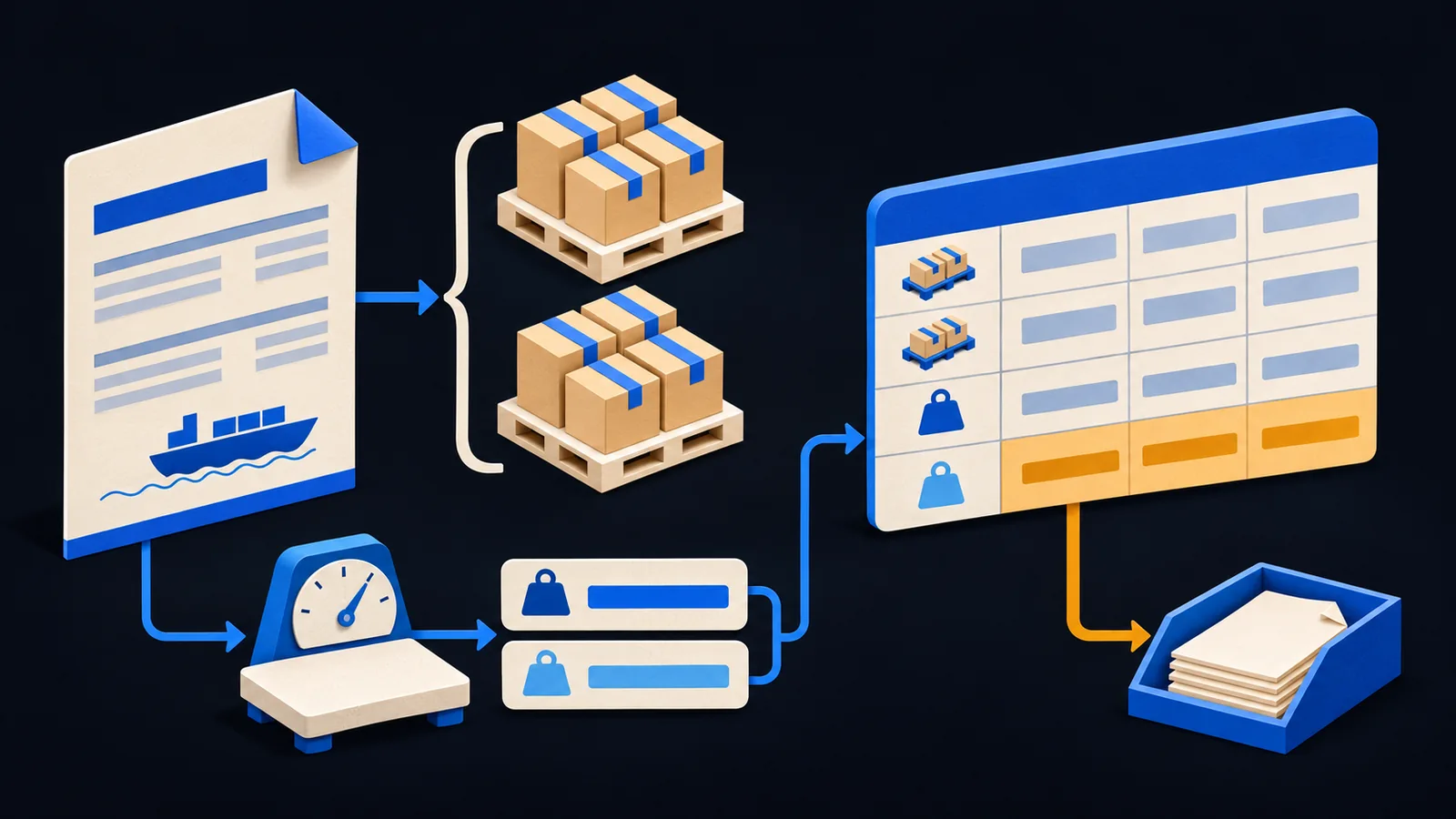
- An extracted number needs its meaning: outer pallets, contained cartons, gross weight and net weight cannot be flattened into interchangeable values.
- The worked source states two pallets containing 48 cartons, with 1,420 KG gross weight. A 98%-confidence proposal still combines the package levels and misreads the weight.
- Use the field register and seven exception cases to test source interpretation, identity and version handling separately from OCR performance.
Start with the transport decision the record will support
A bill of lading can contain several parties, document references, packaging descriptions and weight measures. Copying them into a generic shipment object can erase important distinctions. Define which fields your process needs, what each means and which source establishes it before selecting an extractor or connecting a write action.
Keep the bill-of-lading identifier distinct from a booking, order, container, house document or another reference. A matching-looking number is not enough to join records. Confirm the document type and the context your operation uses. Preserve the original party names and identifiers beside any proposed standardized value.
Place this interpretation step inside a controlled document processing workflow. The output is a reviewable field package, not proof of document authenticity, legal validity, customs sufficiency or permission to release cargo.
Worked example: two pallets containing 48 cartons are not 50 equivalent packages
BOL-1001-v1 states: 'Packages: 2 PLT containing 48 CTN. Gross weight: 1,420 KG. Net weight: 1,280 KG.' The example declares the comma a thousands separator. Booking BK-1001 and consignee SITE-EAST-02 provide the operating context. The download contains a text excerpt, not an image or a measured OCR result.
The proposed extraction reports 50 generic packages by adding the outer pallets to the contained cartons. It also reports 142,000 KG gross weight instead of the printed 1,420 KG. Its supplied confidence is 98%, but confidence cannot cancel those interpretation errors. The next action is source review, not an automatic replacement with a planned shipment value.
The source supports a 140 KG difference between gross and net. That arithmetic alone does not establish an independently certified tare weight or its components. Keep a calculated difference separate from a field explicitly declared by an authoritative source.
| Field | Source | Proposed extraction | Expected handling |
|---|---|---|---|
| Outer packages | 2 PLT | 50 packages after adding levels | Retain 2 PLT as the outer level |
| Contained packages | 48 CTN within the pallets | Combined into one count | Retain 48 CTN as contained packaging |
| Gross weight | 1,420 KG | 142,000 KG | Review source parsing; candidate 1,420 KG |
| Net weight | 1,280 KG | 1,280 KG | Preserve separate measure and unit |
| Gross minus net | Independent calculation | Not a declared source field | 140 KG difference; no certified-tare claim |
| Overall result | Two material interpretation failures | 98% supplied confidence | Source interpretation review |
Download the worked example
- Source excerpt, proposed fields and expected interpretation
- Completed source-aware field register
- Seven unit, identity and version tests
- Complete three-example reference pack with local check script (ZIP)
- Reference-pack instructions and limits
Adapt these working structures to your process. They are examples, with no claimed client results or production accuracy measurements.
Give every extracted value a type, unit and source
For each field, retain its source text, normalized candidate, unit, packaging or business level, document version and evidence reference. A reviewer should be able to locate the printed value that produced an exception. A high-level explanation such as 'quantity mismatch' is not enough when the real problem is comparing pallets with cartons.
Define how your process handles decimal and thousands separators. Do not apply the example's comma rule to every document or locale. When the format is ambiguous, retain the original string and route the interpretation. A number that parses successfully can still have the wrong magnitude or meaning.
Keep missing, unreadable and conflicting distinct. An unreadable weight is not zero. A booking's planned weight is not the weight extracted from an inaccessible document. If an authorized reviewer uses another source, record that substitution explicitly instead of presenting it as something the extractor read.
- Classify and identifyConfirm source document type, version and references before joining transport records.
- Extract with evidenceKeep original strings, candidate values, source locations and unresolved fields.
- Interpret structureSeparate packaging hierarchy, gross/net measures and explicit unit conversions.
- Validate contextCompare identity and selected fields with the applicable booking or operating source.
- Review and verifyResolve material exceptions under the actual policy; verify an authorized destination update.
Compare the right document version with the right movement
Before comparing quantities, check booking and party context. A wrong-consignee document can have the same weight and package count as the intended movement. Conversely, spelling variations may need a verified identity mapping rather than a new consignee record. An extraction model should propose candidates, not merge party identities by similarity.
A later upload is not automatically the effective amendment. Store the document's lifecycle state and the evidence establishing which version applies. An old copy resent today should not overwrite the current approved source because its upload timestamp is newer.
DCSA's implementation guidance treats booking and bill-of-lading information as structured exchanges with explicit document processes. Use the relevant current standard and operating requirements when designing a real integration. This small reference packet does not claim DCSA conformance or implement transport-document issuance, amendment or surrender.
Do not treat extracted shipment fields as proof of receipt
Extracting a shipment's described quantity is a different task from establishing what a receiver evidenced. Preserve the document's role. Do not let a clean bill-of-lading field package silently complete a delivery-receipt or invoice-review gate that requires additional sources.
The proof of delivery invoice matching example follows that later decision. It separates 100 units physically received, 96 accepted and four held, while independently reviewing freight-charge support.
This separation also helps evaluation. A correct extraction can feed an unresolved business decision. Count field correctness and the resulting review route independently, so a valid hold does not look like a failed extraction or an accurate field like an authorized release.
Test units and meaning alongside the model's ability to read
Technology references checked November 2, 2026: current model candidates such as GPT-6.1 Sol and GPT-6 Astra can be evaluated on permissioned transport documents. Use actual document formats, scans and amendments with independently labelled source fields before comparing accuracy, reviewer effort, latency and cost. The supplied text case does not measure those models.
Test at least the seven downloadable exceptions: mixed packaging levels, magnitude errors, wrong consignee, unreadable weight, superseded source, repeated source delivery and explicit unit conversion. Score unsupported field completion and incorrect state changes, not only the percentage of populated boxes.
The wider document data validation guide explains how required fields, source comparisons and calculations work together. Keep the checks that authorize a system update outside a generated confidence score.
Make the exception useful to the transport coordinator
A practical review packet contains the source version, affected booking, source strings, proposed values, failed rule and next decision. Assign an owner who can obtain source clarification or confirm an authorized mapping. If a lookup is unavailable, name the recovery task instead of labelling the document wrong.
When an authorized destination update times out, reconcile the stable transport record before retrying. Keep source delivery identity separate from the shipment identity so a replay does not become a second movement. Monitor field correction minutes, unresolved exception age and uncertain updates as separate operating measures.
OpSmith's logistics automation work can connect transport-document intake, validation and accountable review around the existing systems. Start with one document type and the exception cases the team actually needs to resolve.
Carry validated references into shipment-event intake
The carrier status update automation guide uses shipment and source references to prepare operational event fields. A bill-of-lading reference can support matching, but it does not prove that a later pickup, arrival or delivery occurred. The full shipment exception management workflow connects those events with accountable review.
Frequently asked questions
Should pallet and carton counts be added together?
Not when one describes outer packaging containing the other. Preserve the source's hierarchy and units, then map the quantity required by the receiving process. BOL-1001 describes two pallets containing 48 cartons, not 50 equivalent packages.
Can we fill an unreadable field from the booking record?
Only through an explicit, authorized source-substitution process. Keep the original extraction state unknown and record which operating source supplied the replacement. Do not represent the substituted value as something read from the document.
Does a high extraction-confidence score clear a mismatch?
No. Source fidelity, units, identity, current version and applicable operating rules still need their own checks. The worked case supplies 98% confidence while retaining two material interpretation errors.
Does this example validate a legal bill of lading?
No. It tests structured-field interpretation and review boundaries using a text excerpt. It does not establish authenticity, legal effect, cargo release authority, customs sufficiency or performance on real scanned documents.
Sources and further guidance
These official references provide relevant technical, privacy, risk-management or accountability guidance. OpSmith applies the useful principles to the operation of one business workflow.