
- No purchase-order reference does not automatically establish a valid non-PO route; classification depends on the available evidence and actual policy.
- In the worked case, CAD 1,650 includes an unsupported CAD 150 training line and exceeds the manager's example authority. Service confirmation clears neither issue.
- Use the completed evidence register and seven test cases to rehearse unavailable sources, absent approvers, corrected invoices and uncertain writes.
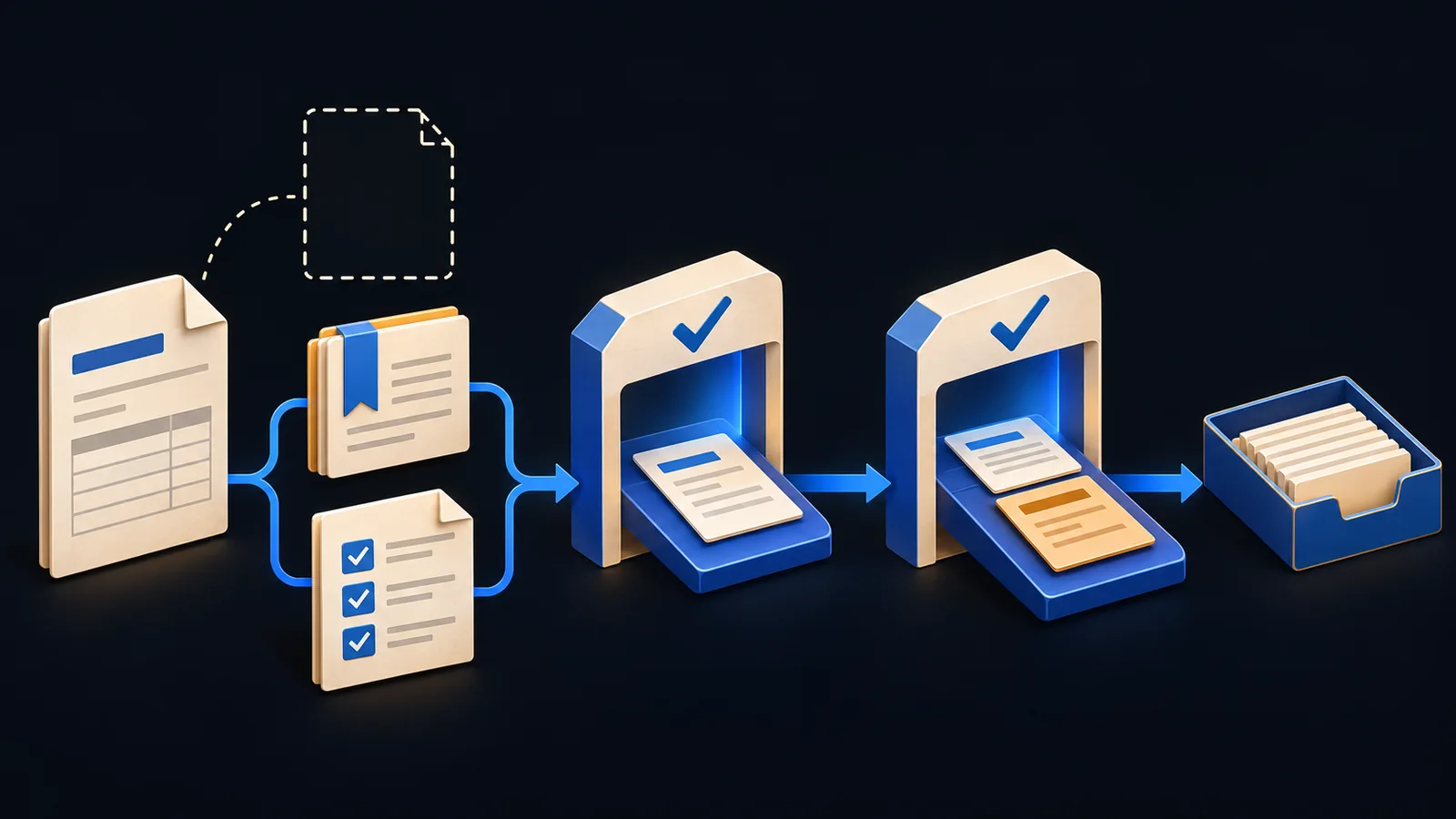
Separate no PO, missing reference and unavailable lookup
An invoice without a printed PO number can represent several situations. A matching order may exist under another verified reference. The supplier may have omitted the reference. The organization's policy may permit an agreement-backed service invoice without a PO. Or the lookup may simply be unavailable. Those situations need different next actions.
Capture the lookup result and the policy basis before selecting the workflow. A failed query is not a confirmed absence of an order. A genuine no-match result is not, by itself, permission to bypass procurement or approve the expense. Route unclear classification to the responsible owner rather than inventing a placeholder PO to satisfy a required field.
This is the alternate evidence-and-authority route within the complete invoice processing workflow. The organization's actual agreement, accounting requirements and authorization policy govern production; the example below is not a universal financial rule.
Worked example: CAD 1,650 of billing, two unresolved review gates
N-1201 v1 is a supplier invoice for CAD 1,500 monthly support plus CAD 150 training, before applicable tax. The example lookup completes, finds no matching PO and locates AGR-1201-v1. The configured category permits a non-PO route. The agreement covers the recurring support amount but does not include training, and the supplied service record does not confirm that extra work.
The example policy separates service confirmation, coding and approval. Manager B can approve up to CAD 1,500 on the declared net-before-tax basis; the invoice is CAD 1,650. Director C has the required amount authority but is unavailable, with no authorized fallback recorded. The result therefore retains both extra-scope review and an approver-coverage hold.
The workflow must not silently approve CAD 1,500, deduct CAD 150, split the invoice to evade the threshold or treat the requester's service confirmation as final approval. Those would change the business decision rather than merely prepare it. The worked example supplies no approval, posting or payment authorization.
| Gate | Worked evidence | Result |
|---|---|---|
| PO classification | Lookup available; no match; category permitted | Use configured alternate evidence route |
| Recurring support | AGR-1201-v1 supports 1,500 | Agreement context available for review |
| Training | 150 not included; completion evidence absent | Extra scope needs support and authority |
| Invoice total | 1,500 + 150 = 1,650 | Arithmetic agrees; business gates remain open |
| Manager authority | Example limit 1,500 | Insufficient for this 1,650 invoice |
| Required approver | Director limit 2,500; unavailable; no fallback | Hold and obtain authorized coverage |
| Coding | IT / GL 7200 proposed | Review against the actual controlled coding rules |
Download the worked example
- Invoice, agreement, service evidence and example policy
- Completed non-PO evidence and owner register
- Seven classification, authority and recovery tests
- Complete three-example reference pack with local check script (ZIP)
- Reference-pack instructions and limits
Adapt these working structures to your process. They are examples, with no claimed client results or production accuracy measurements.
Make the alternate evidence package explicit
List what establishes the supplier identity, obligation, service period, scope, receipt or completion, coding and required decision. Depending on the actual process, that might involve an agreement, authorized request, service-owner confirmation or another approved source. Do not describe a generic attachment bundle as sufficient for every invoice type.
In N-1201, the service owner can confirm October support while the training line remains unresolved. Present the supported recurring scope beside the unexplained line and its source. The reviewer should not need to rediscover why a plausible supplier invoice still needs a question answered.
Retain unavailable evidence as unavailable. An inaccessible agreement does not mean the supplier has no agreement, and a missing completion entry does not prove the service never happened. Assign the collection or clarification task and record the answer before changing the invoice's decision state.
- Classify the routeConfirm the lookup state and the actual policy basis for non-PO processing.
- Prepare the evidenceLink supplier, obligation, period, scope and service evidence to the invoice version.
- Review coding and scopeResolve unsupported charges and proposed coding through the designated owners.
- Check amount authorityUse the actual approval basis, currency and authorized coverage; preserve holds.
- Record and verifyBind the decision to the current invoice and reconcile any approved destination update.
A service confirmer, budget owner and approver need not be the same person
Name the role and decision each action represents. Someone who knows the service occurred may not have authority for the billed amount. A budget owner may need another reviewer for the expense category or exception. The system should not collapse these events into one approved flag just because the same person sometimes performs several roles.
Use the amount basis and currency actually defined by the organization's policy. N-1201 uses net before tax only to make the example's calculation reproducible. A real process may use another basis or require additional authority. Document the rule rather than assuming the model or connector's default total is the right comparison.
When an approver is absent, use an authorized delegation or retain the hold with an escalation owner. Do not let the system choose anyone with a similar job title, allow self-approval contrary to policy or mark a notification delivered as an approval. The coverage decision is part of the control being implemented.
Recheck a corrected invoice instead of carrying an ambiguous approval forward
Suppose the supplier replaces N-1201 v1 with a CAD 1,500 version after resolving the training question. Preserve the replacement relationship and re-evaluate scope, coding, prior posting and the applicable authority for that version. The revised amount may change the required route, but a previous service confirmation should not silently become approval of another document.
Check whether the earlier invoice was already created, posted or otherwise acted upon before selecting a correction path. A new attachment may be a revision, another receipt of the same invoice or a separate obligation. Its upload date alone does not settle that relationship.
Use the duplicate invoice detection guide to compare differently numbered records, revisions and recurring periods. A valid non-PO route still needs the normal identity and duplicate controls.
Treat generated coding and summaries as candidates
The example's IT department and GL 7200 are proposed fields, not recommended ledger codes. Compare coding against the organization's controlled definitions, relevant agreement and authorized rules. A model can prepare a suggestion and cite the source, but its plausible label does not establish the correct accounting treatment.
Technology references checked November 2, 2026: AccountsIQ documents separate non-PO approval configuration. Microsoft Dynamics 365 distinguishes vendor-invoice policy checks from invoice-matching validation. These are product-specific mechanisms to inspect, not evidence that a selected connector already implements your required controls.
Current models such as GPT-6.1 Sol and GPT-6 Astra can be evaluated for extraction, scope summaries and reviewer explanations. Keep classification, amount rules, permissions and version checks explicit. Compare unsupported suggestions, missing exceptions and correction effort with representative permissioned inputs; no production model benchmark is supplied here.
Keep the posting result separate from the approval decision
After a valid decision under the actual policy, an integration may prepare or update the permitted destination record. Confirm the destination identity and business state before closing the item. An approved source invoice and a successful-looking automation run do not independently prove that the intended record exists once and correctly.
If an acknowledgement is lost, use an owned workflow exception handling route to query and reconcile the destination before retrying. Recovery must use the current authorized invoice basis and preserve the original history.
Run the seven downloadable tests before allowing live posting: unavailable PO lookup, service confirmation without approval, missing coverage, corrected amount, proposed coding and uncertain writes all need inspectable outcomes. Measure queue age by reason, reviewer corrections, unresolved scope and duplicate destination attempts, rather than claiming every captured invoice is automated end to end.
OpSmith's document processing automation work can connect source collection, validation and controlled review around your existing finance system. Start with one permitted non-PO category and the people responsible for its evidence and authority.
Frequently asked questions
Does no PO number mean an invoice should be rejected?
Not as a universal rule. Determine whether a matching order exists, whether the lookup completed and whether the actual policy permits another evidence route. Classification and approval should follow the organization's authorized process rather than a missing printed field alone.
Can the requester approve after confirming the service?
Only if the actual authorization policy permits that role and action. N-1201 explicitly separates service confirmation from amount authority and does not allow requester self-approval. Do not generalize its thresholds to another organization.
Can automation approve the agreement-backed part and ignore the extra charge?
Not under this worked example. Keep the invoice and disputed scope intact for the authorized decision or supplier correction process. Do not silently deduct, split or approve part of a record to make it fit a threshold.
What happens when the required approver is unavailable?
Use an authorized fallback or retain an owned hold and escalate for coverage. An absent approver does not authorize bypassing the control or treating another person's acknowledgement as the required decision.
Sources and further guidance
These official references provide relevant technical, privacy, risk-management or accountability guidance. OpSmith applies the useful principles to the operation of one business workflow.
- Non-PO and purchase-document approval workflow configurationAccountsIQ product documentation
- Vendor-invoice policies and their relationship to matchingMicrosoft Learn
- Current model catalogOpenAI