
- Collect only the facts needed for the next useful decision, and retain the source of each fact.
- Separate fit, urgency and readiness; a good-fit lead may not be ready to buy today.
- Use clear dispositions: ready for a conversation, clarify, revisit with permission, redirect or close with a reason.
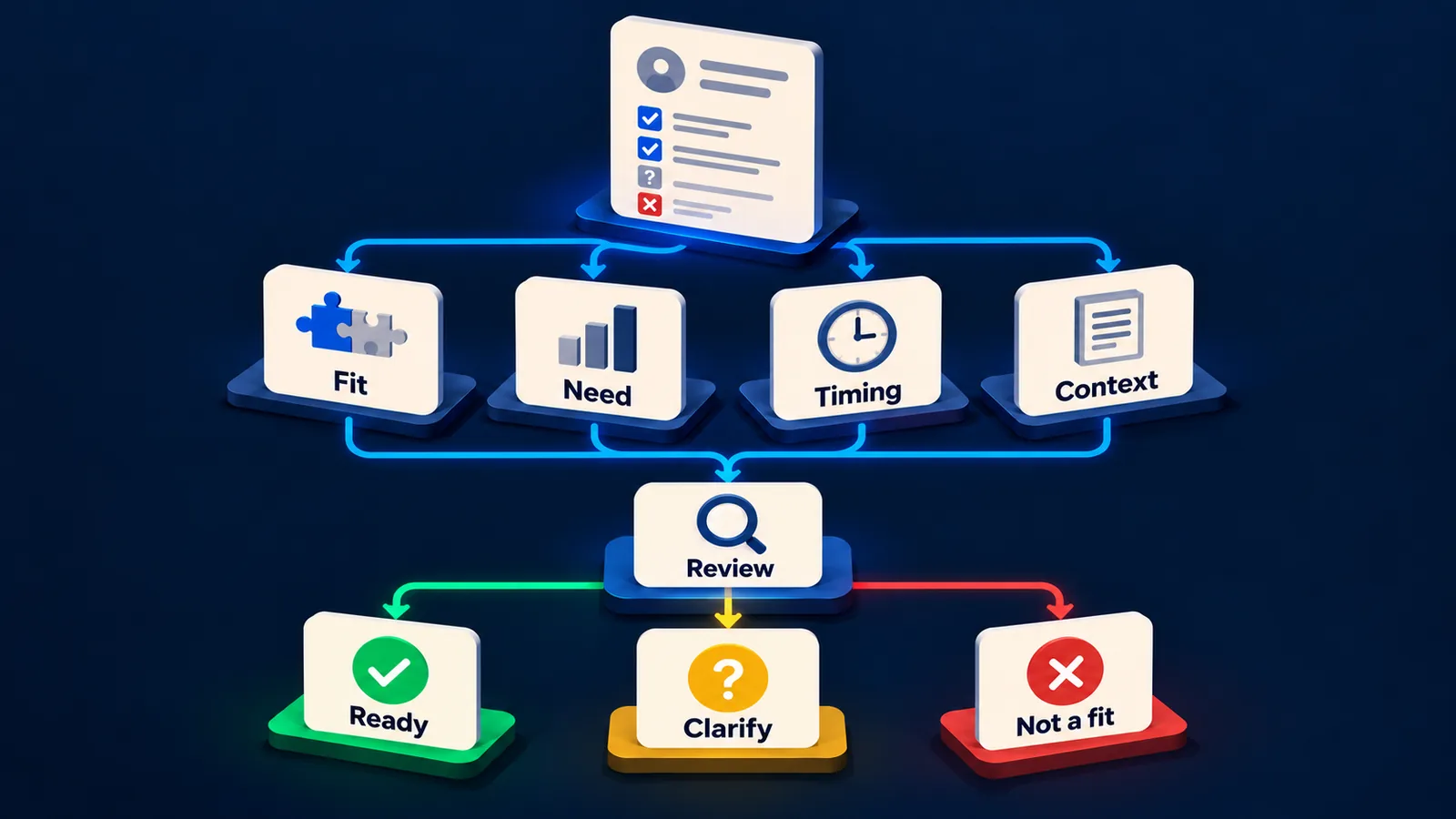
Qualification example: an unknown budget is a question, not a rejection
L-401 asks about automating maintenance-email triage for two buildings. The inquiry explicitly establishes an operational problem and a limited description of scale. It does not establish budget, purchasing authority, implementation timing or systems access. The appropriate example outcome is a discovery conversation, not a fixed proposal and not automatic disqualification.
Qualification is evidence for a next decision. A discovery step may need only a relevant problem and an appropriate contact. A priced implementation proposal requires a clearer workflow boundary, data access, affected systems, acceptance criteria and commercial context. Applying proposal-level requirements to the first conversation can discard relevant inquiries without learning whether a useful project exists.
Worked example. The supplied records and decisions are inspectable reference material, with no claimed customer results or measured model performance.
| Question | Evidence status | Next useful action |
|---|---|---|
| Relevant operational problem? | Known: maintenance-email triage takes hours | Discuss the current process |
| Scale? | Known: two buildings; volume unknown | Ask about typical inquiry volume |
| Budget? | Unknown | Discuss constraints at the appropriate stage |
| Decision roles? | Unknown | Identify affected owner and approver |
| Systems and access? | Unknown | Confirm before solution design |
| Next decision | Discovery supported | Avoid promising scope, price or results |
Download the working files
Use the completed example and templates alongside this guide. Files open directly with no signup.
- Reusable qualification evidence template
- Raw inquiries and expected next steps
- Reference-library instructions and example limits
- Complete reference library with local check script (ZIP) — extract the files before running the optional check.
1. Define what qualification is deciding
Choose the decision before designing questions. For an inbound service inquiry, the next step might be a discovery call, site visit, quote preparation, technical review or referral elsewhere. Each requires different evidence.
A general lead score can help prioritize work, but it should not replace the reason for the decision. Keep the underlying facts visible so a reviewer can explain why an inquiry progressed, paused or closed.
Place qualification inside the wider lead management workflow. A complete questionnaire still needs an owner, response and next action.
2. Use six evidence checks
For each check, record the fact, where it came from, whether it is verified or inferred, and whether it is required for the immediate next step. The questions below are a planning framework; adapt them to your actual services and buying process.
Service and geographic fit
Is the requested work within the services, locations and customer types you can support? What specific fact establishes fit or exclusion?
Problem and desired outcome
What does the customer need changed, delivered or resolved? Preserve their wording and distinguish it from your interpretation.
Scope and inputs
What quantities, systems, sites, documents or constraints are necessary to decide the next action? Which remain unknown?
Timing and urgency
Is there a required date, an external dependency or an immediate issue? Record whether the date is confirmed or provisional.
Decision context
Who is participating, what approval is needed and what commercial expectations are known? Ask budget or authority questions only when relevant to the next decision.
Contact and next step
Which channel and purpose are permitted, what was promised, and who owns the next dated action?
3. Separate missing facts from failed fit
Use at least three evidence states: confirmed, unknown and conflicting. A missing budget is not a confirmed lack of budget. An inferred service category is not a customer-stated requirement. Preserve uncertainty instead of filling mandatory CRM fields with guesses.
Write explicit exclusion rules sparingly. A verified request for a service you do not offer may justify redirection. An incomplete description often justifies one focused question. Conflicting information should reach a person with both sources attached.
Ready
The facts required for the next step are sufficient and the receiving owner can act.
Clarify
A specific missing or conflicting fact blocks the next decision; a named owner asks for it.
Revisit
Fit exists but timing is later; record a reason, permitted contact basis and review date.
Redirect or close
The reason is supported by evidence, recorded and communicated appropriately.
Worked example: a suitable inquiry with unknown budget
Worked example: a property operator asks about automating maintenance-request intake. They identify two buildings and describe repeated email triage. They do not name a budget or say who approves spending.
Service fit and need are supported by the inquiry. Budget and approval context remain unknown. If the next step is a short discovery call, a sensible disposition is ready for conversation with those open questions attached. If the next step is a fixed-price proposal, the same evidence may be insufficient for that more consequential action.
The qualification record should therefore say what is known, what is open and what the owner will do next. It should not fabricate a budget, label the contact a decision-maker or disqualify them solely for leaving a field blank. This is an example operating decision, not a client outcome.
4. Let AI prepare evidence and focused questions
AI can extract facts from the request, classify likely service intent, highlight omissions and draft a concise clarification. Ask it to return source excerpts or references, an uncertainty state and a suggested next action in a defined format.
Keep deterministic exclusions and business rules explicit. Use human review for ambiguous fit, sensitive information, unusual commitments and cases where a wrong classification could discard valuable work. Evaluate AI suggestions against a labelled sample of representative inquiries before widening the scope.
Use human-in-the-loop automation to place review where judgment matters. OpSmith's lead follow-up automation service can connect qualification evidence to clarification, booking and an owned next step.
5. Hand over the decision and its limits
The receiver needs the original request, qualification result, supporting facts, open questions and customer promise. Include the reason a next step is appropriate rather than forwarding a score alone.
Apply the sales lead handoff checklist before marking the transfer complete. If the customer is ready for pricing, continue into the quote request intake process for the scope and commercial inputs that pricing actually requires.
6. Review qualification quality and unnecessary friction
Track clarification rounds, time waiting for missing information, receiver rejection reasons and manual overrides. Sample closed or disqualified inquiries to look for false exclusions and unsupported AI inferences.
Remove questions that do not change the next decision. Add a question when repeated downstream rework proves it is needed earlier. Review readiness by inquiry type rather than imposing a single enterprise buying framework on every customer.
Keep contact details and business context limited to the approved purpose. Store sensitive material only when needed, restrict access and define retention with the people responsible for your privacy practices.
Separate facts, interpretations and the action threshold
Store the customer's wording beside each material qualification fact. If AI interprets 'spend hours' as a costly recurring problem, retain that as an interpretation until the volume and effort are established. Do not manufacture an ROI estimate from a phrase that has no measurement period or count.
Choose the smallest question set that changes the next decision. For this inquiry, asking how requests arrive, who triages them and where the work stalls is more useful than requiring a precise technology specification. Later questions can establish access, privacy constraints and financial feasibility before a commitment.
Allow explicit not-a-fit and redirect outcomes, but tie them to an actual offer boundary. L-402's physical repair request is outside the example service; L-401's unknown budget is uncertainty within a potentially relevant need. Keep those reasons distinct so the business can review its routing and qualification policy.
Try it with your own process
Fill the qualification template from L-401 using only the raw message. Mark unknown fields explicitly, propose three discovery questions and identify which decision each question informs. Compare the result with L-402 and L-403. A good checklist should lead to different next steps because the evidence differs, not because one message contains more confident language.
Example instruction for an evidence-aware draft
Assess this inquiry against the supplied offer boundaries and next-decision policy. Return explicit facts with source wording, unknowns, interpretations marked as such, and the next useful question. Do not infer budget, authority or purchase intent. Recommend discovery, clarification, existing-owner review or an appropriate redirect with evidence; do not contact the person.
Acceptance checks for this example
- Unknown and inferred fields never become verified facts silently.
- The proposed action matches the current evidence threshold.
- A qualification reason is specific enough for a person to challenge.
Technology choices and what to test
Current language models can organize qualification evidence, but fluent reasoning is not evidence of a customer's budget or authority. Require quoted source support for facts and evaluate cases with deliberately missing information.
Use model-assisted qualification as a reviewable recommendation under a documented policy. Monitor incorrect rejections, unnecessary questions and misrouted existing customers alongside speed. Re-test the labelled cases when the model, prompt or offer changes.
Technology references checked October 28, 2026. Model availability and platform behavior can change; confirm the current documentation before implementation.
Compare candidates on a labelled sample from the intended workflow: correctness, preserved unknowns, unsafe proposed actions, reviewer effort, latency and cost. Keep expected outcomes separate from generated answers. Record model identifier, settings, prompt, rules and connector version so a change can be tested against the same cases.
Frequently asked questions
Is BANT required for lead qualification?
No. Budget, authority, need and timing can provide useful context, but the right questions depend on the service and next decision. Do not reject an early inquiry simply because all four are not yet known.
Should unknown budget disqualify a lead?
Not automatically. Decide whether budget is necessary for the next step. Preserve it as unknown and ask when it will materially affect the conversation or proposed work.
How is qualification different from lead scoring?
Qualification determines whether evidence supports a next action. Scoring summarizes selected signals for prioritization. A score should remain traceable to its inputs and should not conceal missing facts.
How many qualification questions should a form ask?
Ask the minimum needed to acknowledge the request and select a useful next action. Move detailed discovery to a suitable conversation when asking everything upfront would create unnecessary friction.
Can AI reject leads without human review?
Use automatic rejection only for well-defined, validated rules within an approved scope. Ambiguous or inferred poor fit should reach a reviewer with evidence rather than silently closing the inquiry.
Sources and further guidance
These official references provide relevant technical, privacy, risk-management or accountability guidance. OpSmith applies the useful principles to the operation of one business workflow.
- Understand the Sales Qualification Agent conceptsMicrosoft Learn
- PIPEDA fair information principlesOffice of the Privacy Commissioner of Canada