
- Give every inquiry one traceable record, a current state, an accountable owner and a dated next action.
- Measure acknowledgement, owner acceptance and meaningful response separately; each answers a different operating question.
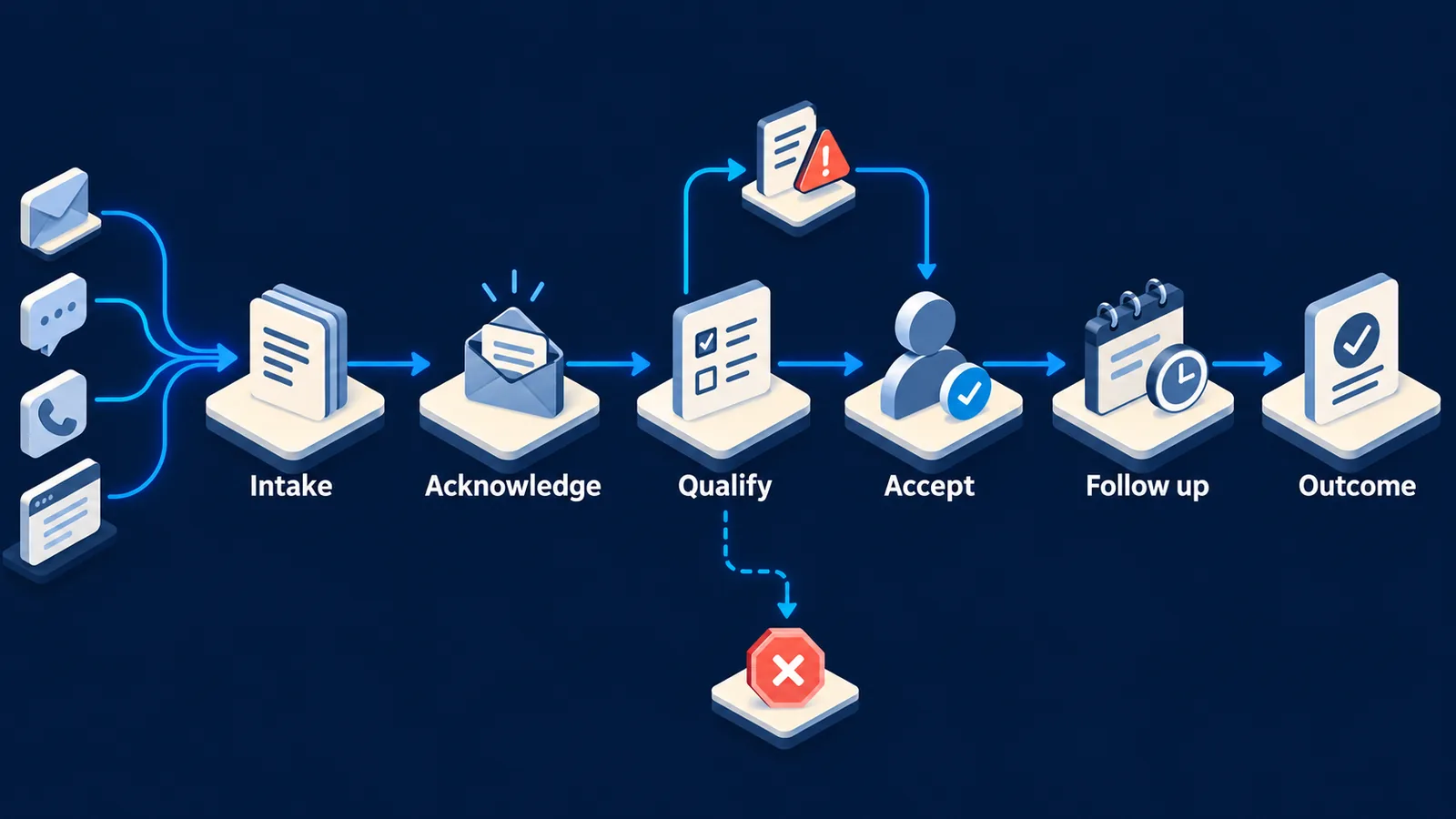
- Use evidence to qualify the next step, then stop scheduled outreach when a reply, booking, opt-out or human takeover changes the journey.
Four inquiries, four different next actions
A lead-management system should preserve the meaning of an inquiry instead of forcing every message into the same sales sequence. The downloadable example intake set contains a relevant automation question, a physical repair request, an existing proposal revision and a request to stop messages. The right outcome is different for each one.
L-401 describes time spent triaging maintenance emails for two buildings. That is enough to support a discovery conversation, even though budget and decision roles remain unknown. L-402 asks for a broken pump to be repaired today, which is outside the example automation offer. Treating it as a hot automation lead would produce a fast but unhelpful response.
L-403 belongs to an existing proposal and needs verified relationship matching before a revision. L-404 expresses a contact restriction that should suppress applicable outreach. These cases make a useful regression set because they test whether automation understands the next permitted action, not simply whether it can write a plausible reply.
Worked example. The supplied records and decisions are inspectable reference material, with no claimed customer results or measured model performance.
| Inquiry | Evidence | Next action |
|---|---|---|
| L-401: maintenance email triage | Relevant operational problem; budget unknown | Discovery conversation |
| L-402: physical pump repair | Different service need | Redirect to appropriate service |
| L-403: existing proposal revision | Existing relationship; quote match unverified | Match and route to current owner |
| L-404: stop messages | Explicit contact restriction | Suppress applicable outreach and retain event |
Download the working files
Use the completed example and templates alongside this guide. Files open directly with no signup.
- Four labelled raw inquiries
- Completed acceptance and return cases
- Response-clock example
- Reference-library instructions and example limits
- Complete reference library with local check script (ZIP) — extract the files before running the optional check.
1. Define the lead states and the evidence that moves them
Start with the journey your team can actually operate. A practical state model is received, acknowledged, awaiting clarification, ready for sales, accepted, active follow-up and closed with an outcome. A status should describe observable work rather than a salesperson's vague impression.
For each transition, write the trigger, required evidence, permitted action and next owner. A record can be assigned without being accepted, or acknowledged without receiving a useful answer. Keeping those distinctions prevents a completed automation run from concealing unfinished customer work.
Received
The original inquiry and received time are stored with a source identifier.
Qualified for a next step
Enough verified context exists to book, clarify, prepare a quote or route elsewhere.
Accepted
The receiving owner acknowledges responsibility and a specific next action.
Closed
The outcome and reason are recorded, and incompatible scheduled actions stop.
2. Capture one inquiry with its original context
Bring website forms, emails, phone notes, referrals and chat inquiries into a common record. Preserve the customer's actual request, source channel, received time, relevant attachments and any contact restrictions. Keep an existing customer relationship attached when it is verified.
Use the existing CRM data quality guide for record ownership and validation. The lead journey should consume reliable identity data rather than create a second customer database in a messaging platform.
Handle repeated submissions explicitly. The same person can ask about two different jobs; two messages about one job may be the same inquiry. Use the inquiry context and stable source identifiers before merging records or launching another follow-up sequence.
3. Acknowledge the inquiry and protect the response window
An acknowledgement can confirm receipt, restate the request and set an honest expectation. A meaningful response answers the question, asks a necessary clarification or proposes a relevant next action. Track those events separately so an instant receipt message does not disguise a delayed sales response.
Define a lead response time policy by channel, urgency and staffed hours. Include after-hours coverage and a fallback owner when the normal person is unavailable.
AI can help classify the inquiry and draft a reply from approved service information. It should flag ambiguity and avoid inventing availability, prices or commitments. A sensitive request, complaint or unusual commercial condition needs the right person with the source message attached.
4. Qualify the next action using evidence
Apply a lead qualification checklist that separates service fit, need, timing and decision context. Record whether each fact is stated by the customer, verified elsewhere or still unknown.
Do not make every inquiry complete a lengthy questionnaire before it receives help. Ask the smallest set of questions needed for the next useful decision. Unknown budget may call for a conversation; a confirmed request for a service you do not provide calls for a different disposition.
Use a review queue for unclear fit rather than quietly discarding low-scoring leads. A score can prioritize attention, but its inputs, thresholds and override reasons should remain explainable to the team.
5. Transfer context and confirm the handoff
Use the existing CRM lead routing workflow for assignment rules. Then apply a sales lead handoff checklist to verify that the selected owner has the request, qualification evidence, promises, next action and deadline.
Define acceptance as an explicit event. If the receiver cannot act, return the record with a reason and route it to an accountable fallback. Avoid two people contacting the customer while an ownership change is unresolved.
6. Follow up from the current customer state
Schedule a small, purposeful sequence around the customer's question and buying context. Recheck eligibility immediately before each send: current owner, valid contact channel, permitted purpose, latest reply, booking and outcome. A sequence scheduled yesterday may no longer be appropriate today.
Pause when a reply arrives, even if classification is still pending. Stop or branch on booking, opt-out, closure, an unresolved delivery result or human takeover. An uncertain send should be reconciled with the provider before it is retried.
After an approved quote is issued, the quote-specific journey belongs in how to automate quote follow-up. OpSmith's lead follow-up automation service connects inquiry handling, clarification, booking and continued contact across the wider journey.
For commercial electronic messages in Canada, assess the actual message and relationship against CRTC guidance on consent, identification and unsubscribe requirements, including relevant exceptions. Store the applicable contact basis and honour restrictions across connected tools.
Worked example: a service inquiry with incomplete scope
Worked example: a contractor receives a request for a multi-site maintenance proposal at 10:00 a.m. The workflow preserves the original email, checks for an existing account and acknowledges receipt. The service appears relevant, but the locations and required start date are unknown.
The lead enters awaiting clarification with a named owner. An AI draft asks only for the locations and desired start date, using the original request as context. Once the customer replies, the scheduled nudge pauses. The owner reviews fit, attaches the evidence and requests a specialist handoff with a proposed discovery call.
The specialist accepts the handoff and records the next action. If they reject it because one location is outside coverage, the inquiry returns with that reason instead of being marked lost automatically. This example demonstrates the workflow; it is not a client result or a promised response benchmark.
7. Measure the journey and test the failure paths
Measure unworked inquiries, meaningful response time, clarification backlog, acceptance time, overdue next actions and closed outcomes by source. Report medians alongside slower-tail measures and unresolved counts so fast cases cannot hide abandoned leads.
Before launch, test duplicate intake, an existing customer, missing contact details, an absent owner, a reply just before a scheduled send, booking through another channel and a provider timeout. Confirm the record state, next owner and permitted action after each event.
Use how to automate business reporting to build an operational view of the journey. Track conversion as a separate business outcome influenced by fit, offer, pricing and sales work as well as automation.
Use one traceable record across intake, ownership and outcome
Keep the original inquiry, received time, source, identity evidence and current action together. Classification should not erase the source text or turn an inferred fact into verified customer data. When an inquiry changes state, retain the event and reason so another owner can reconstruct what happened.
Separate acknowledgement from meaningful response and ownership acceptance. A receipt confirmation does not answer the customer's problem, and a CRM assignment does not establish that someone accepted the next action. Maintain an accountable queue until the receiving person or team accepts responsibility under the defined process.
Close the loop with outcomes that describe reality: discovery arranged, clarification pending, referred elsewhere, revision owned or contact suppressed. Track unresolved work alongside conversions. Otherwise, a dashboard can appear healthy because difficult inquiries were silently removed or marked complete after an automatic acknowledgement.
Try it with your own process
Run the four raw inquiries through your proposed workflow without showing the expected labels to the classifier. Compare its action, supporting evidence and unknown fields with the reference. Introduce a missing owner and an existing duplicate record. The system should preserve responsibility and stop conditions rather than compensate with another generic email.
Acceptance checks for this example
- Unknown budget does not automatically disqualify the discovery example.
- Out-of-scope needs receive the appropriate route.
- Existing relationships and contact restrictions override generic nurture.
Technology choices and what to test
Current models can classify free-text inquiries and draft context-aware responses. Evaluate GPT-6.1 Sol, Claude Sonnet 5.5 or Gemini 3.8 Flash on your actual offer boundaries and difficult historical examples; these names are candidates, not evidence of accuracy.
Keep customer identity, assignment permissions, suppression and message delivery in controlled systems. Structured output can require evidence and unknown fields, but the application still needs to validate the proposed action before it changes a record or contacts someone.
Technology references checked October 28, 2026. Model availability and platform behavior can change; confirm the current documentation before implementation.
Compare candidates on a labelled sample from the intended workflow: correctness, preserved unknowns, unsafe proposed actions, reviewer effort, latency and cost. Keep expected outcomes separate from generated answers. Record model identifier, settings, prompt, rules and connector version so a change can be tested against the same cases.
Measure business outcomes separately from technical attempts
The workflow automation monitoring checklist separates attempts, due outcomes, accepted ownership and evidence freshness. Apply those distinctions before claiming that a successful send or activity write proves a useful lead response.
Frequently asked questions
What is the difference between lead management and lead generation?
Lead generation attracts or captures potential interest. Lead management operates the journey after an inquiry exists: identity, response, qualification, ownership, next actions and outcomes.
Does a small business need separate lead and contact records?
Not necessarily. Use the CRM structure that fits the business, but distinguish the person's identity from each inquiry or opportunity so repeated requests do not overwrite context.
Can AI qualify inbound leads automatically?
AI can extract stated facts, classify intent and suggest a next step. Use approved criteria, retain evidence and route ambiguous or consequential decisions for human review.
When should a lead follow-up sequence stop?
Reassess it when the customer replies, books, opts out, reaches a terminal outcome or is taken over by a person. Pause uncertain cases until the current state is verified.
Which lead management task should be automated first?
Start with a bounded recurring problem such as missed intake, delayed acknowledgement, incomplete handoffs or overdue next actions. Establish a baseline and test the exception path before expanding.
Sources and further guidance
These official references provide relevant technical, privacy, risk-management or accountability guidance. OpSmith applies the useful principles to the operation of one business workflow.
- Unenroll contacts from a sequenceHubSpot Knowledge Base
- Frequently asked questions about Canada's Anti-Spam LegislationCRTC
- Understand the Sales Qualification Agent conceptsMicrosoft Learn