
- Transfer the original request, qualification evidence, open questions, customer promises and one dated next action.
- Record sent, accepted and acted-on states separately so an owner-field update cannot conceal a stalled lead.
- Give returns and unavailable owners an explicit fallback without creating competing customer outreach.
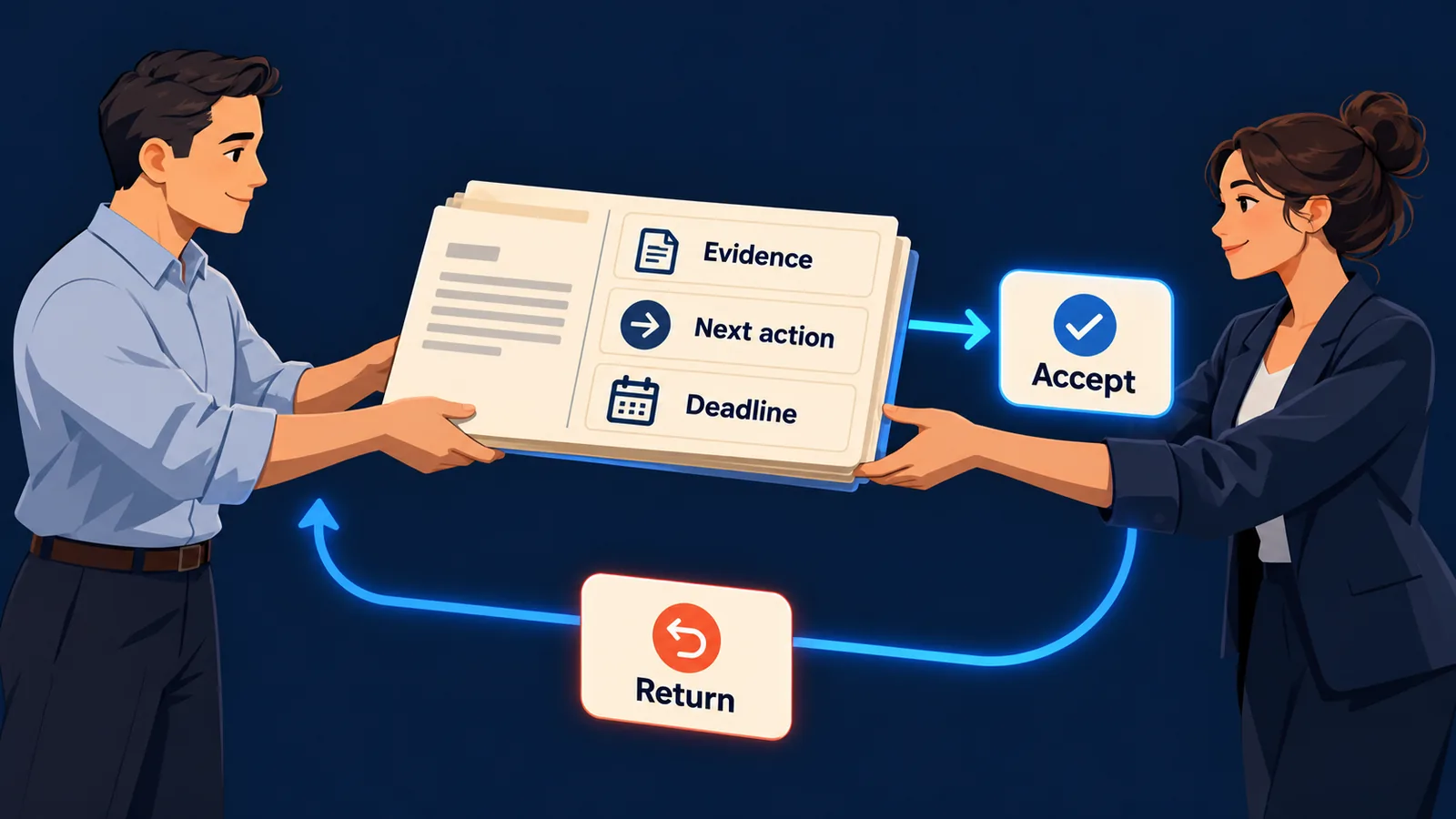
Completed handoff: sent, accepted and returned are different states
The reference handoff register contains accepted, pending and returned packets. The difference matters: an email notification is evidence of sending, while an acceptance event establishes responsibility under the example process. A read receipt alone does not prove that the receiver agreed to complete the promised next action.
One packet is returned because the third attachment is missing. Marking the transfer complete would leave the customer waiting while both teams assume the other owns the work. A returned packet should specify the missing item, retain an accountable owner and preserve the original promise and response clock.
Worked example. The supplied records and decisions are inspectable reference material, with no claimed customer results or measured model performance.
| State | Evidence needed | Responsibility |
|---|---|---|
| Prepared | Source, need, promise, attachments and next action | Sending owner |
| Sent / pending | Recipient and delivery event | Sending owner retains escalation duty |
| Accepted | Named receiver accepts action and due time | Receiving owner under agreed policy |
| Returned | Specific correction reason such as missing attachment | Named correction owner; clock preserved |
| Reassigned | New owner accepts; old tasks reconciled | One current accountable owner |
Download the working files
Use the completed example and templates alongside this guide. Files open directly with no signup.
- Completed accepted, pending and returned packets
- Routing and fallback test cases
- Reference-library instructions and example limits
- Complete reference library with local check script (ZIP) — extract the files before running the optional check.
1. Define the handoff boundary
Name the sending role, receiving role and decision that triggers transfer. The boundary could be marketing to sales, intake to a specialist, a generalist to an account owner or sales to estimating. Avoid a vague instruction to pass qualified leads over.
Specify what the sender still owns while acceptance is pending. Someone must remain responsible for the customer's response promise and existing tasks. If both teams assume the other now owns the inquiry, a technically successful assignment can leave it unattended.
Use the lead management workflow to locate the handoff in the full journey. Detailed assignment and fallback rules belong in the CRM lead routing workflow.
2. Assemble the six-part handoff packet
Keep the packet compact enough to scan, with links to the original evidence. The receiver should not need to repeat questions already answered or search three tools to understand what was promised.
Original inquiry and identity
Customer, inquiry identifier, source channel, received time and the request in the customer's words.
Qualification evidence
Confirmed fit, need, scope and timing, with references and clearly marked unknowns.
Contact history and promises
Relevant messages, meetings, commitments, contact restrictions and the current response deadline.
Next action and due time
One concrete action the receiver can perform, with an accountable owner and a useful deadline.
Open issues and dependencies
Missing information, conflicting facts, approvals and prerequisites that could block action.
Acceptance and fallback
How the receiver accepts or returns the handoff, the expected window and who handles overdue acceptance.
3. Agree on acceptance and return rules
Define the event that proves acceptance: an explicit CRM action, a recorded acknowledgement or another auditable action that fits the team. Viewing an alert may be too weak if it does not confirm responsibility.
Allow a return with a structured reason such as missing scope, wrong specialist, duplicate inquiry or unavailable capacity. Preserve the evidence and current response deadline. A return is a work item to resolve, not an automatic lost-sale outcome.
Escalate overdue transfers to a named fallback. Reassignment should cancel or move incompatible pending tasks and notifications so two owners do not independently contact the same customer.
Sent
The complete packet reaches an eligible receiving owner.
Accepted
The receiver records responsibility and the next action.
Returned
A reason and requested correction route back to an accountable person.
Acted on
The next action occurs and its result is recorded separately from acceptance.
Worked example: transferring an inquiry to estimating
Worked example: intake receives a request for work at three commercial sites. The customer has provided site addresses and a desired start month, but one attachment is missing. Intake has promised a response about the next step by Thursday afternoon.
The handoff to estimating includes the original request, two received attachments, the missing-file flag and a proposed action: confirm whether the available scope supports a site visit. The estimator accepts that action without treating the missing attachment as complete.
If the estimator requires the third attachment before deciding, they return the packet with that reason. Intake remains responsible for clarification and the Thursday promise until the revised transfer is accepted. No automated message says a quote is underway merely because the owner field changed.
4. Automate packet preparation and reminders
Automation can collect approved fields, attach the source messages, generate a concise summary, validate required context and create an acceptance task. AI can help summarize the inquiry when every important statement remains traceable to its source.
Check that the original message and relevant facts survived summarization. Do not infer budget, authority or commitments to make the packet appear complete. Use validation failures to request a specific correction from the sender.
Connect the packet to OpSmith's lead follow-up automation service when ownership, reminders and customer contact span multiple systems. Use lead qualification checklist criteria to define what evidence the receiving role actually needs.
5. Test the handoffs that usually create confusion
Test a receiver who is away, two possible account owners, a duplicate submission, a customer reply during transfer, a meeting booked through another channel and a notification timeout after the CRM already changed ownership.
For each case, inspect the current owner, pending tasks, response promise and permitted outreach. If the ownership update succeeded but notification is uncertain, reconcile the destination before repeating the update. Keep the original transfer identifier to detect retries.
Preserve deliberate human takeover. A person resolving a complex inquiry should be able to pause automation without losing the record of why it paused or how it can safely resume.
6. Measure acceptance and action as separate outcomes
Track time from handoff request to acceptance, acceptance to first action, return rate by reason, overdue pending handoffs and customer promises missed during transfer. Review a sample of accepted records for context quality; a quick acceptance click is not proof the receiver could act.
Use repeated returns to improve upstream intake, qualification or capacity rules. Do not remove a field solely to lower return rates if its absence creates more downstream work.
Apply the lead response time definitions so transfer metrics remain connected to the customer's wait. An internal handoff should not reset the original response clock.
Transfer the promise as well as the record
Include the customer's question, the evidence already gathered, the next action, the due time and any promise made. Link to the source rather than relying on an untraceable summary. The receiver should be able to act without asking the customer to repeat information that the business already has.
Define acceptance and return events in the workflow. A return is not a terminal rejection: it creates a specific correction action with an owner. An unaccepted packet needs a deadline and fallback route. Preserve original received and promised times across returns and reassignment so reporting cannot reset overdue work.
Cancel or transfer incompatible tasks when responsibility changes. Otherwise, the original representative's reminders may continue while the new owner starts another sequence. Check both CRM ownership and communication tasks before declaring the transfer complete, and reconcile any send already in progress.
Try it with your own process
Use the three packet states in the CSV to rehearse a transfer. Remove an attachment, make the receiver unavailable and then reassign the inquiry while a reminder is queued. For each event, name who owes the customer the next action and show the evidence that transfers that duty. If two owners can reasonably assume the other is acting, the handoff contract is incomplete.
Acceptance checks for this example
- Sending a notification does not equal acceptance.
- Returned packets identify the correction and accountable owner.
- Reassignment preserves promises and prevents duplicate outreach.
Technology choices and what to test
AI can draft a concise handoff summary from approved source messages and CRM facts. Require the summary to identify missing attachments and unknowns rather than claim the packet is complete by default.
Use explicit platform events or application records for acceptance, return and task cancellation. Current agent frameworks can coordinate tools, but tool success does not itself prove a human accepted responsibility. Test the actual business-state transition after any connector or model change.
Technology references checked October 28, 2026. Model availability and platform behavior can change; confirm the current documentation before implementation.
Compare candidates on a labelled sample from the intended workflow: correctness, preserved unknowns, unsafe proposed actions, reviewer effort, latency and cost. Keep expected outcomes separate from generated answers. Record model identifier, settings, prompt, rules and connector version so a change can be tested against the same cases.
Use a different packet after commercial acceptance
A qualified inquiry and an accepted offer carry different evidence. Use the accepted quote to job handoff checklist when the next team must receive agreed scope, exclusions, accepted version and delivery prerequisites.
Frequently asked questions
Who owns a lead while the handoff is pending?
Define this explicitly. Usually the sending owner retains the response obligation until the receiving owner accepts, with a named fallback for absence or overdue acceptance.
Is changing the CRM owner enough to complete a handoff?
No. Confirm the receiver has the necessary context, accepts responsibility and records the next action. Assignment, acceptance and action are separate events.
What should happen when sales rejects a handoff?
Record a specific reason and route the required correction or reassignment to an accountable owner. Preserve the customer promise and avoid treating every return as a lost opportunity.
Can AI create a sales handoff summary?
Yes, from approved evidence with source references and visible unknowns. Validate the summary and retain the original request so the receiver can verify important facts.
Should a handoff create a new lead record?
Usually it should transfer responsibility on the existing inquiry or link to the appropriate opportunity. Create a separate record only when your CRM process requires it and identity and activity links are preserved.
Sources and further guidance
These official references provide relevant technical, privacy, risk-management or accountability guidance. OpSmith applies the useful principles to the operation of one business workflow.
- Assign and rotate record owners using workflowsHubSpot Knowledge Base
- AI Risk Management Framework CoreNational Institute of Standards and Technology