
- The worked baseline matches all ten expected decisions. The prepared candidate matches nine but proposes a new create after a lost acknowledgement and unavailable lookup. Release remains blocked.
- The supplied comparisons are recorded worked outputs, not actual model runs or production accuracy measurements. The checker scores the recorded decisions without calling an API.
- Keep expected outcomes separate from candidate outputs. Cover replays, stale versions, conflicting values, missing evidence, unavailable owners and uncertain side effects—not only normal inputs.
Define the changed behaviour and the release boundary
Regression testing checks whether a proposed change breaks behaviour the workflow must preserve. Start by naming the change: a new model, a prompt adjustment, an updated field mapping, a connector release, a routing rule or a revised permission boundary. Capture the baseline configuration and proposed configuration so the comparison can be reproduced.
List the intended improvement and the controls that must remain true. A faster summary must still preserve missing evidence. A new connector must not create a second record after a timeout. A different routing rule must retain the required reviewer and authorized fallback. Those requirements become explicit case expectations.
This is the change-control layer of automation monitoring and maintenance. It does not replace production monitoring: a test sample cannot establish that every live input or dependency will behave the same way.
Worked example: nine of ten correct decisions, release blocked
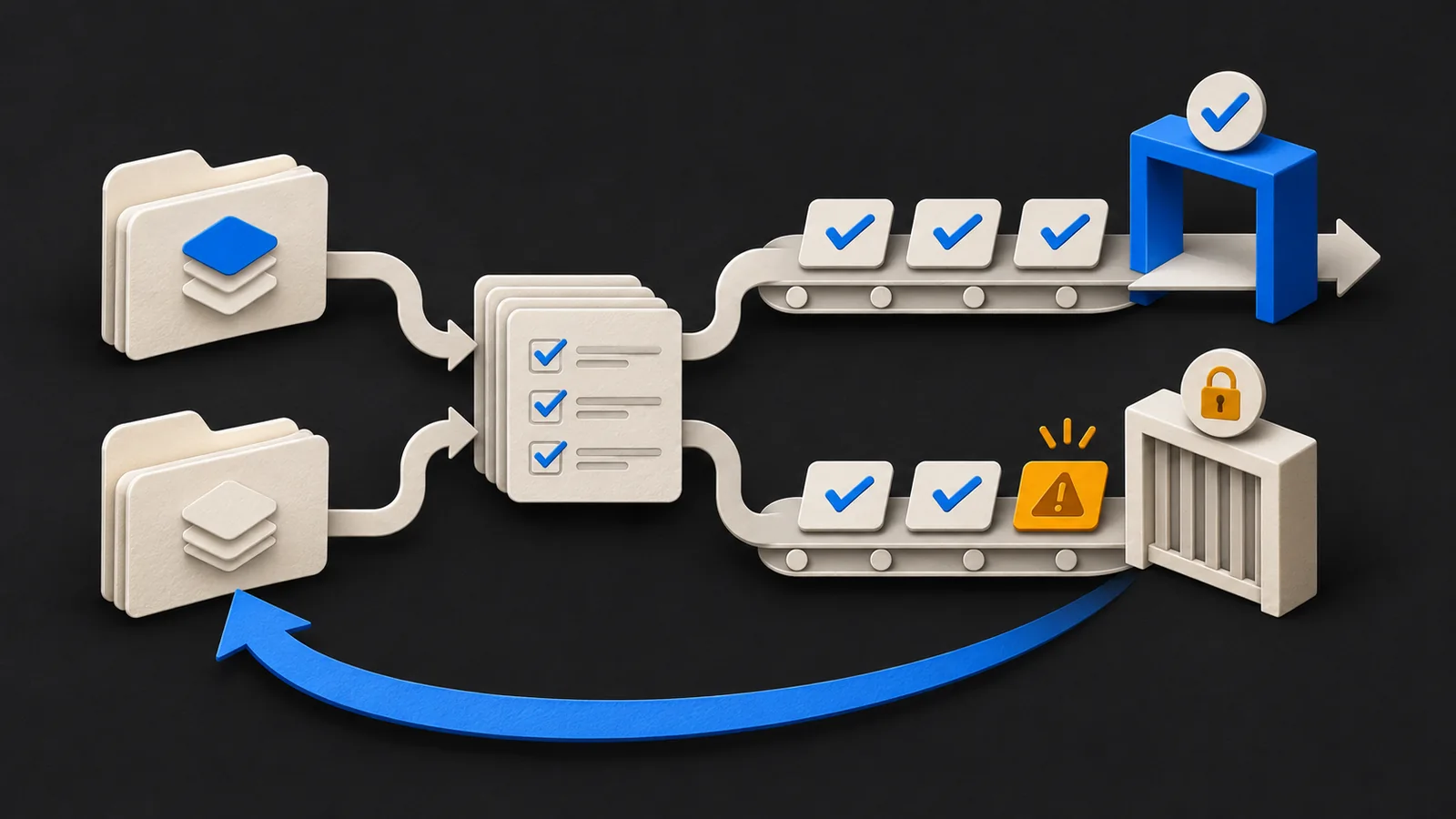
REL-CHANGE-02 compares workflow-v1 with workflow-v2-draft across ten cases. The file contains expected actions plus prepared baseline and candidate decisions. The baseline matches all ten. The candidate matches nine, but in RG-05 it selects retry-create when an acknowledgement is lost and the destination lookup is unavailable. The required action is hold-unknown.
RG-05 is a critical case because another create could repeat a real-world action that already happened. The example release record therefore says BLOCK pending correction and retest. A 90% exact-decision score does not overrule that gate. No actual release approver, provider log, measured latency improvement or production outcome is claimed.
Run the local checker to reproduce the comparison of recorded labels. It does not execute an automation, call a model or establish model accuracy. To test a real version, replace the prepared outputs with captured results from the actual workflow and retain the reviewed expectations independently.
| Case | Expected action | Recorded candidate / decision |
|---|---|---|
| RG-01: one valid destination | verify | verify; matches |
| RG-02: stale destination version | hold-version | hold-version; matches |
| RG-03: repeated source event | no-second-write | no-second-write; matches |
| RG-05: lost acknowledgement; lookup unavailable | hold-unknown | retry-create; critical failure |
| RG-07: required reviewer absent | authorized-fallback-or-hold | authorized-fallback-or-hold; matches |
| Complete packet | 10 reviewed expected decisions | 9 match; release BLOCKED |
Download the worked reference files
- Ten expected cases and recorded version comparisons
- Completed change and blocked-release record
- Local checker for recorded decisions and snapshot evidence
- Complete reliability reference pack (ZIP)
- Instructions, local checks and example limits
The pack contains worked records and explicit expected decisions. It makes no claim about client results or measured model performance.
Freeze the comparison inputs before running the candidate
Record a version manifest: source sample, expected decisions, model identifier, prompt, output schema, business rules, connector version, relevant tool permissions and destination test setup. Not every change needs to retest every unrelated branch, but the release owner should be able to explain which cases cover the changed behaviour.
Preserve the raw input and expected business action outside the generated answer. A model may help propose edge cases or a draft rubric; an accountable reviewer still checks that the expected outcome reflects the actual rule and authority. Do not let the candidate rewrite its own answer key after it fails.
Use permissioned, representative inputs in a controlled environment. Remove unnecessary personal data and secrets, and isolate outbound writes or messages from production. A test that sends a live customer promise or creates a payable is performing the very side effect the test should control.
| Record | Required detail | Why it matters |
|---|---|---|
| Change scope | Baseline, candidate and intended improvement | Separates release intent from accidental differences |
| Known-answer cases | Raw inputs, expected actions and reviewer basis | Prevents self-grading against generated expectations |
| Dependency manifest | Model, prompt, rules, schema, connector and permissions | Makes a changed result traceable |
| Side-effect boundary | Test destination and message/write isolation | Prevents evaluation from changing live business state |
| Release policy | Critical cases, unresolved failures and approver | Prevents overall score from hiding a blocking defect |
| Restoration plan | Configuration restore plus affected-item reconciliation | Recognizes that rollback cannot unsend an action |
Test the decisions that can create expensive mistakes
Include ordinary valid inputs, incomplete evidence, boundary values and conflicting records. Add a repeated event and a corrected source version arriving while work is queued. Test a cancelled item, an unavailable required reviewer and a destination lookup that is incomplete rather than genuinely empty. These cases reveal different problems from a malformed output field.
For material side effects, test the moments before submission, after submission but before acknowledgement, and after a confirmed outcome. Verify the destination as well as the response shown to the caller. A timeout label alone cannot tell you which moment occurred.
The source-to-destination data reconciliation packet makes those outcome checks concrete. Keep its missing, duplicate, mismatch and unknown classifications distinct when assessing a new recovery branch.
For AI-prepared fields, the document data validation guide separates source checks and deterministic rules from model confidence. Include unsupported assertions and lost uncertainty in the evaluation rubric, not only JSON validity.
Evaluate model changes with a stable rubric and repeated observations
Current candidates such as GPT-6.1 Sol and GPT-6 Astra can be evaluated for evidence-linked summaries, classification or field preparation. A newer model identifier is not a reason to bypass release checks. Keep the task, sample, permissions and scoring basis comparable before attributing a difference to the model.
Where outputs vary between runs, one response per case is weak evidence of consistent behaviour. Choose a justified repetition plan and inspect the variation in material failure categories. Record refusals, unavailable dependencies and incomplete observations rather than excluding inconvenient runs from the denominator.
OpenAI's evaluation guidance describes defining objectives, datasets and metrics, then comparing and continuously evaluating changes. Apply that discipline to the business action being prepared. Exact label matching works for this bounded recorded packet; open-ended summaries need a reviewed rubric and supporting evidence, not a word-for-word comparison with one preferred sentence.
A second model can assist a reviewer but should not become an unchecked release authority. Check whether its judgments agree with reviewed examples and whether it can see the evidence needed to score the task. Keep quality, reviewer effort, latency and cost as separate observations; do not trade a critical permission failure for a faster average response.
Make the release decision explicit, then verify affected work
List failed cases, their consequence, corrective action and who can approve the final decision. Under this packet's rule, the unresolved critical failure blocks release. In production, define the actual gates before testing and retain the reason for any authorized exception. Do not quietly lower the threshold after seeing a disappointing result.
After correcting a defect, rerun the affected cases and the cases that protect adjacent behaviour. Record the new candidate version; otherwise a passed screenshot may refer to a different configuration from the one being published. Preserve prior results so the correction and its limits are inspectable.
A rollback restores code or configuration within its supported boundary. It does not automatically remove records already created, retract a customer message or reverse a business commitment. Identify the affected population and the authorized reconciliation or correction route alongside the restoration procedure.
Use the workflow automation monitoring checklist for post-release observation. Follow the AI governance framework for ownership, allowed scope and the authority to expand or narrow the workflow.
- Record the changeFreeze versions, expected decisions and isolated test boundaries.
- Compare behaviourRun the same reviewed cases and inspect meaningful failures.
- Decide releaseResolve required gates and record the authorized decision.
- Observe a bounded releaseCheck destination outcomes, queue states and ownership.
- Restore and reconcile if neededRestore configuration within its limits and account for affected business actions.
Turn useful incidents into permanent regression cases
Add cases when a production incident reveals a missing assumption, such as a shared address, out-of-order source correction or stale lookup. Preserve a minimal permissioned input that reproduces the behaviour and an independently reviewed expected action. Explain which rule the case protects so it survives a later redesign.
Maintain both historical cases and fresh representative inputs. A suite can become reassuring but irrelevant if the source population changes or the team repeatedly optimizes prompts against the same few examples. Review coverage and stale expectations with the business owner rather than treating the fixture count as a quality score.
OpSmith's managed automation services can connect version records, regression checks and post-release monitoring to the workflow's actual operating responsibilities. Start with one consequential change and the cases that should prevent its worst failure.
Frequently asked questions
Is a 90% pass rate enough to release an automation change?
Not by itself. Inspect which cases failed and the actual release policy. The worked candidate fails a critical uncertain-write case, so its nine matching decisions do not authorize release.
Does the reference pack benchmark GPT models?
No. It compares prepared recorded decisions with expected labels. A real model evaluation needs captured outputs from the named model and configuration, representative permissioned inputs and an independently reviewed scoring method.
What should be retested after changing only a prompt?
Test the behaviours the prompt can affect, including preserved facts, unknowns, required actions, output structure and tool-use boundaries. Include important adjacent controls and record the prompt version with the results.
Can rollback undo actions taken by the new version?
Not automatically. Restoring configuration and repairing business state are different tasks. Identify affected records or messages, reconcile their outcomes and use the authorized correction process for any side effects.
Sources and further guidance
These official references provide relevant technical, privacy, risk-management or accountability guidance. OpSmith applies the useful principles to the operation of one business workflow.
- Evaluation objectives, datasets, metrics and continuous evaluationOpenAI
- Current model catalogOpenAI
- Retry-safe API contracts and request identityAmazon Builders' Library