
- BP-101 is a fictional worked assessment of emailed quote-request intake, not a client engagement or measured result.
- Its recommendation is a bounded draft-intake pilot; pricing, quote release and customer commitments stay outside the build.
- Download the completed decision brief and blank template to inspect the deliverable before commissioning an assessment.
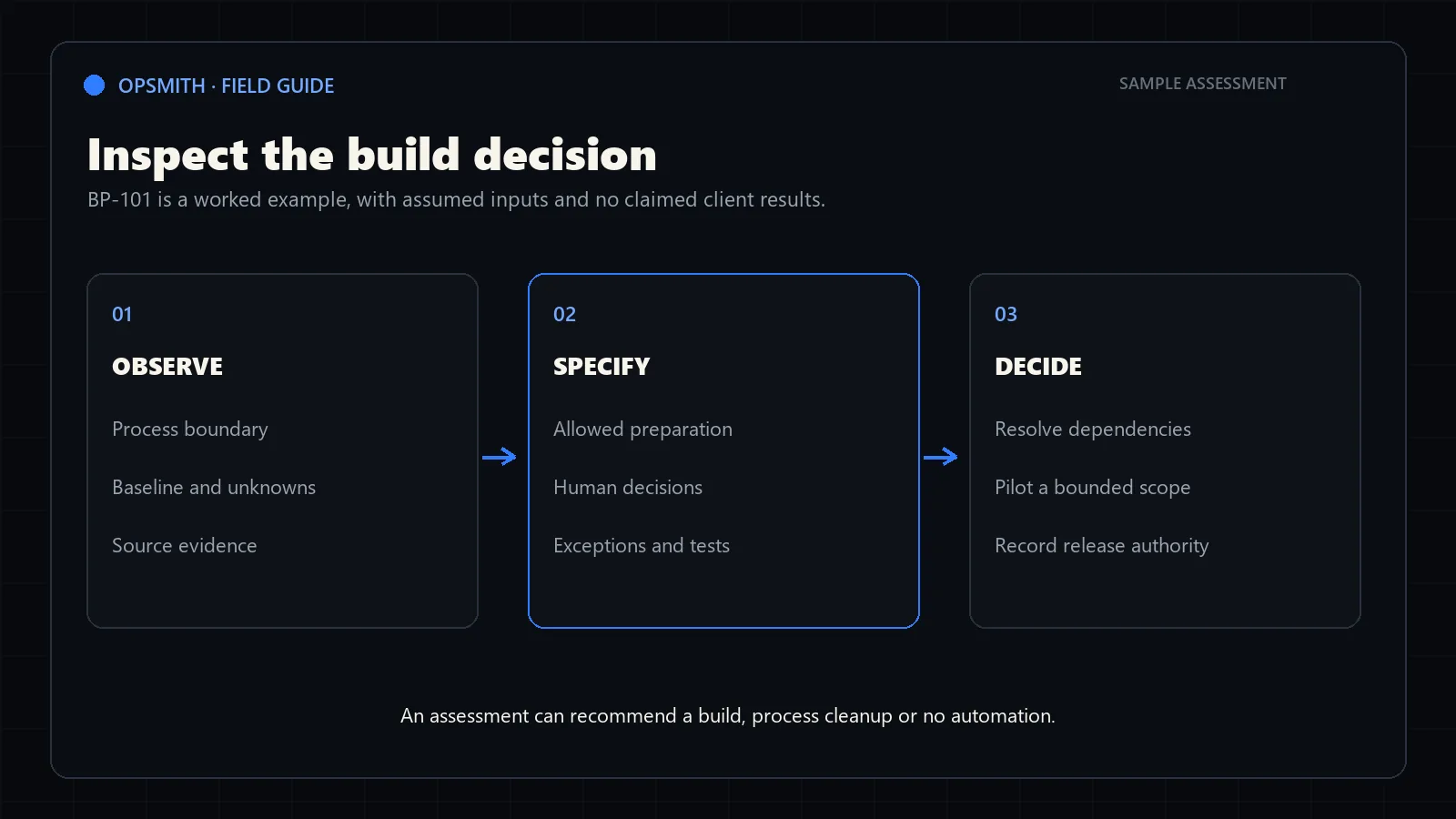
Start with a decision that is small enough to inspect
In BP-101, an established supplier receives quote requests through a shared inbox. A coordinator reads the request, finds the customer, copies the details and asks for missing information. The proposed change prepares a source-linked draft request for the coordinator. It does not choose prices, issue a quote or promise a delivery date.
All people, volumes, timings and decisions in this example are illustrative. No customer files, production logs or measured model outputs are supplied. Its purpose is to show the structure of a useful assessment, including evidence that still needs to be collected.
OpSmith's Operational AI Blueprint assessment maps one actual workflow and produces a recommendation based on its evidence. This example illustrates the kind of operating questions that a focused assessment should resolve; an engagement's specific deliverables are agreed in its scope.
Download the working files
Editable examples and blank registers. No signup required.
Inspect the contents before buying an assessment
A useful assessment should leave the business with a decision it can understand and review. Use the checklist below to discuss the actual engagement scope. A polished diagram alone does not establish feasibility, and a written implementation brief does not mean a production workflow has already been built.
| Part | Buyer question | Where BP-101 demonstrates it |
|---|---|---|
| Workflow boundary and map | Where does the process start and what outcome ends it? | Boundary and current/proposed intake steps |
| Baseline and evidence gaps | What work is happening and how reliable is the estimate? | 100 requests × 12 minutes; actual observation data missing |
| Proposed design and human decisions | What can be prepared and who decides the exceptions? | Draft-only pilot with coordinator review |
| Scope and alternatives | What is included, excluded or better handled another way? | Explicit exclusions and cleanup/native-feature alternatives |
| Access and feasibility questions | Which dependencies still need a technical check? | Matching rules, test access and visible destination records |
| Acceptance and recovery | What evidence permits release and what blocks it? | Six unrun cases with independent expected decisions |
| Investment and next decision | Should we stop, improve first or commission a bounded pilot? | Conditional recommendation; separate build and operating quotes needed |
Record the current workflow and its unknowns
The example assumes 100 eligible requests a month and 12 active coordinator minutes per request. That is 20 hours of monthly handling. The assumed figure excludes waiting for the customer and any estimating work after the request is accepted. An actual assessment would need a defined observation window and a representative sample, including requests that were returned or abandoned.
The coordinator's knowledge is part of the process: which customer identifiers are trustworthy, what makes a request priceable, which attachments supersede earlier versions and who may resolve a conflict. Capture those decisions before proposing a connector.
| Step | Current work | Proposed preparation | Owner or hold |
|---|---|---|---|
| Receive | Open email and attachments | Preserve message identity and source references | Unmatched or unreadable source is held |
| Match | Find the customer manually | Propose a match using approved identifiers | Coordinator resolves ambiguous identity |
| Prepare | Copy requested items and missing facts | Create a source-linked draft with unknowns intact | No invented quantity, price or delivery date |
| Review | Check the reconstructed request | Accept, correct or return the draft | Coordinator makes the intake decision |
| Handoff | Notify estimating | Record accepted request and next owner | Verify destination before declaring completion |
Separate a planning target from a measured benefit
Suppose the pilot target is four minutes of remaining coordinator work per eligible request. At the assumed volume, the target would release 800 minutes, or approximately 13.3 hours per month, before operating and maintenance effort. That is an arithmetic scenario, not a result or a guarantee.
Do not approve the project from that number alone. Include preparation, review, exceptions, training and ongoing support. Decide whether released capacity has a useful destination and whether the investment still makes sense when volume is lower or review takes longer.
As a separate sensitivity assumption, valuing that 800-minute target at CAD 40 per hour produces approximately CAD 533 per month of gross capacity value before operating effort. It is not a payroll reduction or a budget for every benefit. If a real quote and ongoing workload cannot be justified by supported benefits, reduce the scope, use an existing feature or stop. BP-101 supplies no actual build or operating quote with which to establish payback.
The workflow automation cost guide separates these expense categories. Record the actual baseline before comparing any proposed benefit with the investment.
Replace the assumed baseline with observations before deciding
Choose a defined observation window and record eligible requests, active handling time, waiting, returns, rework and exceptions separately. Include difficult records and work that never reached estimating. Have the coordinator verify the step definitions so an apparent reduction in intake time does not simply move work into another person's queue.
The 12-minute current state and four-minute target are assumptions in BP-101. Review and exception work within intake should be included consistently when measuring both states; add maintenance and other operating work separately. Use request counts and their measured times to calculate the total rather than applying one anecdotal best-case timing to every record.
Use the blank Blueprint's evidence and unknowns sections to record the sample, observation dates, source references and collection owner. Compare the same eligible population before and during a pilot, document exclusions and report variation. A small pilot can support the next bounded decision without proving a universal accuracy rate or permanent saving.
Make the build scope and exclusions explicit
The sample pilot accepts one approved shared inbox, one customer-reference source and one draft-intake destination. It prepares records for one type of quote request. The business owner supplies eligible examples, identifier rules and the intake reviewer. System owners confirm permitted access and a suitable test environment.
Excluded work includes a customer-facing visualizer, pricing engine, inventory promise, CRM migration, automatic quote release and every other document family. A later request to add those capabilities changes the implementation scope; it is not a small wording change to the same pilot.
For the underlying operating journey, use the quote request intake guide. This example is an assessment deliverable; that guide teaches how to design the intake process in more depth.
Define the tests before permitting live effects
A useful brief says how a reviewer will decide whether the implementation is acceptable. BP-101 includes independent expected decisions for ambiguous customers, revised attachments, repeated messages, missing quantities and uncertain destination writes. None is a recorded pass: the template leaves actual results and reviewer disposition unrun until testing occurs.
Agree the common-path quality threshold with the business owner using a representative sample. Define critical failures separately: an unapproved customer promise or a duplicate irreversible action should not be hidden by a high average score. Record who can authorize release and what happens after a blocked test.
| Case | Expected decision | Evidence still required |
|---|---|---|
| Two customers share a contact address | Hold proposed match for coordinator review | Reviewed identifiers and actual candidate output |
| Quantity missing from the source | Preserve unknown; prepare a specific clarification | Source-linked draft and reviewer check |
| The same source event arrives twice | Reconcile the existing request | Durable event identity and no duplicate draft |
| Destination acknowledgement is lost | Keep unresolved; inspect the destination before retry | Destination lookup and authorized recovery result |
| A new attachment changes the request | Retain versions and recheck affected fields | Version references and changed-value review |
Leave the readout with a decision, conditions and named next actions
For BP-101, the decision is conditional: explore a bounded draft-intake pilot, with no build or production release authorized by the sample. The business owner must approve the matching rules, system owners must verify test access, the coordinator must review representative records and the release owner must agree acceptance and recovery rules. The actual build and operating quote is another unresolved input.
At the readout, choose among process cleanup, an existing product capability, a narrower pilot, further feasibility work or stopping. Record why the preferred option fits the evidence, which alternative was considered and who resolves each open question. Do not turn a conditional recommendation into a ready status simply because the assessment document is finished.
Keep the completed brief, evidence register and acceptance cases together. If another implementation team will use them, confirm the agreed deliverable rights, access to source material and any additional technical discovery needed. Neither the public template nor the Blueprint label guarantees ownership terms, a fixed build price or readiness for every platform.
The implementation process guide explains how the accepted brief becomes a controlled pilot, reviewed release and handover. For a Winnipeg operation, local workflow observation can help establish handoffs that are difficult to reconstruct from a meeting alone.
Frequently asked questions
Is BP-101 an anonymized customer case?
No. It is a fictional worked example. Its volumes, timings, proposed design and decisions illustrate the assessment structure and do not represent client results or measured model performance.
Does the Blueprint include a production automation?
The Blueprint is an assessment and implementation brief. A production build is separately scoped when the evidence supports it. Confirm any prototype or technical feasibility work in the actual assessment scope.
Can our internal team use the blank template?
Yes. Use it to record the process, baseline, unknowns, proposed boundaries, exceptions and acceptance evidence. A completed form is not proof that the proposed workflow has been tested or approved.
What if the baseline is not available?
Record the missing evidence, its owner and how it will be collected. Use a short defined observation period instead of turning an anecdotal time estimate into a claimed measured saving.