
- A build needs an agreed outcome, access owners, representative inputs and reviewed acceptance criteria before production changes.
- Elapsed delivery time includes client access, policy decisions and review availability as well as development.
- Specify launch support, ongoing monitoring, ownership and change scope in the proposal; they are separate responsibilities.
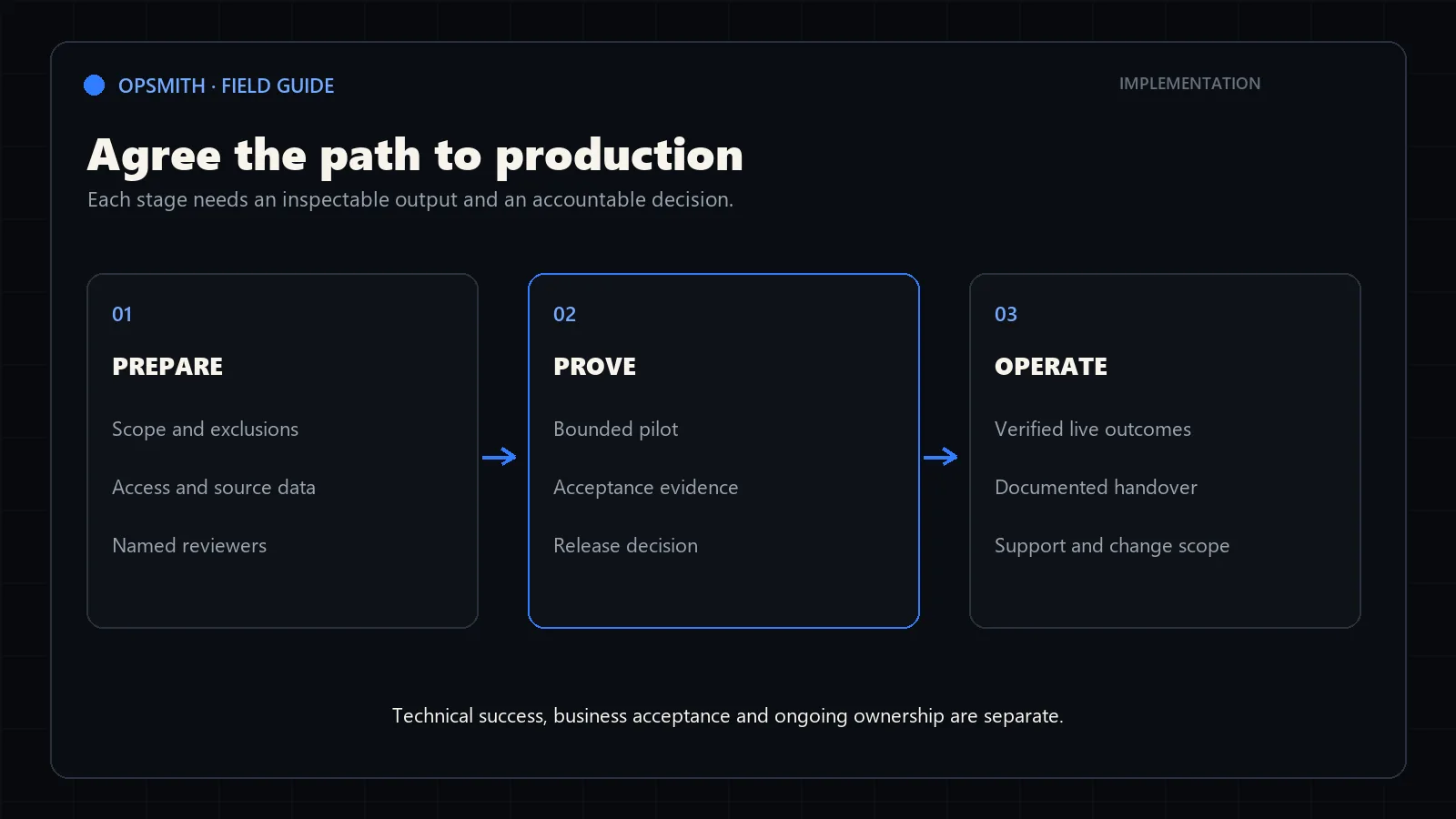
Agree what the supplier is being asked to deliver
Before a build begins, both sides need the same definition of done. A workflow might finish with a reviewable draft, an approved message or a verified system update. Those boundaries change the access, testing and operating responsibilities. An integration running once is not enough to establish acceptance.
OpSmith begins with the operating process. Where its boundaries or feasibility need assessment, the business process automation audit establishes a baseline and proposed implementation brief. The build is scoped separately; the following stages explain what to settle in that agreement.
The business process automation planning guide covers how to design the process. This guide focuses on buying and participating in the implementation: who supplies what, which evidence enables the next stage and how the finished workflow is handed over.
Use stage outputs to judge progress
Request an implementation plan that names the output of each stage, the reviewer and the unresolved dependencies. Some stages can overlap, but a pending permission or business rule should remain visible rather than disappear inside an optimistic completion percentage.
| Stage | Supplier prepares | Client contributes | Decision before progressing |
|---|---|---|---|
| Scope | Process boundary, proposed output and exclusions | Business owner, source examples and desired outcome | Accepted scope and commercial agreement |
| Access and rules | Integration plan and test environment requirements | Authorized access, business rules and approved data | Owners confirm the permitted task and environment |
| Pilot build | Bounded workflow, logs and exception paths | Representative inputs and timely clarifications | Draft outputs are inspectable without unintended live effects |
| Acceptance | Recorded outputs against agreed test cases | Reviewer decisions and correction priorities | Explicit release, narrowed scope or blocked decision |
| Controlled launch | Release plan, monitoring and recovery instructions | Available owner, launch approval and staff readiness | Verify actual destination outcomes |
| Handover | Documentation, account inventory and unresolved-item register | Named operating owner and support decision | Ownership and support boundaries are understood |
Separate development time from elapsed delivery time
A timeline can lengthen because the source data changes, a vendor approval is pending or the only authorized reviewer is unavailable. Ask which dependencies determine the earliest credible launch and which work can continue while a gate is unresolved. OpSmith does not promise a universal delivery duration for every workflow.
For an illustrative schedule, suppose a bounded pilot needs two working days of scope decisions, three for access and source preparation, eight for implementation, four for acceptance and two for controlled release. With no overlap, rework or waiting, those assumptions total 19 working days. They are a planning example, not an OpSmith delivery commitment or an industry average.
Give each milestone an owner and expected review window. A proposal should explain how missing access, changed requirements and delayed feedback affect dates. Confirm the actual schedule after the scope and dependencies have been inspected.
Prepare the inputs that prevent avoidable rework
Choose a business owner who can decide what the workflow should do, a system owner who can authorize access and an operator who understands the exceptional cases. One person may fill several roles, but the decisions remain distinct.
Bring normal records and difficult ones: missing information, revised documents, duplicates, wrong identifiers and unresolved prior actions. Use approved, proportionate data through the organization's chosen access process. Do not collect credentials or unrelated personal information into a project brief.
Specify when the reviewer is available and how proposed changes will be accepted or returned. A supplier can prepare a decision packet, but an unacknowledged notification does not establish approval or transfer accountability.
Agree how defects, changed inputs and new requests are handled
Keep one current scope and an issue/change register that both parties can inspect. A request may correct the implementation, clarify a business rule or add a capability. Classify it against the accepted scope before deciding its fee, timing or release impact; the supplier and authorized client owner settle any disagreement under the agreement.
| Situation | Review question | Decision to record |
|---|---|---|
| A reviewed test fails | Does the observed behaviour breach an agreed acceptance requirement? | Correction, retest evidence and who accepts the result |
| A source field or API changes | Is adaptation covered, and which affected cases need retesting? | Impact, owner and approved plan before deployment |
| A new destination or document family is requested | Does it change the agreed workflow boundary? | Separate scope, fee and timeline decision where required |
| Client access or review is delayed | Which milestone depends on the missing input? | Dependency owner and revised schedule rather than a hidden ready status |
| A noncritical issue remains | Can a specifically bounded release proceed under agreed criteria? | Explicit condition, owner, due date and permitted release scope |
Approve business behaviour before increasing live volume
Start in a test environment or with drafts that cannot make an unapproved customer or financial commitment. Agree expected outcomes before observing the candidate's outputs. Include recovery and duplicate-event cases, not just successful examples.
Separate a deliberate review hold from a technical failure. Check what happened at the destination after a timeout rather than blindly repeating a create action. Record the release decision against the workflow version, the reviewed evidence and the exact allowed scope.
Microsoft's implementation test-plan guidance recommends planning tests early, defining expected outcomes and assigning responsibility for results. Use the automation regression testing checklist to structure change evidence. The downloadable commissioning register leaves actual results unrun until a reviewer inspects the implementation.
Download the working files
Editable examples and blank registers. No signup required.
Use a controlled launch checklist with a real fallback
Before launch, identify the release version, permitted records or volume, authoritative system, available operator and recovery owner. Check that access works in the production environment and that the workflow can be paused. If a manual process remains active, define who handles each record so the pilot and existing process do not both send or create the same outcome.
Inspect the first permitted outcomes at the destination and keep exception work visible during the agreed launch review window. Record what requires a hold or pause and who can authorize resumption. A fall-back procedure needs to explain how partially completed records will be reconciled before manual work or retries resume.
Restoring an earlier configuration does not automatically undo an email already sent or a record already created. Preserve those effects and use the applicable correction procedure. Microsoft describes testing, release control, operation and maintenance within its application lifecycle guidance; the specific release and recovery decisions still need to be agreed for your workflow.
Inspect the handover package before closing the project
Use the acceptance register to assign an owner and evidence reference to each handover item. Have the intended operator walk through a normal record, a held case and the recovery instructions. Unresolved items should remain assigned with an agreed disposition rather than disappear when the supplier's build task closes.
| Item | What the receiving team should inspect |
|---|---|
| Workflow and account inventory | Systems, environment, dependencies, account owner and renewal responsibilities |
| Scope and acceptance record | Released version, permitted actions, test evidence and accepted exclusions |
| Operating instructions | Normal procedure, review queue and who owns unresolved records |
| Monitoring and recovery | Observed outcomes, alert owner, pause/recovery steps and reconciliation |
| Access and deliverables | Approved access transfer/revocation and agreed configuration, code or document rights |
| Training and support | Operator walkthrough, covered support arrangements and escalation path |
| Outstanding work | Open conditions, named owners, due dates and first operating review |
Decide who operates the workflow after the launch
Ask for the account and dependency inventory, permitted actions, operating instructions, exception owners and the recovery procedure. Record where the documentation lives and how a replacement operator can find it. Account ownership and access should be explicit in the agreement.
Distinguish correcting a defect against the accepted scope from adding a new rule, destination or document family. Confirm any included launch-support period, ongoing support fee, covered hours, response arrangement and change allowance in the proposal. A response target is not a guaranteed repair time, and automated monitoring does not establish staffed coverage at all hours.
For a workflow that needs continuing ownership, explore managed automation services. If your team will operate it internally, verify the handover and escalation path before relying on it for daily work.
Connect the implementation plan to the full operating budget
The workflow automation cost guide separates assessment, implementation, software, usage, support and internal review. Compare proposals on the same scope and acceptance boundary before comparing their totals.
The sample Operational AI Blueprint shows a bounded decision brief with explicit exclusions and unresolved gates. Use it to prepare one process for an initial conversation, even if the rest of your operation is still documented in inboxes and spreadsheets.
Frequently asked questions
Must the client write a complete technical specification?
No. The initial conversation can start with one recurring problem. The assessment or scoping work should establish the required boundaries, rules, responsibilities and acceptance evidence before implementation is approved.
Can we keep using the existing process during a pilot?
Where appropriate, a pilot can prepare drafts or run alongside the existing process. Agree which system remains authoritative and how duplicate work and unintended messages will be prevented. The correct transition depends on the workflow.
Does a successful technical run mean the workflow is ready?
No. Review correctness, permissions, exceptions, destination outcomes and operating ownership against the agreed acceptance criteria. A technically successful run can still produce the wrong business record.
Are ongoing changes included in the implementation price?
Only as agreed in the proposal. Distinguish defects against the accepted scope, included launch support, ongoing maintenance and new capabilities. Name any time or change allowance and the approval process for additional work.
Sources and further guidance
These official references provide relevant technical, privacy, risk-management or accountability guidance. OpSmith applies the useful principles to the operation of one business workflow.