
- OpSmith starts at CAD $1,950 for an Operational AI Blueprint, CAD $6,500 for a focused workflow build, and CAD $18,000 for a bespoke connected system. Optional managed support starts at CAD $650 per month.
- Prices are before applicable taxes. The final scope and fee are confirmed in a proposal; software, usage and your team's remaining work need their own budget.
- The worked first-year budget below illustrates assumptions and arithmetic; it is not a project quote or a measured market average.
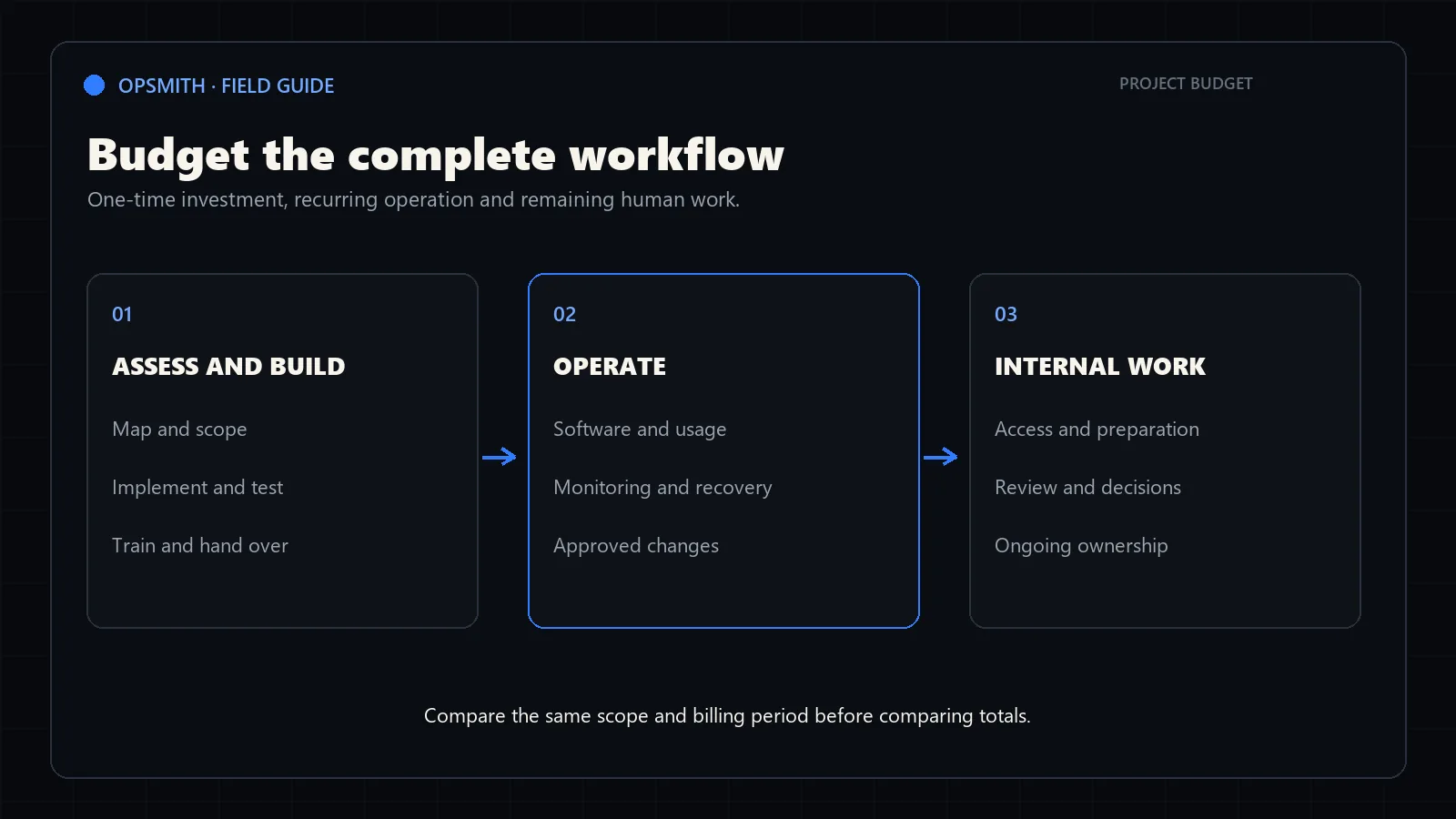
Price the work from its input to a verified outcome
A form that creates a draft task and an invoice workflow that reconciles financial records are different purchases. Counting the number of connectors misses the work needed to resolve identity, handle exceptions, test decisions and verify the destination record.
OpSmith's first 20-minute consultation is free. The Operational AI Blueprint is a paid assessment, and implementation is scoped separately. Starting investments are shown below; the actual fee depends on the agreed workflow, access, exceptions and acceptance requirements.
Start with one trigger, one defined output, named systems and the decisions that still belong to a person. A business process automation audit can establish those boundaries before a larger build is commissioned.
Source variation
One stable form requires different preparation from mixed scans, email threads, revised attachments and missing identifiers.
Destination access
A supported API with test access differs from a manual export, unavailable permission or undocumented application.
Consequence and exceptions
Customer messages, financial writes and irreversible changes require different validation and acceptance evidence from a reviewable draft.
Operating responsibility
The quote needs to explain who monitors the workflow, resolves held work and maintains connectors after launch.
Canadian advertised prices vary with the work being sold
Public Canadian supplier pages show why one automation price is not a useful market average. A supported app-to-app workflow, a custom internal tool and a connected multi-workflow build have different outputs and operating responsibilities. The examples below were checked on November 4, 2026; they are advertised offers, not paid transaction data, a representative survey or a comparison of delivery quality.
The figures come from 204 IT Solutions' CAD price page and Ease AI's Canadian pricing page. Each supplier's exclusions, tax treatment, discovery, testing and post-launch terms need checking in its actual proposal. Their terms do not become OpSmith terms.
| Supplier offer | Published CAD amount | Advertised scope to compare |
|---|---|---|
| 204 IT Solutions: single automation | $1,500–$5,000 one-time | One connected workflow using supported automation tools |
| 204 IT Solutions: custom tools and integrations | $8,000–$40,000 per project | Custom internal app, portal or integration scope |
| Ease AI: single build | $3,500–$8,000 | One chatbot or workflow connected with existing tools |
| Ease AI: multi-workflow build | $8,000–$20,000 | Several connected processes with shared supporting work |
OpSmith starting prices and what they cover
These starting investments are in Canadian dollars before applicable taxes. They apply to a bounded scope agreed in a written proposal. They do not include third-party software, hosting or metered usage unless explicitly included. Assessment and implementation are separate purchases; no automatic assessment credit is assumed.
A focused workflow is one defined path with supported source and destination access, a review boundary, agreed testing, documentation and handover. Multiple interacting workflows, custom interfaces, difficult legacy integration or consequential operating decisions can require a bespoke scope. The number of connectors alone does not determine the tier.
| Engagement | Starting investment | Scope to confirm |
|---|---|---|
| Operational AI Blueprint | From CAD $1,950 | Assessment of one workflow: current-state map, baseline, opportunity and risk review, implementation brief and readout |
| Focused workflow implementation | From CAD $6,500 | One defined workflow with agreed integrations, exception handling, acceptance, documentation and handover |
| Bespoke connected system | From CAD $18,000 | A separately scoped customer journey, custom interface or connected set of workflows; complex work can exceed the starting investment |
| Managed automation support | From CAD $650 / month | Named workflow monitoring and maintenance, with covered hours, included effort and escalation agreed in the support scope |
Separate one-time, recurring and internal costs
Ask each supplier to use the same cost categories and billing period. Otherwise, one proposal can appear cheaper because it omits testing, support or required software rather than because it offers the same result more efficiently.
| Category | What to establish | Common omission |
|---|---|---|
| Assessment and design | Process observation, baseline, scope and acceptance plan | Assuming a discovery call provides a tested specification |
| Implementation | Configuration or code, integrations, exceptions, testing and handover | A connector demonstration presented as a finished operating workflow |
| Software and hosting | Required licenses, environment, storage and account owner | A premium connector or production environment outside the build fee |
| Metered usage | Billing unit, expected volume, peak demand and budget alerts | Ignoring pages, executions, requests, retries or retained logs |
| Support and changes | Named workflow, hours, response arrangements and exclusions | Confusing monitoring with unlimited repairs or future builds |
| Internal work | Access setup, source cleanup, testing, training and remaining review | Treating recovered staff time as an immediate payroll saving |
Worked CAD budget: first-year cost is larger than the build fee
Consider an illustrative document-intake workflow that prepares a reviewable draft record. Use the starting investments of CAD 1,950 for assessment and CAD 6,500 for implementation, including the agreed testing and handover. Assume CAD 100 per month for software, CAD 50 for usage and a support scope at the CAD 650 starting level. This combines starting investments with assumed operating costs; it is not a quote for a particular implementation.
With twelve full operating months, external first-year expenditure is CAD 8,450 plus CAD 9,600, or CAD 18,050 before applicable taxes. Separately, assume ten initial staff hours and four review hours per month valued internally at CAD 40 per hour: CAD 2,320. Total economic cost under these assumptions is CAD 20,370. The internal value is not another supplier invoice.
Change the number of paid months when launch happens partway through the year. Verify whether assessment, launch support or licenses are already included so they are not counted twice. Keep any exchange-rate assumption explicit when a vendor bills outside CAD.
| Item | Calculation | Amount |
|---|---|---|
| Assessment | One-time assumption | $1,950 |
| Implementation including agreed handover | One-time assumption | $6,500 |
| Software, usage and support | ($100 + $50 + $650) × 12 months | $9,600 |
| External first-year expenditure | $1,950 + $6,500 + $9,600 | $18,050 |
| Internal preparation and review value | (10 + 4 × 12) hours × $40 | $2,320 |
| Total economic cost | $18,050 + $2,320 | $20,370 |
Download the working files
Editable examples and blank registers. No signup required.
Separate the one-time total, monthly run cost and support choice
The worked model has CAD 8,450 of one-time external lines and CAD 800 per operating month of software, usage and chosen support. Those are cost categories, not an agreed payment schedule. Deposits, milestone invoices and payment timing belong in the actual proposal.
Managed support is optional. If it is not purchased, removing twelve assumed CAD 650 support months reduces this example's external subtotal by CAD 7,800 to CAD 10,250. That does not make maintenance free: your team or another provider must own monitoring, recovery and changes, and its cost has not been estimated in that subtotal.
If the same software, usage and managed-support assumptions continue for another full operating year, external recurring expenditure would be CAD 9,600. The assumed four monthly review hours add CAD 1,920 of internal capacity value. Recheck volumes, prices and support scope before using those figures as a later-year budget; no repeat build fee is assumed in that scenario.
Give suppliers the same estimate brief
Use the blank budget register to record each line's billing unit, quantity, paid months, source or quote, owner and whether it is already included elsewhere. Enter a quoted fee separately from an unverified allowance. If an item is unknown, name the person who will obtain it rather than silently assigning zero.
For a useful estimate, bring the current systems, intended output, average and peak eligible volume, representative normal and difficult records, required human review and the person who can authorize access. Include data cleanup, migration, training and reporting only if they are actually part of the requested scope.
Before choosing, confirm the fixed scope or other fee basis, payment milestones, change-approval route, software/account ownership, deliverable rights, handover and support exclusions. Do not assume unlimited changes, an assessment credit or a right to every supplier tool unless the agreement provides it.
Test the assumptions that can change the buying decision
Run a low-volume case and a case with more review or maintenance. If monthly usage rises by CAD 150, the example's annual external cost increases by CAD 1,800. If review grows from four to eight hours each month, internal capacity cost rises by CAD 1,920 at the assumed hourly value. Neither change requires a larger initial build invoice to affect the result.
Use the automation ROI calculator to compare cash savings and retained staff capacity. This cost guide supplies the expense side of that decision; it does not predict savings, sales growth or payback for your business.
Require an agreed response to a usage spike, unavailable source or changed system. A budget alert needs an owner and a permitted action, such as reviewing the workload or pausing a nonessential step. An alert alone does not cap spending.
Check the actual license and billing unit
Subscription and consumption prices can change. Microsoft's Power Automate pricing page distinguishes user, process and hosted-process plans and connector capabilities. Confirm the required plan for the actual environment instead of assuming every existing Microsoft subscription covers the proposed automation.
Google's Document AI pricing documentation separates processing capabilities and explains currency treatment. Identify which processor and other services the workflow needs. A page-extraction unit price is one budget component, not the installed cost of an approved document workflow.
The supplier proposal should name the account owner, currency, billing interval, expected usage, required plans and any included allowance. Check those details before signing. The automation platform comparison explains why tasks, executions and request allocations cannot be compared as identical units.
Compare proposals on the same acceptance boundary
Ask what you can inspect at the end: a draft, an approved customer message, an accounting entry or a verified update. Ask which exceptions are included, who provides access, how approval is recorded and what happens if a destination write times out.
The automation implementation process explains the handoffs and responsibilities from discovery through launch. Use it to distinguish a smaller legitimate scope from a proposal that leaves essential work undefined.
If a local walkthrough would help establish the scope, explore AI workflow automation in Winnipeg. Bring the current tools, a few representative records and one measurable bottleneck; a polished specification is unnecessary for the initial conversation.
Frequently asked questions
Is the worked budget an OpSmith quote?
No. It uses OpSmith's starting investments with assumed software, usage, operating months and internal review. The actual scope, implementation fee and support terms are confirmed in a proposal; a starting investment does not guarantee the example's total for your workflow.
Can an existing software subscription remove the monthly cost?
It may cover some capabilities, but confirm connectors, accounts, environments and usage allowances. Even when no extra license is needed, monitoring, review and maintenance can still require staff or supplier time.
Should the assessment fee be counted again if it is credited?
Count the cash actually payable under the accepted proposal. If a supplier explicitly credits an assessment against implementation, record that adjustment once. Do not assume an automatic credit without an agreed term.
Are taxes included in the example?
No. All example amounts are CAD before applicable taxes. Confirm the actual invoice currency, tax treatment and any currency conversion with the supplier and your responsible finance adviser.
Sources and further guidance
These official references provide relevant technical, privacy, risk-management or accountability guidance. OpSmith applies the useful principles to the operation of one business workflow.