
- ON-601 has an accepted engagement and an assigned delivery owner, but four start gates remain unresolved: scope review, approval contact, usable inventory and reviewer access.
- Use the same engagement across the collection, access and kickoff guides. Download the completed registers, automation map, blank model-evaluation sheet and local readiness checker.
- Current platforms and models can prepare evidence and coordinate tasks. Required professional decisions, permission grants and release of client work remain explicit authorized actions.
Define completion as readiness for a specified service
A welcome email, a new CRM account and a folder of attachments can all exist while the engagement is still unready. Decide what must be true before the first deliverable begins: which scope version is accepted, which inputs are usable, who can answer and approve, what access has been verified and who owns the next action.
Define those prerequisites for the actual service rather than copying a universal questionnaire. A reporting engagement might need approved metric definitions and read access to a source. A process assessment might begin with interviews and a sample register while production-system access is intentionally excluded. The permitted work determines the requirements.
The accepted quote to job handoff transfers the agreed commercial basis. This onboarding workflow begins with that handoff received and asks whether the engagement's practical prerequisites are satisfied. A later change in requested scope goes back through authorized review.
Keep professional acceptance, suitability, conflict review or other required judgments with the qualified people and policies that govern the service. The operating structure below does not decide those questions or establish a profession-specific compliance checklist.
Worked example: ON-601 is accepted but not ready for client delivery
At the November 2 snapshot, FILE-601 is the accepted engagement basis. Project lead A has accepted HANDOFF-601. The received scope brief FILE-602 still needs internal review, the client approval contact is missing, and systems inventory FILE-604 is unreadable. The earlier proposal has an authorized waiver recorded as DECISION-605.
The reviewer has received an invitation to the ON-601 folder, but no permitted task has been verified. A coordinator's separate folder access does work; that does not prove the reviewer can work. A broad tenant-administrator request for a proposed helper has been rejected as unnecessary. The requested November 5 kickoff remains proposed, not confirmed.
The result is blocked for client delivery, with four unresolved start gates. Administrative collection and internal review tasks remain useful next actions; they do not turn the whole engagement green. A limited release would need its own current-version decision, authorized owner, exact allowed scope and explicit exclusions.
| Gate | Worked evidence | Owned next action |
|---|---|---|
| Accepted engagement | FILE-601; current basis retained | Keep version and accepted scope visible |
| Scope review | FILE-602 received; review pending | Project lead reviews internally |
| Approval contact | Not supplied | Client coordinator confirms appropriate contact |
| Usable inventory | FILE-604 unreadable | Request a usable replacement when due |
| Reviewer access | INV-601 sent; task unverified | Client system owner verifies named task |
| Delivery ownership | HANDOFF-601 accepted | Project lead owns remaining readiness actions |
Download the engagement-readiness packet
- Complete ON-601 engagement, gate and access records
- Stage-by-stage systems, AI tasks and controls
- Completed readiness and next-action register
- Read-only local readiness checker
- Complete worked onboarding pack (ZIP)
- Instructions, local checks and example limits
Worked records and review structures, with no client-performance or model-accuracy claim. The pack contains no passwords, tokens or actual client files.
Connect the stages without collapsing their decisions
Use an engagement identifier across the CRM, requirement register, file references, access tasks and project record. Keep document identity separate from requirement identity, and the named person separate from the role they are proposed to fill. A replacement file should not create another engagement; a different authorized contact should not overwrite the previous decision history.
At each handoff, record the source, current state, responsible role and evidence required for the next transition. Received can become review pending; accepted can enable a defined downstream task. Unreadable should create a specific replacement request, while a waiver should retain its authorized reason rather than delete the requirement.
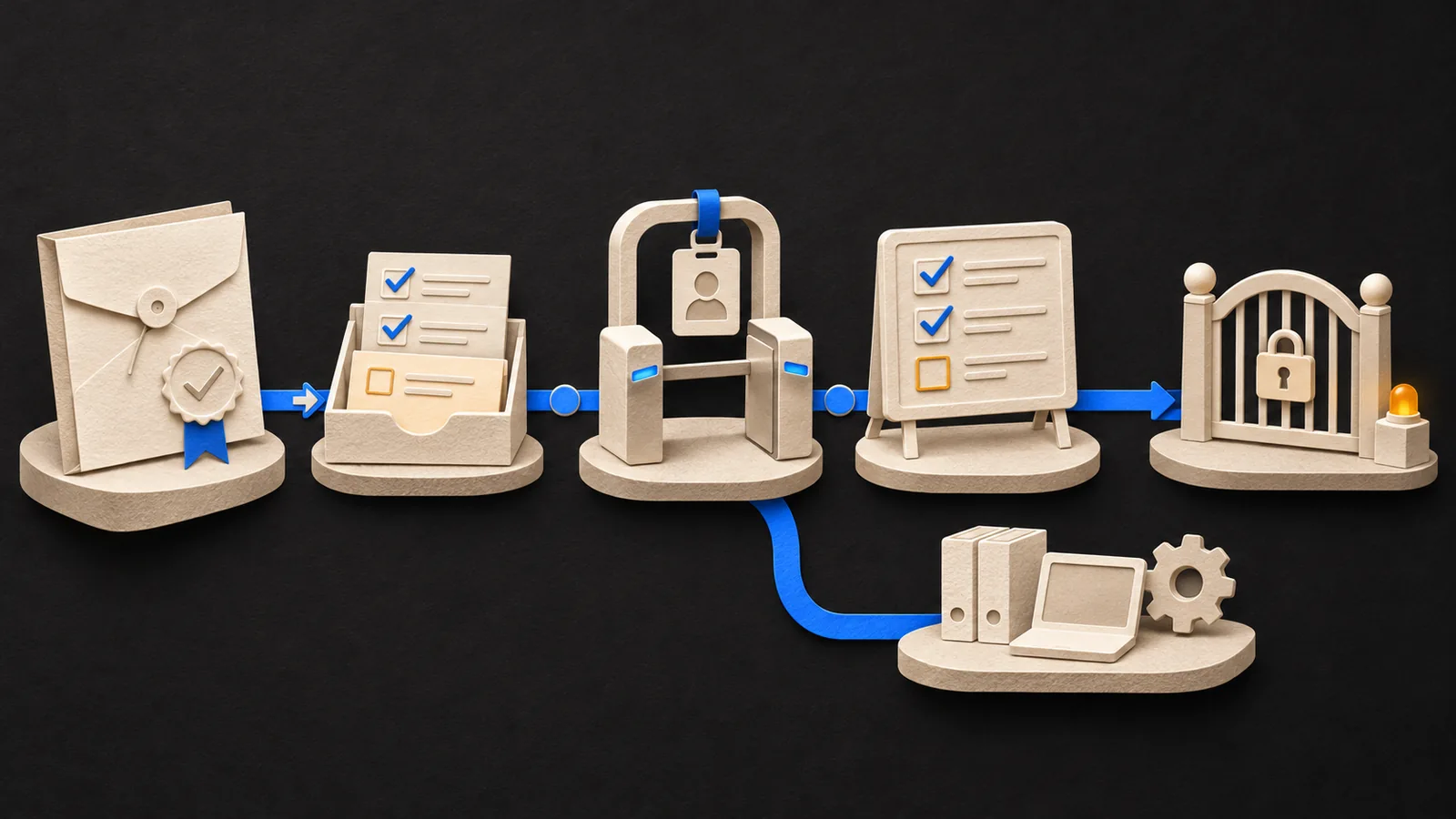
- Receive the accepted basisPreserve agreed scope, version, exclusions and the delivery owner.
- Build the requirement registerRequest only the documents and facts the service needs.
- Review and resolve inputsSeparate client action from internal review and authorized alternatives.
- Coordinate named accessRequest the required resource and role, then verify the permitted task.
- Decide readinessRecord ready, limited or blocked with current evidence and authority.
- Monitor the handoffTrack the owned next action, changed scope and stale queued work.
Use separate controls for documents, access and kickoff
The client onboarding document collection guide owns requirements, received files, reminders and stop conditions. ON-601's scope brief needs an internal reviewer, not another missing-file email to the client.
The client onboarding access checklist owns named identity, resource, role, approval, verification and removal. An invitation record is evidence of an invitation, not evidence that the permitted work can be performed.
The client kickoff readiness checklist brings those inputs together for a specific start decision. It keeps a meeting booking separate from permission to start delivery and tests the effect of a changed engagement version.
Choose technologies for the record, coordination and evidence jobs
Technology references checked November 2, 2026. The table below maps documented product capabilities to possible implementation roles. It is a design recommendation, not a claim that OpSmith has installed every integration or that a particular license includes all required features. Use the existing approved systems where they can preserve the needed states and ownership.
| Technology | Possible job in the workflow | Control still needed |
|---|---|---|
| Microsoft Lists / SharePoint + Power Automate | Requirement metadata, approved file references and date-based coordination | Recheck current state; a reminder template is not a readiness engine |
| Microsoft Entra External ID / ID Governance | Named external identities and governed access lifecycle where configured | Verify actual resource and task; maintain approval, expiry and removal |
| Dynamics 365 Project Operations or existing CRM/project platform | Keep engagement basis, project context and delivery ownership connected | A contract record does not prove inputs or access are ready |
| Google Document AI | OCR, classification or extraction for suitable document sets | Evaluate document fit and review the proposed requirement match |
| OpenAI Responses API with Structured Outputs | Prepare consistent source-linked requirement or exception fields | Schema adherence does not establish truth or grant authority |
Evaluate current models against the onboarding failures that matter
A small missing-item message may need a maintained rule and approved wording. A mixed document packet with contradictory scope may justify a stronger model for preparation. Choose the least complex approach that passes the actual quality and control requirements; model size and context length are not substitutes for reviewed evidence.
The current documentation includes GPT-6.1 Sol and GPT-6 Astra, Claude Sonnet 5.5, and Gemini 4 Argon. The following task assignments are candidates to test, not measured winners. Availability, processing terms, tool support and deployment configuration must be checked for the selected route before client information is submitted.
| Candidate | Useful evaluation task | Failure to inspect |
|---|---|---|
| GPT-6.1 Sol (gpt-6.1-sol) | Structured draft of requirement IDs, source references and unknown fields | Invented facts in valid structured output |
| GPT-6 Astra (gpt-6-astra) | Prepare review questions across conflicting engagement evidence | Treating a requested change as accepted scope |
| Claude Sonnet 5.5 (claude-sonnet-5-5) | Compare source-grounded summaries and next-action drafts | Conflating receipt, acceptance and readiness |
| Gemini 4 Argon (gemini-4-argon) | Evaluate a permitted mixed text, image or PDF packet | Losing source location or inferring inaccessible evidence |
Use the same permissioned inputs and independently reviewed expectations for each candidate. Record unsupported claims, missing uncertainty, reviewer correction effort, latency and cost separately. The downloadable evaluation sheet leaves result columns blank because no provider benchmark was run for this guide.
Download the engagement-readiness packet
- Six-case evaluation sheet with blank actual-result columns
- Eight workflow and event-order acceptance tests
- Complete worked onboarding pack (ZIP)
- Instructions, local checks and example limits
Worked records and review structures, with no client-performance or model-accuracy claim. The pack contains no passwords, tokens or actual client files.
Give AI a bounded evidence task instead of authority over onboarding
A useful extraction result identifies the engagement and requirement, the proposed value, the supporting file or message, and any uncertainty. Keep state changes, permission grants and required professional sign-off outside generated prose. A source document can contain instructions or commercial requests; neither automatically becomes an instruction to the automation.
OpenAI's Structured Outputs can constrain response structure, but the official guidance notes that structured responses can still contain mistakes. Include explicit unknown or incompatible-input states rather than forcing every source into a completed answer. Validate identifiers and the relationship to the current engagement after extraction.
If using retrieval over files, restrict the evidence to the approved engagement and current document versions before retrieval. OpenAI File Search supports file metadata filtering; such filters are one implementation mechanism, not a complete authorization boundary. Apply access controls in the application and backing stores, and verify that retrieved sources belong to the intended client.
Use the AI governance framework to document allowed data, tools, authority and review. Before changing a model, prompt or field mapping, run the automation regression testing checklist against received-but-unreviewed files, stale versions and unavailable access evidence.
Pilot one service type and measure the work that remains
Start with one repeatable engagement type and preparation-only automation. Have the coordinator and delivery owner inspect the register and proposed next actions before enabling messages or system writes. Test late uploads, unreadable files, changed scope, unavailable owners, access expiry and cancellation using the eight provided cases.
Measure collection waiting time, internal review age, access-verification delay, clarification rounds and reminders sent after receipt. Preserve the original state timestamps through returns and replacements. A faster welcome email should not conceal a growing review queue or a start date promised without the prerequisites.
For an uncertain update or send, follow workflow exception handling and reconcile the destination before repeating the action. OpSmith's professional services automation work can connect these administrative handoffs around the firm's existing systems and professional review.
Frequently asked questions
Does a signed engagement mean client work can start?
Not automatically. Preserve the accepted scope, then check the practical and professional prerequisites for the specific work. ON-601 still has unresolved scope review, contact, inventory and access gates despite its accepted engagement.
Do we need to replace our CRM or buy a client portal?
Not necessarily. Existing approved systems can support a bounded process if they preserve requirement states, source references, permissions and ownership. A portal can improve interaction, but does not determine whether inputs or access satisfy the start conditions.
Which AI model is best for client onboarding?
There is no measured winner in this guide. Evaluate the current named candidates on the actual preparation task, approved data route and independently reviewed cases. Keep quality, uncertainty, reviewer effort, latency and cost separate from permission or professional authority.
Can some setup proceed while onboarding is blocked?
Only within an explicit authorized scope. Internal next actions are not a blanket release of client delivery. Record the allowed activities, excluded work, responsible owner, evidence and current engagement version for any limited release.
Sources and further guidance
These official references provide relevant technical, privacy, risk-management or accountability guidance. OpSmith applies the useful principles to the operation of one business workflow.
- Project contract context and structureMicrosoft Learn
- Date-based SharePoint reminder building blockMicrosoft Learn
- External-user access lifecycleMicrosoft Learn
- Document AI processing capabilitiesGoogle Cloud
- GPT-6.1 Sol model documentationOpenAI
- GPT-6 Astra model documentationOpenAI
- Structured Outputs and remaining factual errorsOpenAI
- File Search and metadata filtersOpenAI
- Claude Sonnet 5.5 documentationAnthropic
- Gemini 4 Argon and supported input typesGoogle