
- Power Automate deserves a first look for Microsoft 365 processes and desktop automation; Zapier for supported handoffs across cloud apps; n8n for flexible orchestration with a capable workflow owner.
- n8n offers both managed Cloud and self-hosting. Custom code can extend any of these platforms when one operation needs it.
- Compare the same workload, required plan and maintenance effort. This is a documentation-based buying guide checked November 4, 2026; no speed, reliability or hands-on platform benchmark is claimed.
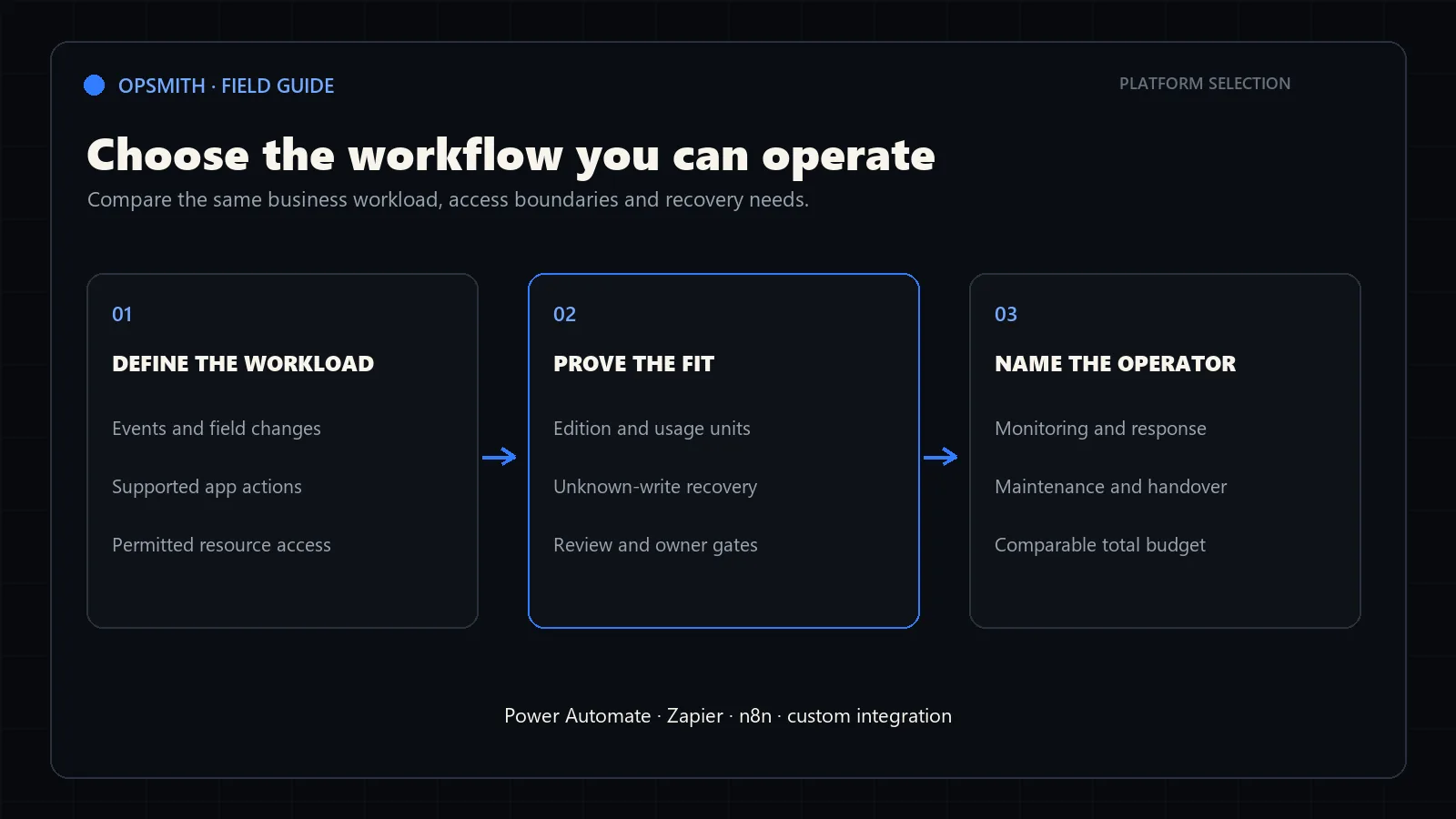
Use a conditional shortlist instead of a universal winner
A small team moving a form submission into a SaaS system has a different operating problem from a Microsoft tenant handling shared-mailbox documents or a technical team coordinating several APIs. Start with the tools already governed by your organization, then check the exact action and authentication method. A connector name alone does not prove it can perform the required operation under your account's permissions.
The table is OpSmith's selection judgment, not a vendor performance ranking. Platform capabilities, editions and app actions change. Confirm the current contract, connector action and administrative requirements in a trial before treating any candidate as selected.
| Candidate | Why shortlist it | Main trade-off | Resolve before choosing |
|---|---|---|---|
| Power Automate | Microsoft 365 processes; cloud flows and desktop automation in one product family | Licensing and tenant governance need attention; desktop automation adds machine dependencies | Exact actions, premium/custom rights, flow ownership and request limits |
| Zapier | A visual handoff across supported cloud apps that a business team can inspect | Action and task requirements can grow as the process branches or repeats | App-specific fields, authentication, plan and replay behaviour |
| n8n | Flexible workflow orchestration with managed Cloud or self-hosted deployment | Someone still owns workflow logic; self-hosting adds infrastructure work | Required edition, deployment choice, credentials and recovery |
| Custom integration | A specific unsupported operation or state-management requirement | Your maintainer owns the API and software lifecycle | Durable state, deployment, monitoring and long-term support |
Compare hosting, desktop automation and the skills your team needs
Power Automate cloud flows connect services through event, button or scheduled triggers. Its desktop flows add robotic process automation, or RPA: interacting with a desktop or web interface when that is the chosen integration route. If a legacy Windows task is central to your process, assess that capability explicitly rather than comparing only cloud-app connectors.
Zapier is a hosted service for building app-to-app workflows. n8n offers managed Cloud as well as self-hosted editions, so choosing n8n does not require running a server. Managed hosting removes some infrastructure work; the business still needs someone to maintain mappings, credentials, review rules and exception handling.
For a simple supported trigger and action, a business user may be able to maintain the workflow. As branches, custom API requests and shared state accumulate, technical support becomes more valuable on every platform. Assess the actual design your team will inherit rather than assigning a permanent beginner or developer label to a product.
Worked selection: one inbox, two applications and an unresolved access gate
Assume a fictional coordinator reviews requests from a Microsoft 365 shared inbox and updates an existing HubSpot contact. The team already has a Microsoft administrator but no infrastructure operator. Its desired outcome is fewer repeated copies between the inbox and CRM, with the coordinator still approving the proposed fields.
First test whether HubSpot's native inbox options already cover the need. If custom field updates and review are still required, shortlist Power Automate around existing tenant ownership. Keep Zapier as an alternative if its exact Outlook and HubSpot actions meet the same contract. n8n Cloud remains an option for a capable workflow maintainer; self-hosting has no established benefit in this scenario because nobody owns the server work.
The recommendation stops at a shortlist until shared-mailbox access and destination property updates are proven. If the required operation is missing, compare a small custom adapter with switching the orchestration platform. This decision trace is original planning analysis, not a record of a connected trial. The separate integration walkthrough develops the same example's access and field contract.
Starting prices help orient a budget; the required tier decides the bill
On November 4, 2026, the US Power Automate pricing page lists Premium at US$15 per user per month, paid yearly. Zapier's pricing page lists Professional from US$19.99 per month billed annually. n8n's pricing page lists hosted Starter at €20 per month billed annually with 2,500 executions. These are vendor entry points in their displayed markets and currencies, not equivalent plans or Canadian-dollar quotes.
A 3,000-task workflow should not be priced at a plan's minimum allowance without checking the matching tier. Likewise, the n8n Starter execution allowance does not establish that its collaboration or governance features meet your requirements. Desktop bots, premium connectors, extra usage, AI services and support may change the selected package.
For a Canadian budget, record the vendor's billing currency, annual commitment, applicable tax and current quote for the actual workload. Keep implementation, internal review and ongoing maintenance separate from the subscription. The worksheet below makes those inputs visible without inventing a price for an unscoped build.
Prove the required action with the access you can actually grant
Write down the source resource, destination record, fields, expected volume and permitted action. Then check read versus write access, shared versus personal resources, tenant consent, service-account policy and who can renew or revoke access. A working personal-mailbox demo does not establish a shared-mailbox production design.
Power Automate licensing distinguishes user and capacity arrangements, and premium or custom connectors may require additional rights. Existing Microsoft 365 access should not be assumed to cover every intended flow. Microsoft also documents request allocations separately from individual service and connector limits. Check both against the proposed design.
For a concrete permission boundary, see the Outlook-to-HubSpot integration walkthrough. The same business workflow can be implemented with different orchestration tools, but each implementation must still satisfy the source and destination APIs.
Normalize one workload before comparing subscription prices
Assume a fictional month contains 1,000 new source events. Each event needs three successful destination action steps: one lookup, one approved update and one owned handoff. Exclude retries, tests, branching, polling and AI usage for this first calculation. These exclusions make it a lower-bound planning scenario, not a quote.
Under the stated Classic Zap assumption, 1,000 multiplied by three billable successful action steps produces 3,000 tasks. For n8n, assuming exactly one workflow execution per event gives 1,000 executions. Those are different units, not evidence that either plan is cheaper. Zapier documents billing changes beginning December 1, 2026 for NextGen Zaps and SDK usage; this November 4 example does not apply that future model to Classic Zaps.
For Power Automate, enumerate the actual requests and confirm the applicable entitlement and connector limits; three business actions are not a complete request count. For custom code, estimate compute, queues, storage, logs and API usage as well as engineering and support. Add reviewer time and exception handling to every option, then compare the same currency, tax treatment and time horizon.
The Canadian workflow automation cost guide covers implementation and ongoing costs. Vendor subscriptions are separate from OpSmith's scoped service fees; this worksheet introduces no new platform or implementation prices.
| Option | Illustrative planning quantity | Still to price or verify |
|---|---|---|
| Zapier Classic | 3,000 successful billable action tasks | Plan, actual billable actions, replay and product-specific rules |
| n8n | 1,000 workflow executions | Plan/edition, execution boundaries and hosting responsibilities |
| Power Automate | Request count not determined by this business-action sketch | Actual flow operations, entitlement and connector constraints |
| Custom | 1,000 logical events, not a hosting bill | Infrastructure, API consumption and maintenance effort |
Download the platform decision worksheets
Record your requirements, evidence and budget assumptions before comparing quotes. The completed workload uses fictional volumes.
Compare the recovery path and the person who will operate it
Ask what happens if a destination accepts an update but its response is lost. The design needs an inspectable action identity, recorded attempt, destination reconciliation and a defined retry decision. A platform's successful-run badge is not enough to establish that the intended business record is correct. Replaying a whole workflow can repeat a previously completed side effect unless the design prevents it.
Self-hosting n8n adds responsibility for infrastructure, access, updates and recovery; edition-specific features still need checking. Hosting software in your chosen location does not by itself establish that every connected app, log or AI processor keeps data in Canada. Map the full data path and the actual vendor arrangements.
Custom code can sit inside or beside these platforms. A small adapter may solve one unsupported operation while leaving scheduling and review in an existing tool. Compare that bounded option with replacing the entire workflow. Record source ownership, configuration export, credential transfer, monitoring, incident response and an exit path before handover.
Select after a bounded pilot, with written acceptance evidence
Run a representative normal case plus duplicate delivery, changed input, revoked access, rate limiting, unknown update outcome and owner absence. Record the expected destination state and verify it directly. Use synthetic or approved test data, and inspect what test actions can actually change in the connected apps.
Reject a candidate that cannot satisfy a required boundary with an acceptable operating burden. If two candidates pass, compare total cost and who can maintain the resulting design. Keep the evidence behind the decision so a future connector or licensing change can be reassessed without restarting the analysis.
Use an Operational AI Blueprint assessment to define that scope and acceptance plan. For a live workflow, managed automation services should have an explicit monitoring and ownership agreement. The reconciliation guide explains how to verify outcomes beyond run status.
Frequently asked questions
Which is best: Power Automate, Zapier or n8n?
There is no universal winner. Shortlist Power Automate for a Microsoft-centred process, Zapier for a supported SaaS handoff, and n8n for technically owned orchestration. Validate exact actions, permissions, recovery and total cost before selecting.
Does Microsoft 365 include every Power Automate workflow?
Do not assume so. Check the actual licensing arrangement, connector classification, flow ownership and request requirements. Premium or custom connector use can require additional rights.
Are 3,000 Zapier tasks comparable to 1,000 n8n executions?
Only as quantities calculated from explicit workload assumptions. They are different billing units and do not establish equal capability or relative cost. Add retries, tests, hosting, plan features and operating work before comparing budgets.
Is self-hosted n8n free to operate?
Software availability does not eliminate infrastructure or operating work. Budget for hosting, access controls, updates, backups, incident response and any edition-specific features the workflow requires.
When should we choose custom integration code?
Use it when a concrete requirement justifies the additional ownership, such as an unsupported API operation or specific state and recovery needs. A bounded custom adapter can also complement an existing automation platform.
Sources and further guidance
These official references provide relevant technical, privacy, risk-management or accountability guidance. OpSmith applies the useful principles to the operation of one business workflow.
- Cloud flows and desktop flowsMicrosoft Learn
- Power Automate plan pricingMicrosoft
- Zapier plans and task tiersZapier
- Managed Cloud and self-hosted deployment choicesn8n
- Power Automate licensing typesMicrosoft Learn
- Power Platform request limits and allocationsMicrosoft Learn
- How task usage is measuredZapier
- Execution-based plans and featuresn8n
- Self-hosting responsibilitiesn8n