
- RC-401 v1 is accepted at CAD 1,600. A proposed v2 adds CAD 120 and changes the requested pickup window, but has not been accepted.
- The newest document does not silently replace the agreed basis. A coordinator owns the next action while appointment and driver-assignment gates remain unresolved.
- Download the version comparison, held dispatch packet and blank handoff template. The example does not establish carrier eligibility, routing or permission to move freight.
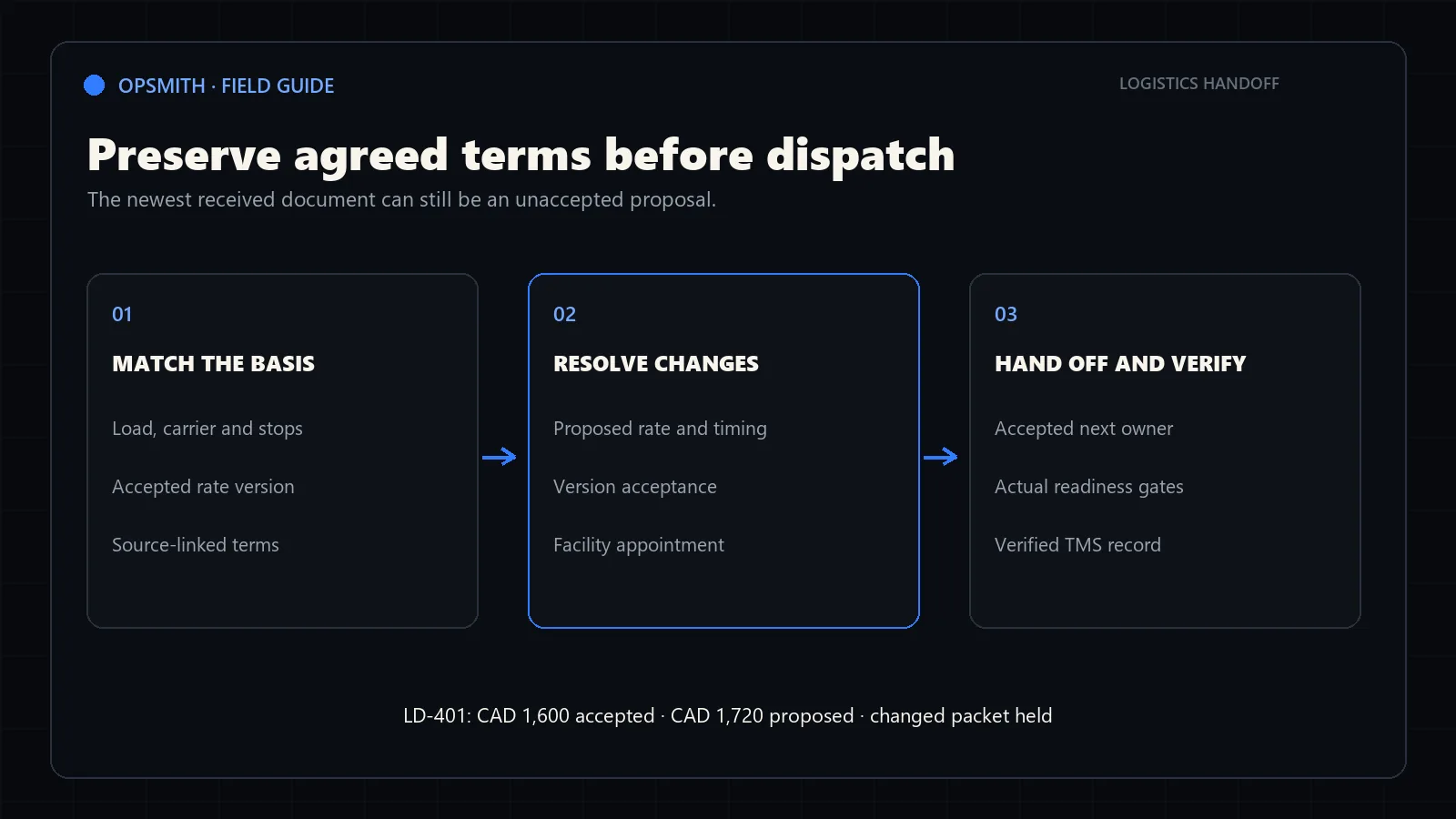
Separate commercial agreement from operational readiness
A rate confirmation can carry the parties, load reference, charges, stop requirements and agreed terms for a movement. Its creation, transmission, receipt and acceptance are different events. Define which evidence establishes the current commercial basis and which operating decisions must still occur before the dispatch handoff is released.
The actual agreement and responsible commercial and dispatch owners determine what is permitted. This guide organizes administrative records; it does not verify carrier authority or insurance, determine hours-of-service or route safety, interpret liability or authorize a vehicle movement. Keep those required checks in the organization's actual operating process.
OpSmith's logistics automation work can connect the document and dispatch records around existing tools. The bill of lading data extraction guide covers a different document handoff; a bill of lading is not interchangeable with the commercial rate-confirmation record.
Review the source fields before preparing the dispatch record
This guide addresses the administrative handoff between the people resolving commercial terms and the people coordinating dispatch. Name which party owns each decision in your operation. A broker's bid award, carrier acceptance, appointment confirmation and internal release can be different events even when the same document carries several of their references.
Use the checklist to define the source contract for extraction. Preserve the actual wording and evidence for an exception rather than turning an omitted field into a default. These are fields to assess for your operation; the LD-401 teaching packet does not provide a complete real-world movement record.
| Group | Capture and compare | Unresolved question to route |
|---|---|---|
| Parties and load | Intended accounts, carrier and load/customer references | Does the document match the approved movement and parties? |
| Stops | Ordered pickup/delivery locations, dates, windows, time zones and references | Is a time requested, proposed or confirmed by the facility? |
| Cargo and equipment | Relevant commodity, quantity, units, equipment and stated requirements | Which required facts need confirmation rather than inference? |
| Charges | Linehaul, fuel, other charges, currency and total | Which additions are proposed or require separate agreement? |
| Conditions | Source-linked stop instructions and applicable commercial exceptions | Who must resolve an unclear or conflicting term? |
| Acceptance and version | Issued/received version and acceptance evidence | Does the available agreement apply to this exact version? |
| Next operating handoff | Coordinator, remaining readiness gates and destination record | Who owns the next action and what evidence permits release? |
Worked example: an accepted CAD 1,600 basis and a pending CAD 1,720 proposal
LD-401 is a fictional road-freight load with carrier reference CARRIER-401 and stops PICKUP-401 and DELIVERY-401. RC-401 v1 contains CAD 1,450 linehaul plus CAD 150 fuel, totaling CAD 1,600 before applicable tax. The example records acceptance of v1 and a requested November 5 pickup window of 08:00–10:00 UTC-06:00. A requested window is not evidence of a confirmed facility appointment.
A proposed RC-401 v2 adds CAD 120 and requests a 10:00–12:00 pickup window. Its arithmetic is CAD 1,720, but acceptance of the changed version is pending at the November 4 cutoff. The example's current accepted basis remains v1; the newest received document is the pending proposal, not an automatically agreed replacement.
The organization's fictional release policy holds this materially changed packet until the commercial owner resolves whether to proceed on the existing basis or obtain agreement to the revision. A dispatch coordinator has accepted responsibility for the next action, but facility appointment confirmation and driver assignment are still pending. The packet is held; the example contains no actual booking, dispatch, carrier verification or price quote.
| Field | Accepted v1 | Proposed v2 | Handoff consequence |
|---|---|---|---|
| Linehaul | 1,450 | 1,450 | Preserve the same charge basis |
| Fuel | 150 | 150 | Do not omit an agreed component |
| Additional charge | 0 | 120 proposed | Commercial authority and acceptance remain pending |
| Total | 1,600 | 1,720 proposed | 120 difference is not automatically an approved charge |
| Requested pickup window | Nov 5, 08:00–10:00 UTC-06:00 | Nov 5, 10:00–12:00 UTC-06:00 | Reconcile requested timing and facility confirmation |
| Version acceptance | Accepted in worked record | Pending | Retain v1 as accepted basis; hold changed packet under example policy |
Download the worked records and templates
These are fictional administrative examples. No actual drawings, carriers, contracts, client results or executed model-performance measurements are supplied. Acceptance cases state expected decisions with actual results unrun.
Match the parties, movement and stop identities before copying fields
Preserve the original document or message and match its load, account, carrier, stop sequence and source identity against the approved records. An abbreviated reference or a familiar carrier name may be insufficient where several accounts or movements share similar identifiers. Keep ambiguous matches in review instead of creating a plausible new load.
Store each charge with its currency, description, amount, inclusion or exception reference and version. Keep requested, proposed and confirmed stop times distinct, with dates and explicit time zones. Avoid carrying an undated local time from a forwarded email into a confirmed appointment field.
AI can prepare a source-linked field proposal or highlight differences between versions. Validate identity, arithmetic and missing fields outside that draft. It should not invent an accessorial agreement, remove an inconvenient condition or infer that opening a document establishes acceptance.
The document processing automation service can prepare this extraction and review path. The consequential commercial and dispatch decisions remain with their responsible owners.
Retain the accepted basis while resolving a proposed change
Keep a version register with issue, receipt, acceptance evidence, effective terms and the source of each change. A newer file can be a proposal, correction or disputed document. Resolve that meaning before overwriting the operating record or preparing customer-facing instructions from it.
In LD-401, the difference is not only CAD 120: the requested pickup window also changes. The coordinator must not merge the new total with the old timing or reuse v1 acceptance for v2. The commercial owner decides the next permitted basis, and the relevant parties establish any required acceptance under their actual agreement.
Record what was accepted, by whom, when and for which version. If the evidence is unclear, preserve the unresolved question rather than declaring either cancellation or agreement. A repeated copy of v1 should not create another booking, and a genuine revision should not be discarded as a duplicate solely because the load number is unchanged.
Give each readiness gate a named owner and inspectable evidence
A useful dispatch packet includes the current commercial basis, load and stop references, relevant cargo and equipment requirements, access details, appointment evidence, dispatch owner and the next operational action. Include the unresolved decisions so a coordinator does not have to reconstruct them from an inbox.
Keep coordinator acceptance separate from carrier acceptance, a facility appointment, driver assignment and any other required operational checks. LD-401's coordinator owns the next task, but that does not establish that the changed terms are agreed or that the movement is ready. Use the actual operation's release criteria; this worked checklist is not a complete dispatch procedure.
When a TMS draft is prepared, verify its identity, version and fields at the destination. A successful technical run does not prove that dispatch responsibility was accepted. After an uncertain write, inspect the destination before retrying so the recovery path does not create another load or instruction.
- MatchPreserve source, parties, load and ordered stop identities.
- CompareKeep accepted terms and pending proposals versioned.
- ResolveObtain the required commercial and appointment decisions.
- HandoffConfirm the named coordinator and actual readiness gates.
- VerifyInspect destination records and retain unresolved outcomes.
Use the version comparison to produce a useful held handoff
Read the completed rate-version comparison alongside the blank dispatch-handoff template. Enter the source version, accepted basis and proposed differences separately. Keep commercial agreement, appointment evidence, coordinator ownership and remaining operating checks as distinct gates. For an unresolved field, name the person who can answer it and the next review time.
LD-401's held packet can be summarized as follows: accepted basis RC-401 v1, CAD 1,600; received proposal v2, CAD 1,720, acceptance pending; requested November 5 pickup changes from 08:00–10:00 to 10:00–12:00 UTC-06:00; facility appointment confirmation and driver assignment remain pending; coordinator owns follow-up. This wording preserves the actual differences rather than labelling the movement ready.
If the revision remains unresolved near the required operating decision, escalate it through the commercial and dispatch owners' actual process. Record the permitted next basis when the decision arrives, recheck affected downstream fields and retain the earlier version. A resend of the same document should recover its existing review state; a changed version needs a new comparison.
Confirm the booking workflow and carry its evidence downstream
DAT One's bid guidance describes acceptance followed by sending a rate confirmation. Its private-load documentation describes different booking paths, including broker portals. Check your actual provider and account path; a received PDF or booking request does not establish every remaining operating decision.
Check the actual account, broker or carrier workflow, TMS integration and acceptance evidence. The LD-401 reference structure is independent teaching material, not a DAT payload or a claimed OpSmith installation. Choose the native capabilities that preserve the necessary identities and decisions before adding custom synchronization.
After the handoff, carrier status update automation prepares operational event evidence. A later ETA should not silently change the accepted commercial terms or customer appointment. The shipment exception management workflow owns deviations that need accountable response once the movement is being coordinated.
Pilot changed terms, unknown outcomes and incomplete readiness
Test ambiguous load identity, a currency mismatch, an accepted old version with a pending revision, a changed stop window, an unagreed added charge, coordinator ownership without driver assignment, duplicate source delivery and an uncertain TMS write. The acceptance file has expected decisions with actual results unrun; no production reliability or model accuracy is claimed.
Measure preparation and review effort separately from the age of commercial holds, appointment questions and unaccepted operating handoffs. Retain the actual reason work is waiting. A faster document-to-TMS transfer is not evidence of a confirmed appointment, safer dispatch or improved delivery performance.
For downstream billing evidence, use proof of delivery invoice matching. That later comparison needs the applicable accepted agreement and delivery evidence; it should not treat LD-401's proposed CAD 120 as an approved charge merely because it appeared in a received document.
Frequently asked questions
Does receiving a rate confirmation prove the load is ready for dispatch?
No. Record document receipt, version acceptance and the applicable operational checks separately. The responsible commercial and dispatch owners define the actual requirements for the movement.
Should the newest rate confirmation overwrite the accepted one?
First determine whether it is an accepted revision, pending proposal or correction. Preserve the accepted basis and the proposed differences with their evidence. A later receipt time alone does not establish agreement.
Why is LD-401 held even though the coordinator accepted the task?
The changed commercial version is pending, facility appointment confirmation is absent and driver assignment is unresolved. Coordinator ownership establishes who acts next, not that all readiness gates are satisfied.
Can an added charge be included automatically if the arithmetic is correct?
Correct arithmetic does not establish commercial authority or acceptance. Keep the added charge tied to its version and supporting decision, and route unresolved terms to the responsible owner.
Does the packet verify carrier eligibility or authorize a vehicle movement?
No. It is fictional administrative teaching material, not carrier verification, transport-safety guidance, regulatory advice or permission to dispatch. The actual operation must apply its required checks and authorized decisions.
Sources and further guidance
These official references provide relevant technical, privacy, risk-management or accountability guidance. OpSmith applies the useful principles to the operation of one business workflow.
- Bid acceptance and rate-confirmation handoffDAT One Help Center
- Provider-specific private-load booking pathsDAT One Help Center