
- OWN-017 is the intended recipient of a NORTH-04 packet for October 2026; release awaits recipient verification. SOUTH-09 belongs to a different owner and is excluded from the example's report scope.
- Five opening work orders plus three new orders minus two verified closures leave six open. The completed inspection still has two open findings.
- Download the source snapshot, draft owner narrative and report-control register. The example is not a client report, accounting opinion or performance result.
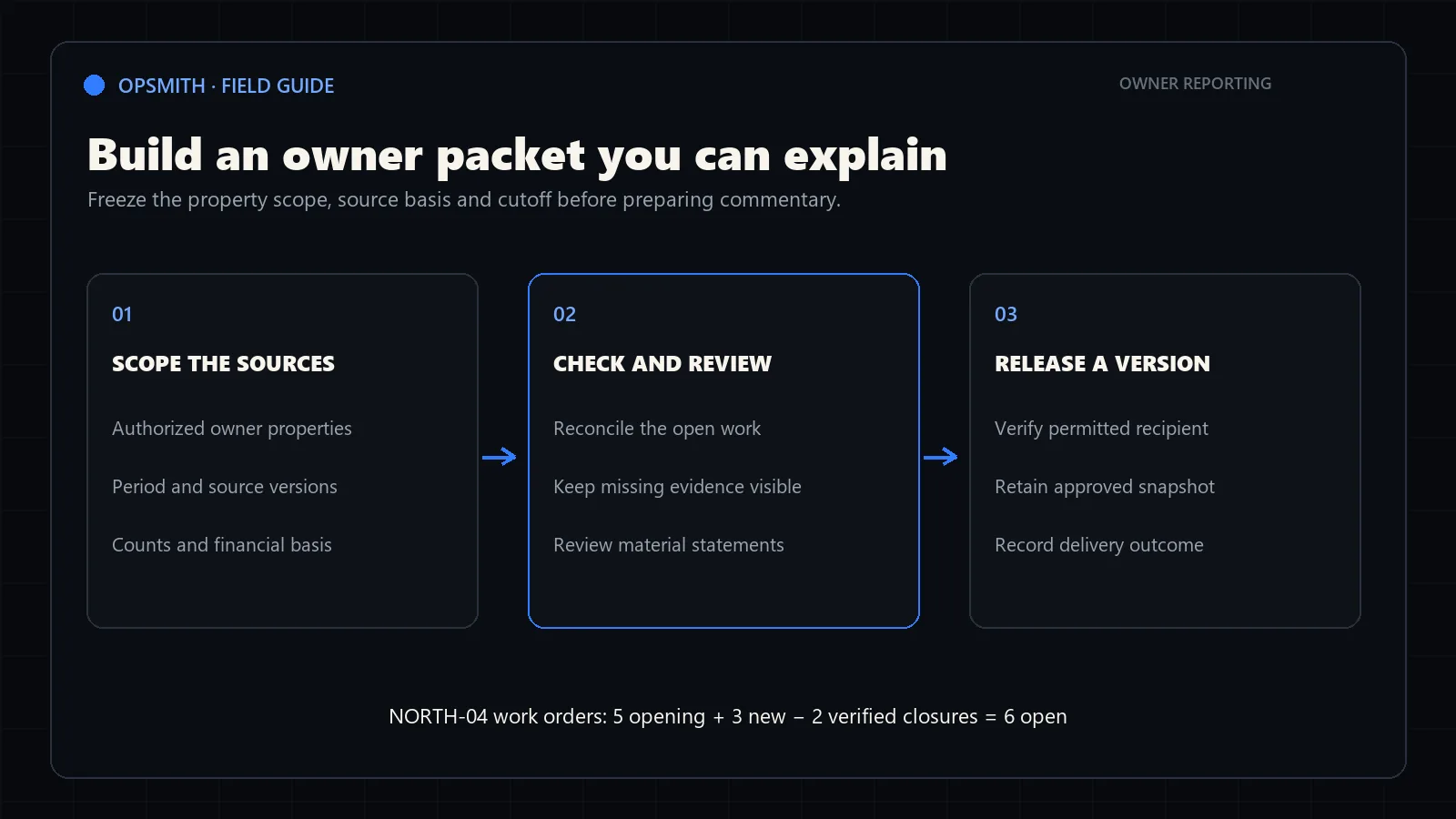
Define the owner, properties, period and reporting basis first
Begin with the recipient's authorized property scope, the applicable period and the purpose of the packet. A report for one owner is not the same population as the manager's entire portfolio. Confirm effective ownership or reporting entitlements, property identifiers and the intended audience before joining records.
A monthly packet can combine an approved financial statement, occupancy snapshot, maintenance activity and management commentary. Keep each source's basis visible. A point-in-time occupied-unit count, a count of new requests during the month and a cash-receipt total answer different questions; a common page layout does not make them interchangeable.
OpSmith's property management automation work can connect these source and review steps around your existing records. Confirm the authoritative accounting and property systems before introducing a new reporting layer.
Choose the report contents around the owner's decisions
Agree the contents and reporting deadline with the owner under the management arrangement. A useful packet explains the approved financial position, property activity and decisions needed next. The following is a planning checklist; include the sections relevant to the property and available approved sources rather than filling every section with guessed figures.
Buildium's owner-reporting guidance describes combining financial information, property activity and fee/distribution visibility. This guide adds the source, cutoff and release controls needed to assemble that information across systems.
| Section | Useful content | Source or review needed |
|---|---|---|
| Financial statements | Approved period statement and any agreed comparison with budget | Financial owner's approved basis, period and version |
| Rent and receivables | Rent roll, receipts and overdue balances where authorized | Defined billed/received/overdue measures; no inference from occupancy |
| Occupancy and leasing | Occupied units, vacancies, renewals and upcoming leasing actions | Dated unit/lease records and the measure's denominator |
| Maintenance and inspection | Work opened/closed, unresolved findings and material exceptions | Item-level registers with verified closure and next owners |
| Fees, reserves and distributions | Agreed fees, approved balances and distribution information | Approved financial source; cash balance alone is not a payment instruction |
| Decisions and next period | Pending owner decisions, planned work and responsible next actions | Manager-reviewed scope, due dates and required authority |
The NORTH-04 fixture demonstrates occupancy, work-order reconciliation, inspection status and illustrative cash activity. It does not supply a full rent roll, arrears ageing, budget comparison, fee calculation or distribution instruction. Obtain those approved sources before including those sections in a real packet.
Worked example: six open work orders and two unresolved inspection findings
The fictional RPT-2026-10-N04 v1 packet is for owner OWN-017 and property NORTH-04, covering October 1 through October 31, 2026. Its cutoff is October 31 at 23:59:59 UTC-05:00. SOUTH-09 is assigned to OWN-028 in the example register, so it is excluded rather than accidentally combined with NORTH-04. The planned population for this packet is one property, with one covered property snapshot.
The work-order source contains five orders open at the start, three created during the period and two with verified closure during the period. There are no reopened, transferred or cancelled orders in this particular fixture. Closing backlog is therefore 5 + 3 − 2 = 6. WO-801 is one of those six: the contractor has reported work complete, but verification is still pending.
The linked INSP-801 inspection contains three findings. One has verified closure; the other two await verification or location clarification. These finding counts are not added to the six work orders, because findings and work orders have different identities and can refer to the same underlying work. The packet remains a draft awaiting manager review and recipient confirmation.
| Measure | Source basis | Worked result | Interpretation |
|---|---|---|---|
| Property coverage | One authorized property expected; one source snapshot present | 1 of 1 | Coverage for this owner packet, not the whole portfolio |
| Physical occupancy | 9 occupied units / 10 units at cutoff | 90% | Point-in-time unit count; not economic occupancy or a rent-collection rate |
| Open work-order bridge | 5 opening + 3 new − 2 verified closures | 6 closing | No reopen, transfer or cancellation adjustment in this fixture |
| Inspection findings | 3 findings; 1 verified closed | 2 open | Do not add finding count to work-order backlog |
| Illustrative cash activity | Approved example statement: 24,000 receipts − 8,500 payments | CAD 15,500 net movement | Not NOI, profit or an amount authorized for owner distribution |
Download the worked records and templates
The fictional NORTH-04 property connects the inspection and owner-reporting examples. There are no client records, real photographs, production results or repair instructions in these files.
Carry the approved financial basis without inventing accounting conclusions
The example statement FIN-N04-OCT v1 supplies opening cash of CAD 10,000, receipts of CAD 24,000 and payments of CAD 8,500. On that supplied cash-activity basis, net movement is CAD 15,500 and closing cash is CAD 25,500. These are arithmetic checks on a fictional source statement, not a prescribed accounting method or a reconciled bank account.
Do not label the net movement as net operating income, profit or cash available for distribution. Deposits, reserves, liabilities, capital items, fees and reporting policies can affect what different figures mean. The responsible financial owner approves the actual definitions, statement and disclosure; the automation should carry that approved basis rather than reconstructing accounting from fragments.
A CAD 600 invoice arrives on November 2 for a described October service. In this example it has not been approved or paid and is not part of the October cash payments. Record the late document for the financial reviewer. Its service date alone does not authorize an October posting or a silent change to the issued financial statement.
Use contractor invoice matching for the earlier authorization and completion checks. An owner-report summary is downstream evidence presentation; it does not post invoices or approve payments.
Keep the denominator and status meaning with each measure
Define whether a maintenance count concerns reports, findings, work orders, distinct assets or verified completions. One inspection finding can link to an existing work order, and multiple resident reports can concern one action. Counting messages, attachments or technical runs as completed repairs hides the actual workload.
A general backlog bridge may need reopening, transfer, cancellation and scope-change adjustments as well as new and closed work. Preserve item-level records so a reviewer can explain the bridge. The simple 5 + 3 − 2 formula is valid for the supplied fixture because those other event classes are absent, not because every portfolio should ignore them.
The 90% physical occupancy example uses nine occupied units out of ten at the cutoff. It is not an average for the month, a percentage of rent collected or evidence that vacant units were available for letting. Define the treatment of out-of-scope or unavailable units with the owner of the actual measure. Aggregate compatible counts and denominators rather than averaging property percentages blindly.
Generate commentary from a frozen, source-linked packet
Create a source register with the property scope, period, observation time, extract version, record counts and reviewer. Check completeness, identities and approved definitions before summarizing. An unavailable source is not zero activity; give the missing section a visible disposition and owner.
For the example, a useful draft says that six work orders remain open and that WO-801 awaits verification of the correct door. It does not say all inspection repairs were completed, because only one of three findings has verified closure. Material statements should point to the source identifier or register row that supports them.
AI can prepare a concise narrative from the approved fields and exceptions. Keep calculations and recipient selection outside the drafting task. Instruct the draft to preserve unknowns and avoid inferring causes, tenant fault, investment returns or commitments not present in the source. Have the property manager review material claims and the financial owner approve financial interpretation where required.
The report data validation checklist helps organize these checks. For the narrative step, the AI report summary workflow keeps source evidence and review authority visible.
Approve the recipient and preserve report versions
Use the current approved owner-property and contact register, not an address inferred from an old email thread. Check attachments, property scope and access permissions at release. The fictional recipient identifier in the download has no real email address, and the packet remains held until a manager confirms a permitted destination.
Verification of WO-801 received on November 1 is a later event under this example's cutoff policy. Keep the October snapshot intact and carry the verified result into the next appropriate update. If an error in the original report requires correction, issue a reviewed v2 with its reason, changed fields and relationship to v1. Do not overwrite the original document in place without a trace.
Record the approved report version, recipient scope, send attempt and confirmed outcome. A queue acknowledgement is not proof that the owner received the packet. If delivery outcome is unknown, reconcile the attempt before resending, particularly when the report contains sensitive financial or resident information.
- ScopeResolve authorized owner, properties and reporting basis.
- FreezeRecord source versions, cutoff and coverage.
- ValidateReconcile counts, definitions and material gaps.
- ReviewApprove commentary, financial interpretation and recipient scope.
- ReleaseRetain the report version and inspect the delivery outcome.
Set a close calendar and use the template to control release
Work backward from the agreed owner-delivery date. Assign source extraction to the system owners, financial review to the financial owner, operational commentary to the manager and recipient verification to the release owner. Set dates for each dependency; a scheduled email should not bypass an unfinished close or unresolved audience check.
Use the blank owner-report control register to record each section's period, source, definition, reviewer and unresolved question. Compare it with the completed NORTH-04 register. If a required source is late, the manager chooses the approved hold or qualified-release route and records what the owner will receive. Do not change the cutoff silently to make the report appear complete.
End the packet with decisions needed, responsible people and next review dates. In NORTH-04, the open door-verification question belongs in that action list. Keep sensitive resident details in their approved system and share only the operational description needed by the owner. The report's distribution remains separate from authority to spend or pay.
Use native reporting where it fits and test the missing handoff
Buildium describes owner packets, financial reporting, scheduled delivery and owner-portal access. Review the current plan and your account configuration before commissioning an additional report generator. An existing report may already provide the required statement; the useful custom work may be source validation, exception commentary or a cross-system handoff.
Keep tenant details and source images out of the owner packet unless they are necessary and permitted for that audience. Use the minimum useful operational description and approved document access. The privacy regulator's fair information principles provide relevant purpose, disclosure and safeguard guidance; the responsible organization determines applicable obligations and permissions.
Pilot one owner, one property set and one reporting cycle. Test a wrong-owner property, missing source, unverified completion, denominator mismatch, late invoice, changed cutoff state, unsupported narrative and uncertain sending outcome. The supplied acceptance cases have expected decisions but no claimed executed model or platform results.
Measure assembly and review time separately, along with missing-source rate, corrections after release and owner questions that expose unclear definitions. Faster publication is useful only when it preserves the right scope and evidence.
OpSmith's reporting automation services can connect this source-to-review path. Use the property inspection workflow to establish the finding and closure evidence that feeds the packet in the first place.
Frequently asked questions
Is an owner report the same as an owner statement?
An owner packet can include an approved financial statement plus occupancy, maintenance, exceptions and commentary. Keep the accounting statement's basis and approval separate from broader operational narrative rather than treating the two as interchangeable.
Can AI calculate the owner's payment from the report?
The workflow in this guide does not authorize owner distributions or accounting entries. It presents approved source figures. The responsible financial owner determines distributions, reserves, liabilities and the relevant accounting treatment.
Should a reported-complete work order count as verified closed?
Only when it satisfies the organization's defined closure evidence. In the example, WO-801 remains open at cutoff because its completion evidence identifies a different door. A contractor's status alone does not clear that verification gate.
What if one source is unavailable at the reporting cutoff?
Preserve the missing section or measure as unavailable, identify its owner and follow the approved hold or qualified-release policy. Do not silently substitute zero, a prior period or an invented current figure.
Does the example show real financial or customer results?
No. NORTH-04, its owners, records and amounts are fictional worked material. The packet demonstrates source scope, arithmetic, review and reporting boundaries; it is not a client case, bank reconciliation or accounting opinion.
Sources and further guidance
These official references provide relevant technical, privacy, risk-management or accountability guidance. OpSmith applies the useful principles to the operation of one business workflow.
- Owner report scope and native reporting capabilitiesBuildium
- Fair information principlesOffice of the Privacy Commissioner of Canada