
- RFI-401 has a designated response, but the received drawing revision is still under review. Neither field recipient has acknowledged the revised package.
- The example's CAD 1,250 cost proposal remains unapproved and its schedule impact is unresolved; an answered question does not clear those records.
- Use the combined RFI/drawing register to preserve identity, versions, affected recipients and the actual authority for the next action.
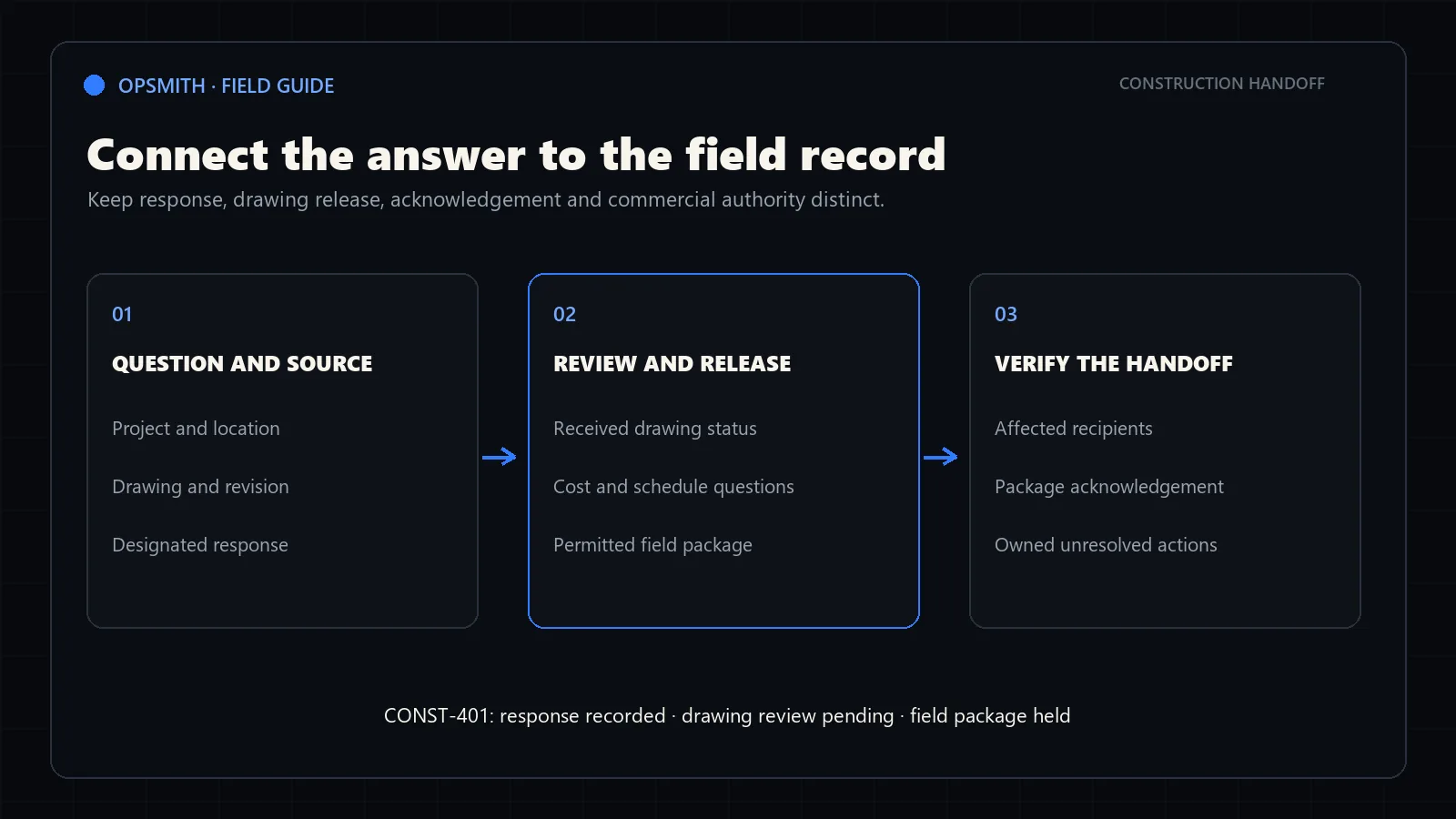
Start with the question and the project record it affects
An RFI, or request for information, asks the responsible project parties to resolve a specific information need. It may refer to drawings, specifications, site observations or an earlier response. Capture the project, location, document and revision references, exact question, required respondent and decision needed before routing it.
Keep the source question separate from proposed answers and informal discussion. The governing contract and authorized project roles determine the effect of a response, instruction or revised document. This guide designs administrative handoffs; it does not interpret a contract, supply design instructions or determine code or safety compliance.
The construction workflow automation guide connects field evidence with office records. OpSmith's construction automation work can organize this information path while preserving the decisions that belong to the project team.
Prepare an answerable RFI and identify the right review route
Check the available project documents and existing RFI register before raising another question. Describe one clear information need with its exact location and document references. Keep a suggested resolution labelled as a proposal so it cannot be mistaken for the designated answer.
Procore's construction RFI guide discusses document references, the information requested and the response process. The register below is an administrative starting point to adapt to the project's actual roles and procedures.
| Field | Capture | Review purpose |
|---|---|---|
| Identity | Project, RFI number, location and initiating party | Match the question to the correct job and history |
| Source references | Drawing/detail and specification references with revisions | Show exactly which documents need clarification |
| Question | Observed conflict or missing information and the specific decision requested | Make the information need answerable |
| Supporting material | Relevant permitted photo, sketch or attachment with source | Preserve evidence without supplying an invented design |
| Response owner and due date | Designated respondent, date needed and affected planned activity | Route and escalate under the project's agreed procedure |
| Potential effects | Identified cost, programme or field questions and their owners | Keep those questions visible without declaring them approved |
For CONST-401, a draft question could identify A-201 revision B and FS-04 revision C, describe the panel-type conflict and ask the designated respondent to confirm the coordinated requirement and applicable document reference. It should not convert the supplier's P2 proposal into an instruction.
Worked example: the RFI is answered while three handoffs remain unresolved
On fictional project CONST-401, RFI-401 asks about a panel-type conflict between A-201 revision B and finish schedule FS-04 revision C. A supplier comment proposes P2, but is not the designated project response. The authorized project process later records RESP-401 as the selected response, referring to coordinated documentation for the panel selection.
A-201 revision C is then received with transmittal TX-401. Its document-controller review and field-release decision are still pending at the November 4 cutoff. Two intended field recipients are listed, and neither has acknowledged a released revised package. A comparison or an upload does not substitute for that release and distribution record.
The linked commercial proposal CHG-401 contains a CAD 1,250 cost estimate before applicable tax. Its approval is pending and the schedule effect has not been resolved. The example explicitly holds the changed field package while the responsible roles resolve drawing release, field handoff and the applicable commercial decision. These are fictional records, not project instructions or verified construction outcomes.
| Record | Worked state | What is established | Owned next decision |
|---|---|---|---|
| RFI-401 / RESP-401 | Response designated in the example project process | The selected response and its source are identifiable | RFI owner confirms any remaining information question |
| A-201 revision C / TX-401 | Received; document review pending | A newer source file exists | Document controller records the permitted release status |
| Field package FP-401 | Not released; 0 of 2 acknowledgements | Intended recipients are known | Release owner distributes the reviewed package and verifies the handoff |
| CHG-401 | CAD 1,250 proposed; approval pending | An estimate exists, not an accepted price change | Commercial owner resolves authority and schedule impact |
Download the worked records and templates
These are fictional administrative examples. No actual drawings, carriers, contracts, client results or executed model-performance measurements are supplied. Acceptance cases state expected decisions with actual results unrun.
Keep drawing identity, revision and release status together
Use the project and drawing identifiers alongside the revision, issue purpose, source transmittal, received time and reviewed release status. Preserve the earlier revision and the relationship to the proposed replacement. Sorting by filename, upload time or the largest revision label is not enough to establish the document the field should use.
A visual comparison helps a reviewer find differences, but a highlighted difference is not a design decision. Procore's drawing-comparison guidance notes that drawings of different sizes cannot be compared through that feature. Check source quality, alignment and tool limits before treating a comparison as complete evidence of every change.
For A-201 revision C, retain TX-401 and the review hold. If another revision arrives before release, reassess the affected package rather than silently replacing the file behind an earlier approval. Give the field a clear current reference and preserve the history needed to explain a prior instruction.
Track field acknowledgement and commercial effect as separate decisions
Name the affected trade or field recipients, the exact package and revision they should receive, and the acknowledgement required by the project's process. A notification sent is not proof that the relevant people have the released information. Acknowledgement establishes receipt of that package; it does not automatically authorize every physical or commercial action discussed in it.
The CONST-401 packet has zero acknowledgements from two intended recipients because the revised package is not released. Do not present that as a failed field response or repeatedly chase receipt of a package that has not been authorized for distribution. Route the current release question to its owner first.
Use the construction change order approval workflow when scope, price or schedule requires a separate decision. CHG-401's CAD 1,250 is an unresolved estimate in this example, not an amount the automation can add to an approved commitment.
- MatchIdentify project, location, question and source revisions.
- ResolveRetain the designated response and its actual authority.
- ReviewInspect the proposed drawing revision and related change questions.
- ReleaseRecord the specific package permitted for field distribution.
- VerifyTrack acknowledgement, remaining holds and destination records.
Use the register to control overdue answers and superseded packages
Open the completed RFI/drawing register beside the blank template. Retain separate references for the question, designated response, received drawing, field package and any related commercial decision. The RFI owner manages the information question; the document controller manages the drawing record; the release owner controls the permitted distribution. Assign those responsibilities to actual project roles.
When an answer is overdue, show the date needed, affected planned activity, respondent and next escalation. Use the response period and escalation path established for the project; do not create a universal seven-day rule or treat silence as approval. If a later response changes the earlier one, retain the relationship and route the affected decisions for review.
Before distributing a reviewed drawing package, identify the recipients and the earlier package it supersedes. Keep history accessible for audit while making the permitted current reference clear under the document-control process. Track acknowledgement of the exact released package. CONST-401's zero acknowledgements are expected while FP-401 is held; chase the release decision first, not receipt of an unreleased revision.
Pilot the handoff with mismatches, late files and uncertain updates
Test a question referencing the wrong project, an unofficial reply, conflicting source revisions, a drawing received after approval, an overdue response, duplicate source delivery, incomplete distribution and a lost destination acknowledgement. The downloadable cases specify expected decisions; actual implementation or model results are unrun.
After a possible create or update, reconcile the destination before retrying. A timeout should not generate a duplicate RFI or a second distribution event. Keep returned, answered, revised, released and acknowledged states explicit enough that a coordinator can identify the next useful action.
Measure the age of unanswered questions separately from document-review time, release delay and unacknowledged field packages. Record who is holding each decision and why. A shorter RFI thread is not evidence that the changed work is authorized or that the field is using the reviewed drawing.
The construction daily report workflow can preserve the day's source observations and references. It should carry the actual information state, not turn a proposed revision into a claim that work was directed or completed.
Frequently asked questions
Does an answered RFI automatically approve a cost or scope change?
The status label alone does not establish that. The governing contract, response and authorized project roles determine the effect. In this example, the separate cost proposal and schedule decision remain unresolved even though a response is designated.
Is the newest uploaded drawing automatically the one the field should use?
No. Preserve drawing identity, revision, issue purpose and reviewed release status. A file can be newly received while still awaiting review, or belong to a different project or issue purpose.
Can AI combine conflicting replies into the official answer?
It can organize the source evidence and identify the unresolved question. The responsible project parties must resolve and designate the actual answer; generated wording should not create technical authority or replace design judgment.
Does a field acknowledgement authorize the work?
It records the handoff defined by the project process. It does not by itself settle design, access, safety, contractual or commercial authority. Retain the exact package and the separate decisions needed for the permitted action.
Are actual drawings or approved construction instructions included?
No. CONST-401 is fictional administrative teaching material. The files contain references, states and expected tests, not actual drawings, contract interpretation, design advice or permission to carry out work.
Sources and further guidance
These official references provide relevant technical, privacy, risk-management or accountability guidance. OpSmith applies the useful principles to the operation of one business workflow.
- RFI information and response workflowProcore
- Designating an RFI official responseProcore Support
- Drawing revision comparison and feature limitsProcore Support