
- ENG-901 records eight hours: four supported billable hours, two held for scope review and two nonbillable hours under the fictional agreement.
- Four hours at an illustrative CAD 150 plus one approved CAD 120 expense support CAD 720 of candidate lines before tax. A pending acceptance gate still blocks release.
- Download the source entries, completed billing review register and blank handoff template. The example does not establish OpSmith rates, tax treatment or an invoice.
Start with the engagement's actual billing model
Time-and-materials work, fixed-fee milestones, retainers and capped arrangements do not turn records into bills in the same way. Establish the engagement, client, currency, effective rate or fee schedule, allowed expenses, approval roles and applicable release conditions before selecting lines.
Approved time can establish that work was recorded correctly without proving the client must be billed for each hour. A fixed-fee engagement may use time for internal cost monitoring while the bill follows a milestone. A retainer may need an agreed included-work and overage check. Keep those rules in an approved record instead of asking a model to infer them from a timesheet description.
OpSmith's professional services automation work can prepare this handoff around existing project and accounting systems. It does not replace the responsible commercial owner, accountant or authorized invoice approver.
Apply the right selection rule for hourly, fixed-fee and retainer work
Write the commercial rule before mapping a timesheet field to an invoice line. The following comparison is a workflow planning aid; the actual engagement determines rates, inclusions, caps, expenses and when billing is permitted. If the rule is unclear, the commercial owner resolves it before automation selects a charge.
| Model | What selects a candidate line | Key review question |
|---|---|---|
| Time and materials | Approved billable units at the applicable agreed rate | Is the work in scope, unbilled and within any agreed cap? |
| Fixed fee or milestone | Agreed fee event and its documented release conditions | Has the relevant milestone or scheduled billing event been established? |
| Retainer | Agreed recurring fee plus separately permitted extras, if any | Which work is included and how are any overages authorized? |
| Capped arrangement | Eligible work subject to the actual remaining cap and agreement | Would this packet exceed the permitted amount or require a change decision? |
ENG-901 uses a fictional hourly agreement with a separate deliverable-acceptance gate. Client acceptance is a condition of this example, not a universal prerequisite for every professional-services invoice.
Worked example: eight recorded hours do not produce an eight-hour invoice
The fictional ENG-901 October packet uses an agreed time-and-materials basis and an illustrative CAD 150 hourly rate. T-901A contains four approved, in-scope billable hours. T-901B records 1.5 hours of internal rework, and T-901D records 0.5 hours of administration; both are nonbillable under this example's agreement. T-901C records two hours against a proposed scope change that has not been authorized.
E-901A is an approved CAD 120 expense with evidence and reimbursement authority. E-901B is a CAD 80 claim whose supporting evidence is missing, so it remains held for review. The records support CAD 600 of candidate time and CAD 120 of candidate expense lines: CAD 720 before any applicable tax. The held items have a nominal CAD 380 combined value, but they are not approved additions to that candidate total.
The example agreement also requires acceptance of DEL-901-OCT before the period's invoice packet can be released. Internal approval and confirmed delivery of v2 do not satisfy that gate. Client acceptance is pending at the cutoff, so the packet remains held even though CAD 720 of candidate lines is supported. All amounts, rates and decisions are fictional; they are not OpSmith prices or an accounting determination.
| Record | Recorded basis | Billing disposition | Candidate amount |
|---|---|---|---|
| T-901A | 4 hours × 150; in scope and approved | Supported line, subject to packet release gate | 600 |
| T-901B | 1.5 hours internal rework | Nonbillable under example agreement | 0 |
| T-901C | 2 hours × 150; change not authorized | Held for commercial scope decision | 0; nominal 300 not released |
| T-901D | 0.5 hours administration | Nonbillable under example agreement | 0 |
| E-901A | 120 expense; approved evidence and reimbursement | Supported line, subject to packet release gate | 120 |
| E-901B | 80 expense; evidence missing | Held for evidence review | 0; nominal 80 not released |
| Packet | Supported candidate lines total 720 | Client acceptance pending; release blocked | No invoice issued |
Download the worked records and templates
ENG-901 is a fictional advisory engagement shared by both guides. Its records, rates and decisions are teaching material, with no client results, professional opinion or executed model-performance claim.
Bind every line to the right client, period and approved version
Retain a stable entry identifier, client and engagement, work date, service period, submitted version, approval evidence and billing disposition. Keep the person or supplier reference and the source system available to the responsible reviewer. A familiar client name is insufficient when several engagements have different rates and inclusions.
Resolve duplicate source deliveries before preparing another invoice line. A corrected entry needs a version relationship to the earlier record, not a second independent charge. If an earlier version has already reached the accounting system, route the correction through that system's approved process rather than deleting history or issuing an automatic credit.
Preserve whether each record is unapproved, approved but nonbillable, held, supported for the draft or already included in an identified invoice. Avoid one ready flag that loses the distinction between valid work and a permitted charge.
Resolve approval, expense evidence and scope exceptions separately
The delivery manager can confirm the recorded time while a commercial owner decides whether an additional request changes the billable scope. An expense reviewer can verify a receipt without authorizing client reimbursement. Record the decision being made, the applicable policy or agreement reference and the exact entry version.
T-901C remains held because its change authority is unresolved; the workflow does not decide to bill or write it off. E-901B needs evidence review, not an invented receipt or an automatic rejection. A useful review packet states the missing question and names who can answer it, rather than sending the same generic approval reminder to everyone.
The recurring client deliverable workflow preserves the version and acceptance evidence for DEL-901-OCT. Carry that specific decision forward; do not replace it with a project task marked complete.
Prepare a billing packet and leave consequential release explicit
Show supported candidate lines, excluded records and unresolved holds together. Include the client, engagement, currency, period, agreement version and expected destination. Review caps, included fees, prior billing and release conditions before authorizing the next step. The ENG-901 packet has two supported lines but is still blocked by client acceptance.
The actual accounting system and responsible financial owner determine tax handling, invoice numbering, currency conversion, accounting entries and document requirements. The teaching packet stops before those decisions. CAD 720 is a pre-tax candidate amount, not an invoice, recognized revenue or proof of an amount owed.
When a released packet is transferred, preserve its identity and the destination reference. A successful request or a lost acknowledgement does not establish the final invoice state. Reconcile the destination before retrying a create action, and keep ambiguous outcomes owned so a replay does not produce a second invoice.
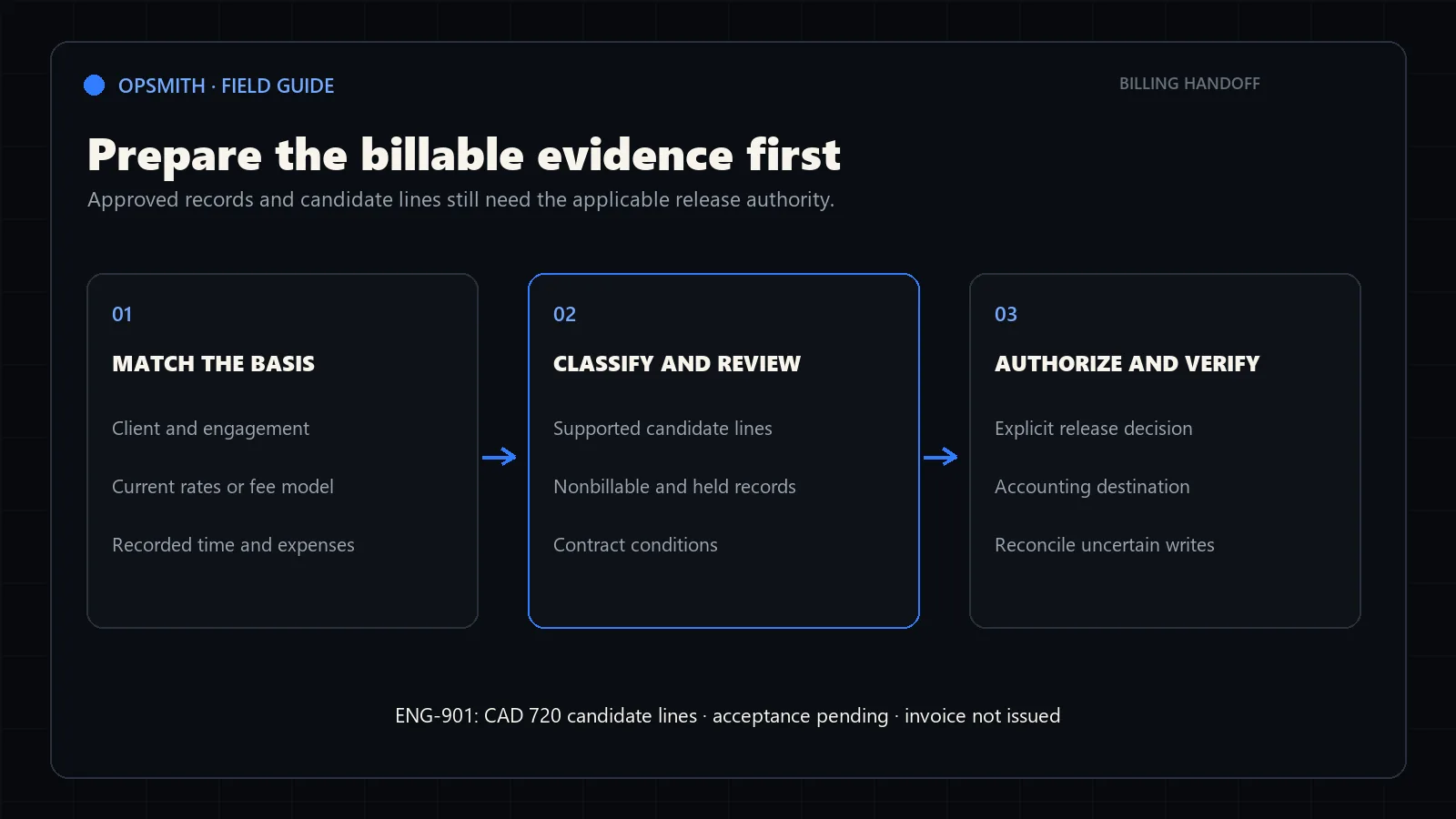
- MatchIdentify client, engagement, period and effective billing basis.
- ClassifyKeep approved, nonbillable, held and previously billed entries distinct.
- PrepareShow supported lines and every unresolved decision in one packet.
- AuthorizeConfirm contract gates and the actual billing-release decision.
- VerifyRecord the accounting destination and reconcile uncertain transfers.
Close the period with an entry-level review and a packet-level decision
Start with the completed billing review register, then populate the blank handoff template from your own approved sources. Match each entry to the client, engagement, period and current rate or fee basis. Mark previously billed or corrected entries before totaling the candidate lines. Keep an excluded or held entry visible with its reason and next owner.
Have the project reviewer confirm the work record, the commercial owner resolve scope or cap questions, and the expense reviewer confirm evidence and reimbursement authority. Then give the billing approver one packet showing supported lines, exclusions, unresolved holds, applicable release gates and the accounting destination. One person's approval should not silently answer a different role's question.
A held entry does not automatically decide the disposition of every other line. The agreement and authorized billing owner determine whether a supported portion can proceed or the whole packet must wait. In ENG-901 the period-wide client-acceptance gate keeps the entire packet held. In another agreement the permitted decision may differ; record that rule explicitly.
Check what project software approves and what accounting issues
Microsoft's Project Operations approval documentation separates time, expense and material approval records. Its Core proforma documentation describes another review level for invoice proposals and distinguishes those proposals from customer-facing invoices produced through an appropriate financial or accounting system.
That separation is useful when defining the interface between delivery and finance. Confirm the actual deployment, integration mode, permissions and configuration instead of assuming every edition has the same invoice capabilities. A project-system approval should not be treated as universal authority to post or send a customer document.
AI can organize approved descriptions, flag missing references and prepare a reviewer explanation. Keep the allowed rates, calculations, billing rules and authority outside generated prose. Test a plausible description that claims a change was approved when no source decision exists; the expected result is a hold, not a fabricated authorization.
Use the minimum client and staff information needed by the billing reviewer and control access to time descriptions and receipts. Avoid copying confidential advisory notes into a customer invoice merely because they share an engagement identifier. The responsible organization determines applicable privacy and retention requirements.
Pilot one billing basis and measure unresolved work
Choose one engagement type and a representative set of normal and exceptional records. Test nonbillable approved time, an unauthorized scope change, a missing expense receipt, a duplicate entry, revised work already billed, a pending client gate, an incompatible fee model and an uncertain accounting write. The downloadable cases state expected decisions with actual results unrun.
Measure preparation and review effort, age and cause of held records, duplicate or corrected lines and time to resolve release gates. Separate unbilled work from work genuinely eligible to bill. Do not turn a reduced backlog into a revenue or cash-collection claim without observing the actual billing and payment outcomes.
Use source-to-destination data reconciliation to verify the permitted transfer. For ongoing visibility, reporting automation services can prepare a defined view of supported lines, nonbillable records, holds and next owners.
Frequently asked questions
Does approved time always become a customer invoice line?
No. The agreement's billing model, billable scope, inclusions, rates and release conditions determine the handoff. Approved time can be nonbillable or used for internal costing on a fixed-fee or retainer engagement.
Why is the example's CAD 720 packet still held?
Its supported candidate lines are four hours at CAD 150 plus one approved CAD 120 expense. The fictional agreement separately requires client acceptance of the period's deliverable, which remains pending. Supported lines do not override that gate.
Should missing expense evidence be guessed or rejected automatically?
No. Retain the original claim and route the specific evidence question to the authorized reviewer. A missing source is an unresolved state; the responsible policy and reviewer determine its disposition.
Does this guide determine tax, revenue recognition or accounting entries?
No. It describes administrative preparation and review before accounting release. The responsible financial owner and accounting system determine the applicable treatment and customer-facing invoice requirements.
Are the example's hourly rate and billing amounts OpSmith prices?
No. ENG-901 uses an illustrative CAD 150 rate and fictional time and expenses to demonstrate the workflow. It is not an OpSmith quotation, client contract, issued invoice or measured financial result.
Sources and further guidance
These official references provide relevant technical, privacy, risk-management or accountability guidance. OpSmith applies the useful principles to the operation of one business workflow.
- Time, expense and material approval workflowMicrosoft Learn
- Project Operations Core proforma review and invoice boundariesMicrosoft Learn
- Fair information principlesOffice of the Privacy Commissioner of Canada