
- ENG-901's October brief is internally approved and its delivery is recorded, but client acceptance is still pending. Those are three separate states.
- An early draft incorrectly says all twelve actions are complete. The reviewed source supports ten verified completions and two open actions.
- Use the completed delivery register, blank template and acceptance cases to define the recurring workflow beyond onboarding.
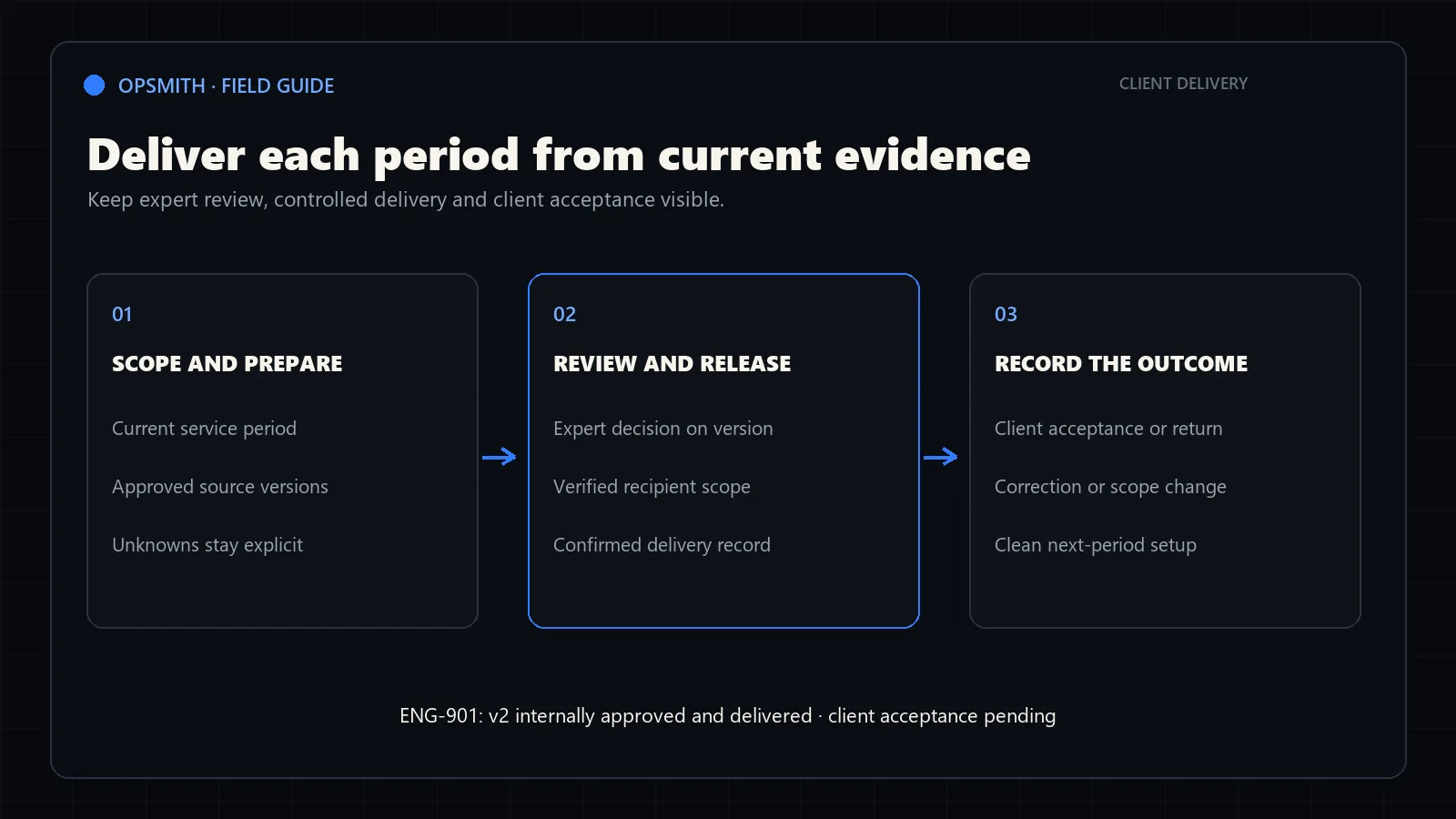
Make one service period the unit of recurring work
A recurring task is a reminder that work is due. A recurring deliverable is a specific work product for an agreed client, engagement, service period and scope version. Give it a stable identity so a delayed October brief does not become November's work simply because someone changed its due date.
Record what the client has commissioned, the inputs needed, the responsible professional, review requirements and what completion means. Separate preparing the deliverable from authorizing its release, confirming that the intended recipient can access it and recording any required client acceptance.
The client onboarding workflow establishes the engagement, access and readiness to start. OpSmith's professional services automation work can carry that context into recurring delivery without copying old permissions or treating expert judgment as a routine generated step.
Build a reusable deliverable brief with current dates and owners
Choose a recurring work product rather than a broad promise to automate client service. A monthly operating review, campaign report or project-status brief can share a workflow structure while keeping its own required sources and professional review. Start with the accepted engagement and write down what a reviewer and client should receive.
Use the blank client-deliverable register for the period-specific record, with the engagement and approved scope as references. The completed ENG-901 register shows how that record connects sources, versions and decisions. Reuse the checklist structure for the next period and confirm its dates, scope and access before work starts.
| Define | Record | Responsible role |
|---|---|---|
| Work product | Client, engagement, service period, scope version and required sections | Engagement owner |
| Inputs | Source owners, required coverage, cutoff and input deadline | Preparer and source owners |
| Acceptance criteria | Required checks, permitted qualifications and correction route | Responsible professional |
| Schedule | Preparation start, review due date and agreed client-delivery date | Delivery owner |
| Release | Approver, exact version and authorized client destination | Reviewer and release owner |
| Follow-through | Required client response, next owner and any applicable billing condition | Engagement owner |
Worked example: a reviewed October brief that is not yet client-accepted
ENG-901 is a fictional operational-advisory engagement. DEL-901-OCT is its October 2026 operating-review brief under SCOPE-901 v1. The source register includes ACTIONS-901-OCT v1: twelve actions in the agreed population, ten with verified completion and two still open. A second source input is unavailable, so its section must remain visibly qualified under the example's approved release scope.
Draft v1 says all twelve actions are complete and fills in the missing section as though the source were current. The internal reviewer returns it. Draft v2 preserves ten verified completions, two open actions and the unavailable section. A responsible reviewer records approval of that defined v2 scope on October 31.
The worked record then shows v2 released to the approved client destination with a confirmed delivery record. No client acceptance decision has been received at the cutoff. The example agreement requires that separate acceptance before this period's billing packet can be released. These are fictional events, not a client case, live send or measured model evaluation.
| Decision or evidence | Worked state | What it establishes | What remains open |
|---|---|---|---|
| Source population | 12 actions; 10 verified complete; 2 open | The approved denominator and current evidence | No inference that every action is finished |
| Draft v1 | Returned for correction | Unsupported claims were identified in the example | It is not an approved client version |
| Draft v2 | Internally approved with an unavailable section disclosed | Permission to release the reviewed v2 scope | Client acceptance is not inferred |
| Delivery | Confirmed for the approved v2 destination | The example records delivery of that version | Receipt is not approval of its content |
| Client acceptance | Pending at cutoff | An owned follow-up remains | The example's billing-release gate is still closed |
Download the worked records and templates
ENG-901 is a fictional advisory engagement shared by both guides. Its records, rates and decisions are teaching material, with no client results, professional opinion or executed model-performance claim.
Freeze the source basis before preparing the draft
For each source, retain its owner, period, version, observation time and whether it covers the expected population. A file received is not automatically usable, current or approved for this purpose. If an input is missing, assign the next action and decide whether the work must wait or a specifically qualified release is permitted.
Prepare the brief from that register. Calculations and record counts should be independently checkable. AI can summarize approved fields, organize open questions and draft source-linked commentary. It should not manufacture missing results, determine professional advice or turn a client request into an unauthorized commitment.
The AI report summary workflow explains evidence-linked drafting in more detail. For repeated report assembly, reporting automation services can connect source collection, validation and expert review around the existing client systems.
Make expert review a version-specific decision
Give the reviewer the proposed deliverable, source references, unresolved issues and the exact question they are deciding. Keep approve, return for correction and reject as distinct outcomes. A task marked done or an unqualified thumbs-up should not silently approve every attached version and every consequential statement.
The ENG-901 reviewer can authorize the explicitly qualified v2 while v1 remains returned. If a later draft changes a material conclusion, period, recipient scope or source basis, route the affected change through the applicable review. Do not inherit permission merely because the file keeps the same name.
Where specialist review is required, preparation and routing can be automated around it. The authorized professional retains responsibility for the applicable conclusions and release. This workflow does not substitute for legal, financial, medical or other regulated professional judgment.
- IdentifyBind the client, engagement, service period and current scope.
- PrepareCollect permitted source versions and preserve missing evidence.
- ReviewRecord the expert decision on the actual deliverable version.
- ReleaseVerify recipient scope and the permitted delivery outcome.
- Follow throughRecord acceptance, returned work or an owned next decision.
Separate a correction from a request for additional work
A client can identify a factual error, ask for clarification or request something beyond the accepted scope. Preserve their words and the deliverable version before classifying the next action. The responsible engagement owner applies the actual agreement; a model should not decide that a requested forecast is included or that every complaint justifies a new charge.
A separate ENG-901 request asks for an additional forecast that is not included in SCOPE-901 v1. Record it against a proposed change rather than silently extending every future monthly brief. Clarify commercial authority, timing and impact on the current acceptance decision. Pending scope approval is neither automatic rejection nor permission to bill.
If a correction is required, retain the original released version, the reason, affected claims and reviewed replacement. If only part of a deliverable is accepted, record that precise boundary. Do not convert partial acceptance into permission to treat the entire engagement as complete.
Check recurrence and approval controls in the actual platform
Asana's recurring-task documentation says the next instance is created when the current task is completed. For fixed monthly obligations, keep a calendar of periods due so an overdue prior-period task cannot hide the next obligation. The business schedule should remain visible even when completion-driven recurrence is used.
Asana's approval documentation describes approve, request-changes and reject outcomes and notes that completion is not necessarily limited to the assignee. Check permissions and plan features before treating assignment as exclusive approval authority. Retain the approved file version and source references.
Create the next period from a clean scope and current evidence requirements. Do not carry prior acceptance, stale source attachments or old client recipients into an automatically approved state. Test cancellation, pause, changed service scope and delayed prior-period delivery so reminders and next-cycle work follow the actual engagement state.
Keep client-specific material isolated. Reuse the workflow structure rather than another client's data, conclusions or sharing links. Use approved access and retention controls, and limit the preparation context to the information needed for this service.
Give the client a clear delivery note and own blocked work
Send the approved version through the verified channel with its period, scope, material qualifications and requested next action. Keep the note concise enough that the client can see what changed and what needs a response. A delivery acknowledgement should not be recorded as substantive acceptance unless that is what the agreed process establishes.
For the fictional ENG-901 packet, a source-faithful draft note could say: October brief v2 covers twelve tracked actions, with ten verified complete and two open. The unavailable source section is identified in the brief. Please review the stated scope and send any corrections or the acceptance decision required by the engagement. This is illustrative wording, not an actual sent message or an acceptance clause to adopt.
When an input, review or client decision is late, record the specific blocker, owner and next follow-up date. Keep October's pending acceptance attached to DEL-901-OCT and give November its own current-period record when due under the engagement. Do not mark October accepted merely to generate the next task. Pause or stop future instances when the service scope is suspended or ends.
Measure the whole delivery cycle and hand off the correct billing basis
Track preparation time, review time, returned drafts, age of missing inputs, release delay and client-acceptance age separately. A shorter drafting step is useful only if the professional can verify the result and the client receives the right work. Record sample size and observation period before making a time-saving claim.
Pilot one deliverable type for one client scope. Include an unsupported completion claim, stale source, wrong recipient, revised version after approval, changed engagement and feedback asking for out-of-scope work. The supplied acceptance file contains expected decisions with actual results unrun; it does not claim a tested model or production deployment.
The time and expense to billing workflow uses ENG-901 to show the next handoff. Internally approved time and expenses can prepare a billing packet, while the example's separate client-acceptance condition still prevents invoice release.
Frequently asked questions
Does a recurring task prove the next client deliverable is ready?
No. It establishes scheduled work. Each service period still needs current scope, source evidence, required review and its own release decision. Prior-period approval should not automatically transfer.
Can an internally approved deliverable still be awaiting client acceptance?
Yes. Internal approval, delivery and client acceptance are different records. The example has an approved and delivered v2, while client acceptance remains pending under its fictional agreement.
Should a client revision request automatically create billable work?
No. Preserve the feedback and have the engagement owner distinguish correction, clarification and proposed scope change under the actual agreement. A request alone does not authorize additional charges.
What should happen if one source is unavailable?
Record the missing evidence, owner and consequence for the deliverable. Hold the affected work or use a specifically approved qualified release; do not substitute zero, a prior period or an invented current result.
Is ENG-901 an anonymized client engagement?
No. It is fictional teaching material with no real client records, actual delivery or measured model results. Its scope, sources and decisions illustrate the operating boundaries to adapt and test.
Sources and further guidance
These official references provide relevant technical, privacy, risk-management or accountability guidance. OpSmith applies the useful principles to the operation of one business workflow.
- Recurring task behaviour and schedulingAsana Help Center
- Approval outcomes and permission considerationsAsana Help Center
- Fair information principlesOffice of the Privacy Commissioner of Canada