Quote automation
Prepare a faster first draft from complete customer and product inputs.
 Free 20-minute consultation ↗
Over several months, Terry designed, developed, tested and refined a connected customer journey for a building-material supplier: an AI-assisted custom house-wrap visualizer, instant quoting and automated lead follow-up.
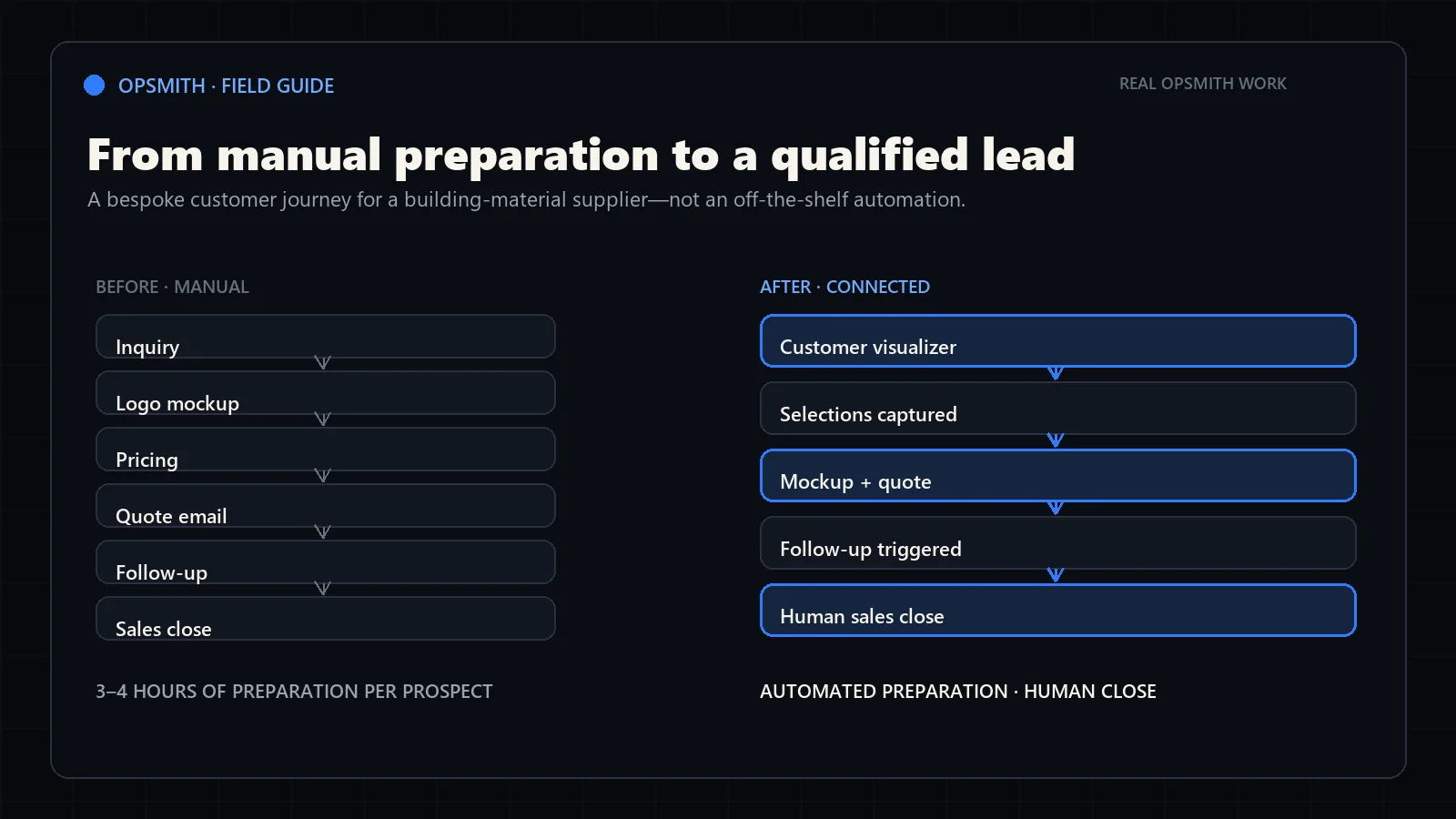
Sales work began long before a qualified conversation. A team member had to prepare a branded mockup, assemble pricing and manage the email sequence for each interested prospect.
The development was not one task. It was a months-long process of understanding the customer journey, connecting each operating step, testing edge cases and refining how information moved.
The prospect could generate a house-wrap mockup using their own branding and product selections directly on the supplier’s website.
The customer’s approved visualizer inputs moved into an instant quote experience instead of being reconstructed manually by sales.
The system continued the approved follow-up sequence and preserved the final closing conversation for the salesperson.
The mockup, quote preparation and recurring follow-up no longer consumed hours for every prospect. Human effort remained focused on understanding the opportunity, resolving unusual needs and closing the sale.
This system created value because it was designed around a distinctive product, customer experience and sales operation. The right starting point was the process—not a list of AI features.
The sales quotation process guide turns that request-to-quote-to-follow-up pattern into a reusable operating model without presenting this bespoke client workflow as a universal template.
The 3–4-hour figure describes repeated preparation per prospect sequence in this project. It is not a guaranteed result, a payroll reduction or an estimate for another business. Your own baseline needs to account for volume, remaining review and exceptions.
For a local team considering a similarly connected process, explore AI workflow automation in Winnipeg. The local service can include observing your handoffs on site; this case illustrates the approach without identifying the client’s location.
No. The customer journey was developed around the supplier’s product, sales process, website experience and the information required to create a useful branded mockup and quote.
The system was developed across several months of process design, implementation, testing and refinement. It was not a single automation task.
The final sales conversation and close remained with the salesperson. Automation removed repeated preparation and follow-up administration so the human entered when judgment and relationship mattered most.
The transferable principle can be reused, but the workflow itself was bespoke. Another company would need its own product rules, customer journey, pricing inputs, exceptions and approval requirements mapped before implementation.
Prepare a faster first draft from complete customer and product inputs.
Move from inquiry to the right human conversation with clear stop conditions.
Find and scope the process worth improving before implementation.
Bring the customer journey or operating process your team has learned to work around. We will help determine whether it can become a dependable system.